
What Happened Today?
President Donald Trump is hosting Chinese President Xi Jinping in Washington for a two-day summit running September 24-25, 2026. This is Xi's first visit to the White House since 2015 — an eleven-year gap — and only the second in-person meeting between the two leaders this year, following their May 2026 talks in Beijing.
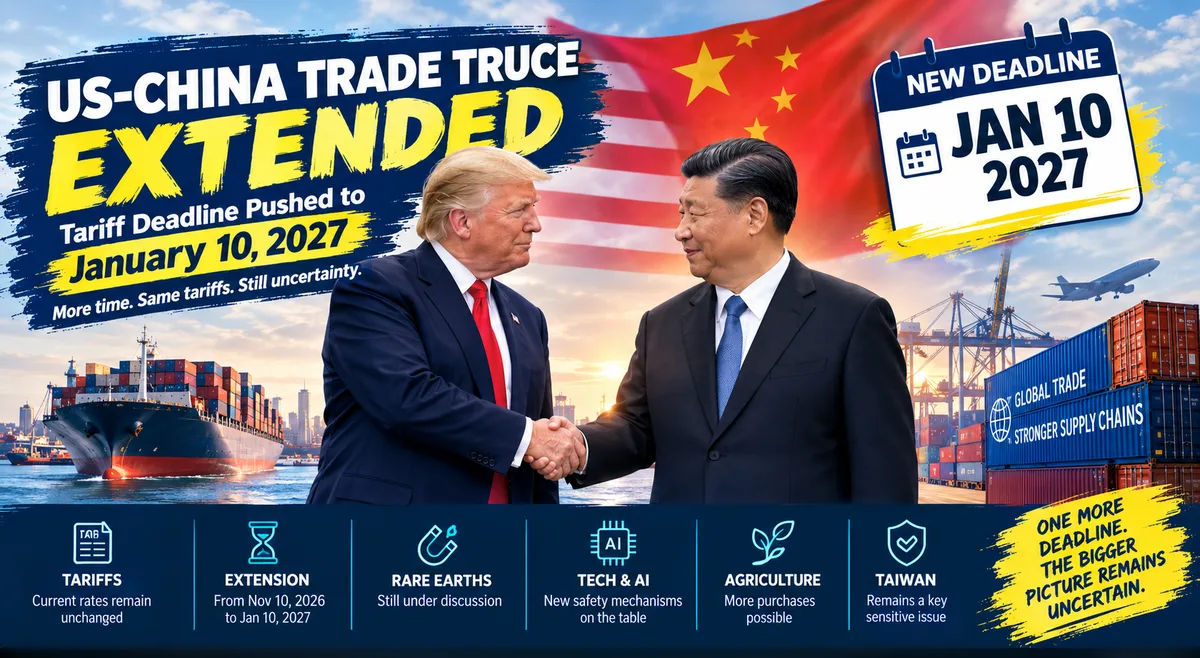
Before the formal summit talks even began, one concrete outcome had already emerged. US Treasury Secretary Scott Bessent said Washington and Beijing agreed to extend their existing trade truce until January 10, 2027. That agreement had previously been due to expire on November 10, 2026.
For importers, freight forwarders, and anyone managing a supply chain touching China, this is the single most important piece of news to come out of the summit so far — it directly affects tariff planning for the next several months.
A Quick Recap: How Did We Get Here?
To understand why this extension matters, it helps to know the recent history:
- October 2025 — Busan truce: Trump and Xi met in South Korea and agreed to reduce tariffs and ease some export controls. Following that agreement, the effective US tariff on Chinese goods dropped from 57% to 47%.
- May 2026 — Beijing summit: The two leaders met again, producing new institutional frameworks called the "Board of Trade" and "Board of Investment" — meant to add more structure to the relationship and reduce sudden surprise announcements.
- September 24-25, 2026 — Washington summit: The current meeting, where the truce originally due to expire November 10 has now been pushed to January 10, 2027.
Treasury Secretary Bessent noted in an interview earlier this week that "we had some deliverables that have not been completely fulfilled" by China under the Busan agreement — a signal that trust between the two sides remains incomplete even as both sides work to avoid a sharp tariff escalation.
What Else Is on the Table at This Summit?
Beyond the tariff truce extension, the two-day summit covers several other topics directly relevant to global trade and supply chains:
- Rare-earth minerals and export controls — critical for electronics, EVs, and defense manufacturing. Any changes here affect global supply chains for a wide range of industries.
- Artificial intelligence — the two sides are discussing a possible AI safety notification mechanism, a new area of engagement not covered in previous meetings.
- Taiwan — a sensitive geopolitical topic being watched closely across Asia, though not expected to directly affect near-term freight and shipping operations.
- Agricultural purchases and other trade barriers — any commitments here could affect commodity shipping volumes on US-China trade lanes.
High-level preparatory talks were held in New York over the weekend, with Treasury Secretary Bessent and US Trade Representative Jamieson Greer meeting Chinese Vice Premier He Lifeng and chief trade negotiator Li Chenggang for roughly eight hours of discussions covering artificial intelligence, tariffs, and rare earth minerals.
What Does "Extending the Truce" Actually Mean for Tariff Rates?
This is the practical question every importer needs answered: does this extension change the tariff rate you are currently paying?
Based on what has been confirmed so far, the answer is: current tariff levels remain unchanged — the extension simply pushes back the deadline before which either side could escalate tariffs again. In plain English, the truce extension is not a tariff cut. It is a delay of the risk that tariffs could jump back up.
Remember: this is separate from the Section 301 "forced labor" tariffs of 10-12.5% we covered in July, which apply to 60 countries including China at 12.5%. Those tariffs remain in place under separate legal authority and are not directly affected by this truce extension.
What Is Still Uncertain?
Analysts covering the summit are cautious about expecting major breakthroughs. Analysts expect few major breakthroughs, describing the visit's likely success as measured by progress on prior commitments rather than new agreements.
Several major issues remain unresolved even with the truce extension:
- No permanent trade agreement. The truce is a temporary arrangement, not a comprehensive trade deal. January 10, 2027 is simply a new deadline — not a resolution.
- China's fulfillment of prior commitments remains incomplete, according to Treasury Secretary Bessent's own comments this week.
- Rare earth export controls — a major flashpoint since Beijing announced controls on rare-earth magnets in October 2025 — have not been fully resolved.
- Underlying tensions on technology, Taiwan, and broader strategic competition continue regardless of this specific tariff extension.
Why This Matters for Shippers and Supply Chain Planners
For anyone managing freight, imports, or supply chains connected to China, this extension has real practical value — but with important limits:
- More planning certainty through early January. With the truce now running to January 10, 2027 instead of November 10, 2026, importers have roughly two extra months of predictable tariff conditions to plan shipments, negotiate contracts, and manage inventory.
- The clock is still ticking. January 10 is not far away. Importers should treat this as an extension of the current window, not a permanent resolution — and should continue contingency planning for potential tariff changes after that date.
- Watch for rare-earth and technology developments separately. Even with the broader tariff truce extended, specific product categories tied to rare earths, semiconductors, or advanced technology could still see separate restrictions or changes announced at any time.
- This does not affect the Section 301 forced-labor tariffs. If your imports from China are subject to the 12.5% Section 301 tariff we covered in July, that rate structure remains separate and unaffected by today's truce extension.
- Front-loading decisions may need reassessment. Many importers have been front-loading shipments ahead of tariff uncertainty throughout 2026. With the truce extended to January, some companies may have slightly more flexibility in timing shipments over the next quarter.
What Should Importers and Freight Forwarders Do Right Now?
- Update your planning calendar. Move your tariff risk review date from November 10 to January 10, 2027, and build in time before that date to reassess sourcing and shipment timing.
- Don't assume rates have changed. Confirm with your customs broker that your current tariff rates remain the same — this extension delays a deadline, it does not cut any duties.
- Watch for summit follow-up announcements. With talks continuing through September 25, additional details on rare earths, agricultural purchases, or technology could still emerge. Check for updates before making major sourcing commitments this week.
- Keep contingency plans ready for January. Two extra months of stability is valuable, but it is not permanent. Continue monitoring alternative sourcing options in case the truce is not extended again after January 10.
Key Takeaways — September 24, 2026
- Trump and Xi are meeting in Washington for a two-day summit, September 24-25, 2026 — Xi's first White House visit since 2015.
- US-China tariff truce extended from November 10, 2026 to January 10, 2027 — confirmed by Treasury Secretary Bessent before formal talks began.
- This extension delays tariff escalation risk — it does not reduce current tariff rates.
- Section 301 "forced labor" tariffs (10-12.5%, covering 60 countries including China) remain separate and unaffected.
- Rare earths, AI safety mechanisms, agricultural purchases, and Taiwan are also on the summit agenda.
- Analysts expect limited major breakthroughs — success measured by progress on prior Busan commitments, not new deals.
- Importers should update planning calendars to January 10, 2027 and continue contingency planning beyond that date.
Today's tariff truce extension buys importers and supply chain planners valuable extra time — but it is a delay, not a resolution. With the new deadline set for January 10, 2027, the underlying trade relationship between the world's two largest economies remains a work in progress. Shippers moving goods from China should treat the coming weeks as an opportunity to plan carefully, not a signal that trade tensions are fully resolved.





Comments
No comments yet. Be the first to share your thoughts!