
What Just Happened?
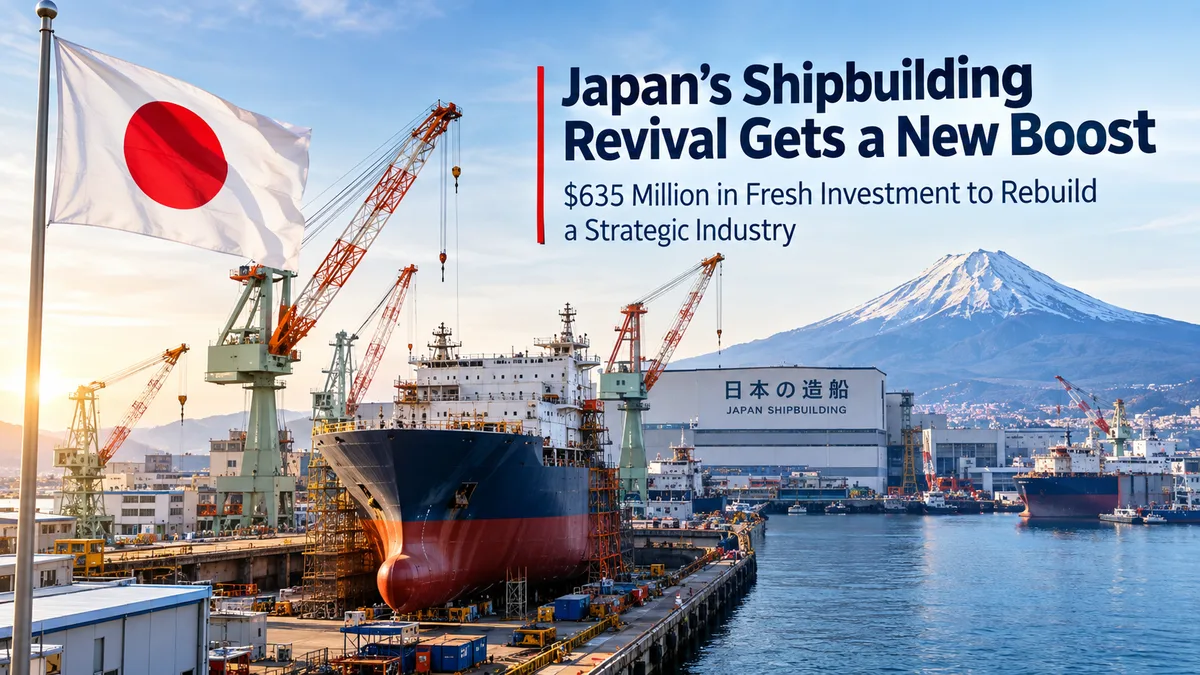
On September 14, 2026, Japan's transport ministry approved a second major wave of investment under the country's national shipbuilding revival fund — allocating up to another ¥98 billion (approximately $635 million) in state support across five shipyard groups.
This is not a one-off grant. It is the latest step in one of the most ambitious industrial revival programs currently underway anywhere in the world — Japan's attempt to rebuild a shipbuilding industry it once dominated, but lost to South Korea and China over the past three decades.
Which Shipyards Got Funding — And How Much?
The Ministry of Land, Infrastructure, Transport and Tourism has cleared projects from five separate shipyard groups:
- Mitsubishi Shipbuilding: Up to ¥40 billion ($260 million) — the largest individual allocation in this round
- Shin Kurushima group: Up to ¥32 billion ($208 million)
- Kawasaki Heavy Industries: Up to ¥15.6 billion ($102 million)
- Oshima Shipbuilding: Up to ¥6.1 billion ($40 million)
- Naikai Zosen: Up to ¥4.3 billion ($28 million)
These are some of the most established names in Japanese heavy industry — companies that have built ships, engines, and industrial equipment for generations. This round of funding is specifically aimed at helping them modernize and expand production capacity.
How Big Is This Program Overall?
This second wave builds directly on top of earlier approvals made just weeks before. Combined with three projects approved earlier in September, Japan has now cleared eight investment plans this month alone, representing around ¥900 billion (approximately $5.83 billion) of combined public and private spending — with government support making up roughly ¥311 billion (about $2 billion) of that total.
The earlier September approvals included a group led by Imabari Shipbuilding — eligible for up to ¥113.8 billion ($727 million) — along with Japan Marine United and Namura Shipbuilding, which received up to ¥49.4 billion ($316 million) and ¥49.9 billion ($319 million) respectively. Japan's transport minister said at the time that those three programs alone were expected to mobilise around ¥600 billion ($3.84 billion) of public and private investment over the coming decade and lift the participating shipyards' combined construction capacity by roughly 50%.
Why Is Japan Doing This Now?
Japan was once the world's dominant shipbuilding nation, controlling the industry through the 1960s to 1980s. Since then, its global market share has fallen sharply — first overtaken by South Korea, and more recently by China, which now controls more than half of global shipbuilding market share, backed by extensive state subsidies, industrial consolidation, and close ties between its military and civilian shipbuilding sectors.
Japan's government has now labelled shipbuilding as one of 17 nationally important sectors, treating it as a matter of economic security rather than purely commercial competitiveness. The roadmap behind these investments aims to roughly double Japan's annual shipbuilding output to 18 million gross tons by around 2035.
This drive forms part of Japanese Prime Minister Sanae Takaichi's broader economic security agenda — reflecting growing global concern, particularly in the US and among its allies, about relying too heavily on Chinese-built commercial vessels for critical global trade infrastructure.
What Will the Money Actually Be Spent On?
Funding from Japan's shipbuilding revival program is going toward concrete, practical upgrades rather than research alone. Previous rounds of this fund have gone toward major production upgrades including dock expansion, new cranes, automation systems, and labour-saving equipment — all aimed at increasing how much and how efficiently these shipyards can build.
Some yards are also exploring entirely new capacity. Namura Shipbuilding, for example, has been separately considering a new dock specifically for building LNG and ammonia carriers — next-generation energy vessels that will be essential as global shipping transitions toward cleaner fuels over the coming decades.
What Does This Mean for the Global Shipping Industry?
For shippers, carriers, and logistics companies worldwide, Japan's shipbuilding revival is a long-term structural story rather than something that changes freight rates tomorrow — but it matters for several reasons:
- Vessel supply diversification. Currently, the vast majority of new commercial vessels are built in China and South Korea. A revived Japanese shipbuilding sector would give carriers a meaningful third option for new vessel orders — potentially reducing dependency risk and giving buyers more negotiating leverage on pricing and delivery schedules.
- New vessel types coming online. Japan's focus on LNG and ammonia carrier capacity specifically targets the next generation of cleaner-fuel ships that the industry will increasingly need as environmental regulations tighten under IMO's net-zero targets.
- Long lead times mean this is a decade-long story. These investments are explicitly designed to play out through 2034 and beyond. Shippers and carriers planning fleet strategy for the 2030s should be aware that Japanese shipbuilding capacity will look significantly different by the time these projects mature.
- Geopolitical diversification of supply chains. As US-China trade tensions and broader geopolitical uncertainty continue to affect global commerce, having shipbuilding capacity distributed across allied nations — rather than concentrated primarily in China — adds a layer of resilience to the global vessel supply chain.
- Competitive pressure on South Korea. A revived Japanese shipbuilding industry, particularly in specialized areas like LNG carriers, could increase competitive pressure on South Korean shipbuilders, who currently lead that segment. This could eventually translate into more competitive pricing for carriers ordering new LNG-capable tonnage.
What Are the Challenges Facing This Revival?
Despite the scale of investment, Japan's shipbuilding comeback faces real obstacles. The industry has struggled with an aging labour force, stalling productivity growth, and fragmented shipyards spread across the country rather than consolidated into larger, more efficient operations.
Industry leaders have been direct about these challenges. Yukito Higaki, chairman of the Shipbuilders' Association of Japan and chairman of Imabari Shipbuilding, has said that most Japanese shipyards have lost competitiveness due to aging infrastructure, and that long-term investments in large-scale cranes, automation systems, and robotics are essential to reversing that trend.
Japan has also lost significant skilled shipbuilding workforce as the industry contracted since the 1990s — meaning that even with capital investment, rebuilding the human expertise needed to compete at scale will take time. Some Japanese shipbuilders are reportedly considering technical cooperation arrangements with Korean companies specifically to help restore capabilities like LNG carrier production more quickly.
Key Takeaways — September 15, 2026
- Japan approved a second wave of shipbuilding revival funding on September 14, 2026 — up to ¥98 billion ($635 million) across five shipyard groups.
- Mitsubishi Shipbuilding received the largest allocation in this round: up to ¥40 billion ($260 million).
- Combined with earlier September approvals, Japan has cleared ¥900 billion ($5.83 billion) in shipbuilding investment this month alone.
- Government support across these eight approved plans totals roughly ¥311 billion ($2 billion).
- Japan aims to double its shipbuilding output to 18 million gross tons by around 2035.
- The push is part of PM Sanae Takaichi's economic security agenda, aimed at reducing reliance on Chinese-built vessels.
- China currently controls more than 50% of global shipbuilding market share.
- Funding is targeted at dock expansion, cranes, automation, and new capacity for LNG and ammonia carriers.
- Challenges remain: an aging workforce, fragmented shipyards, and years needed to rebuild lost expertise.
Japan's shipbuilding revival will not change freight capacity next month or even next year — but it represents one of the most significant long-term shifts in global vessel supply currently underway. For carriers, shippers, and logistics planners thinking beyond the next quarter, a resurgent Japanese shipbuilding industry could mean more choices, more competitive pricing, and a more geographically diversified vessel supply chain by the mid-2030s.





Comments
No comments yet. Be the first to share your thoughts!