
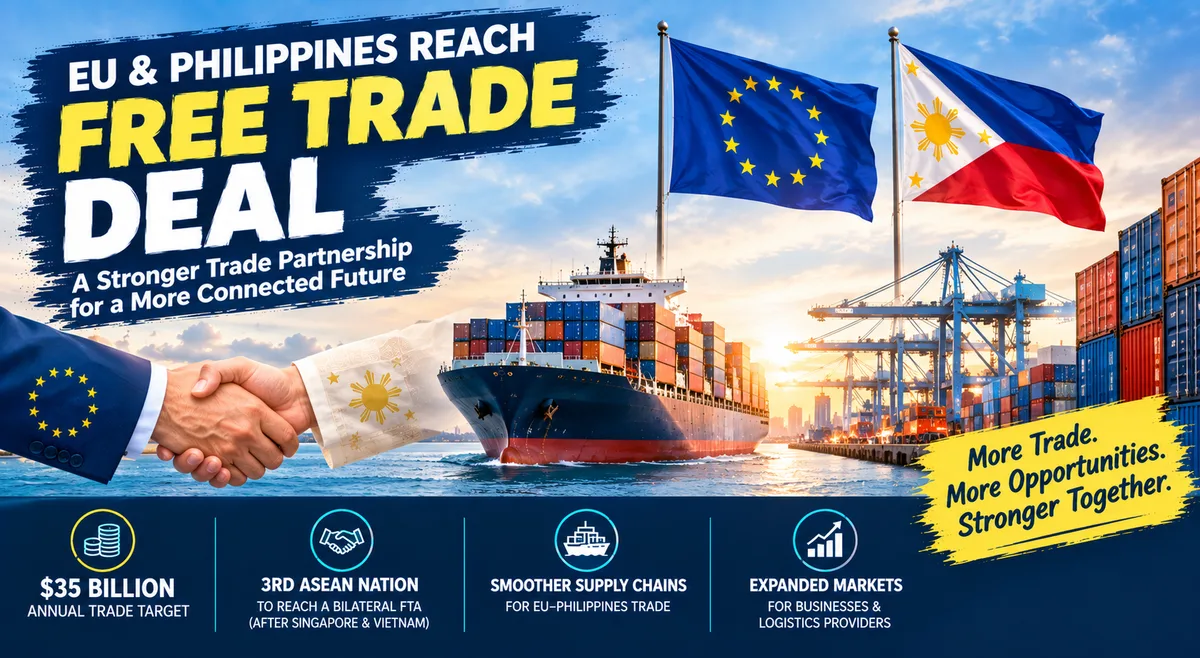
The European Union and the Philippines have reached substantial agreement on a free trade deal, marking the conclusion of talks first relaunched three years ago. European Commission President Ursula von der Leyen said she spoke with Philippine President Ferdinand Marcos Jr. on Tuesday and confirmed the two sides had agreed on the pact, according to a joint statement from EU trade commissioner Maroš Šefčovič and Philippine Trade Secretary Cristina Roque.
What's in the deal
The agreement is structured to grow the nearly €30 billion (around $35 billion) in annual trade between the 27-nation EU and the Philippines, a Southeast Asian economy of 115 million people. Philippine exports to the EU were valued at roughly $8.1 billion in 2024, while imports from the bloc reached about $7.5 billion. The Philippines becomes only the third ASEAN member country to conclude a bilateral free trade agreement with the EU, following Singapore and Vietnam.
While both sides have welcomed the agreement, the deal is not yet finalized. Negotiators must still settle remaining details before the pact can move through formal legal review, signature, and ratification procedures, with a possible signing targeted for 2027. Technical groundwork for the deal began in 2023, followed by the formal resumption of negotiations in March 2024 and six negotiating rounds held through May 2026.
A decade in the making
The path to this agreement has been anything but straightforward. Talks between the EU and the Philippines first stalled years earlier before technical stocktaking, a preliminary review process, began in 2023 to assess whether renewed negotiations were viable. That groundwork paved the way for formal talks to relaunch in March 2024, culminating in six full negotiating rounds completed by May 2026. Von der Leyen's visit to Manila three years ago is widely credited with putting the negotiations back on track after a long period of dormancy.
Why the timing matters
Von der Leyen described the prospective deal as part of the EU's broader push for deeper economic ties with Southeast Asia, framing bilateral agreements with individual ASEAN economies as building blocks toward stronger region-to-region trade relationships. The deal comes as Brussels works to diversify its trading relationships amid ongoing tensions with China, Russia, and the United States, a strategy that has taken on added urgency as global trade patterns continue to shift in response to geopolitical pressure.
Interestingly, the EU's approach to the Philippines deal echoes a "middle powers" strategy that Canadian Prime Minister Mark Carney outlined earlier this year at the World Economic Forum in Davos. Carney was recently the guest of honor at von der Leyen's annual State of the European Union address in Strasbourg, where she signaled the EU's intent to forge a new kind of "associated membership" arrangement with Canada, part of a wider pattern of the bloc reimagining its trade partnerships in a more fragmented global environment.
European businesses want more
The announcement also comes as European businesses push for something bigger than country-by-country deals. At the 58th ASEAN Economic Ministers' Meeting in Manila, the EU-ASEAN Business Council urged both blocs to move beyond individual bilateral agreements and establish a region-to-region economic framework. Jens Ruebbert, chair of the EU-ASEAN Business Council, made the appeal directly to ASEAN economic ministers and EU trade officials at a consultation held alongside the ministerial meeting.
According to the council's latest Business Sentiment Survey, 74% of European business respondents believe a broader ASEAN-wide FTA would deliver more benefits than a patchwork of bilateral agreements with individual Southeast Asian countries. Nearly half, 49%, want negotiations on a regional pact to begin next year, timed to mark the 50th anniversary of EU-ASEAN relations. The council has proposed an ASEAN-EU Economic Framework Agreement built on a modular approach, allowing economic integration to progress incrementally rather than requiring every element of a comprehensive FTA to be finalized at once.
Part of a broader pattern
The Philippines deal follows a similar EU agreement with Indonesia finalized in Bali last September, while FTAs with Singapore and Vietnam are already in force. Negotiations with Thailand and Malaysia are expected to conclude by 2027. Together, these deals reflect the EU's strategy of building a network of Southeast Asian trade partnerships even as talks toward a single comprehensive ASEAN-EU agreement remain a longer-term goal, with the Philippines deal serving as the latest proof point that the bilateral approach is gaining momentum.
Key takeaways
- The EU and the Philippines reached substantial agreement on a free trade deal on September 22, 2026.
- The deal targets growth in the roughly $35 billion in annual trade between the two economies.
- The Philippines is the third ASEAN nation, after Singapore and Vietnam, to reach a bilateral FTA with the EU.
- Formal signing is expected in 2027, pending remaining negotiations and ratification procedures.
- European businesses are now pushing for a broader ASEAN-wide trade framework, with 74% saying it would outperform bilateral deals alone.
For freight forwarders and logistics providers handling EU-Philippines trade, this agreement could open the door to smoother customs procedures and expanded trade volumes in the years ahead, making it a development worth tracking closely as the deal moves toward formal signature.



Comments
No comments yet. Be the first to share your thoughts!