What Is MAIA and What Does It Do?
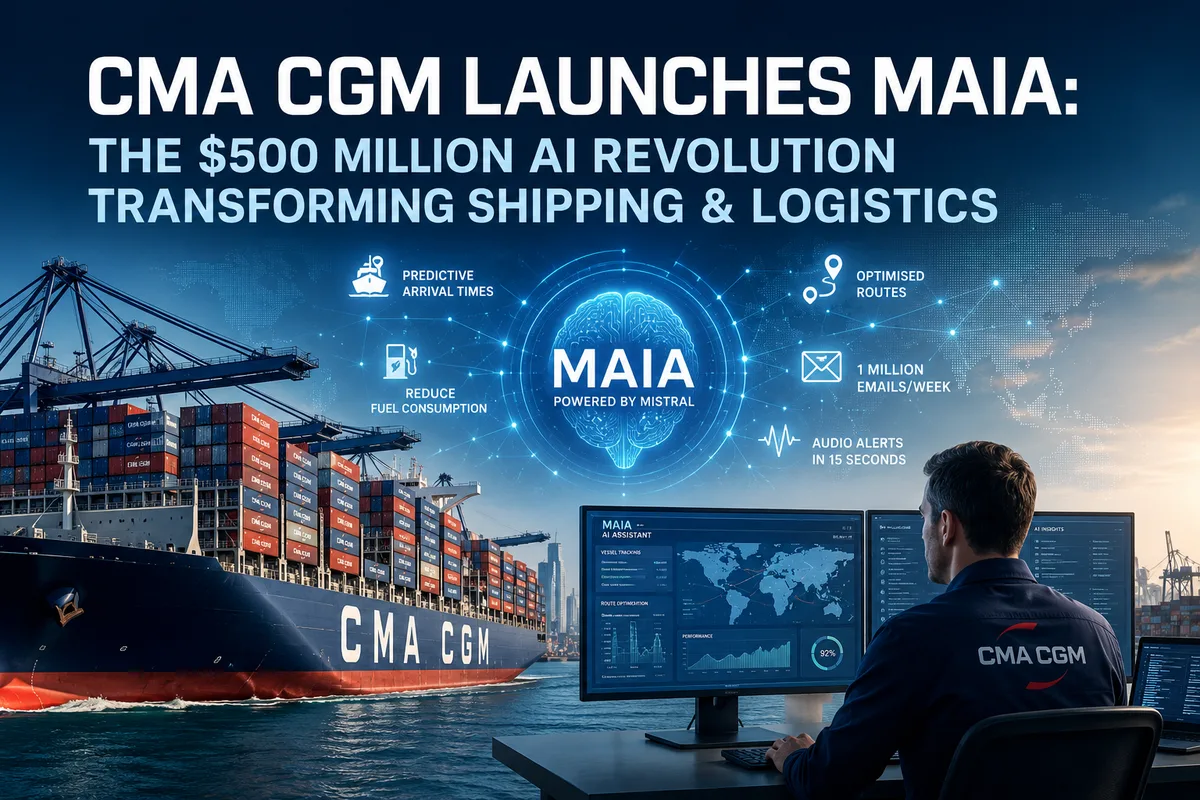
On June 1, 2026, CMA CGM began rolling out MAIA, Powered by Mistral — a brand new agentic AI platform built specifically for the shipping and logistics industry.
The platform was co-developed with Mistral AI to accelerate the large-scale deployment of artificial intelligence use cases serving shipping, logistics, and media activities. It enables the development and orchestration of AI agents connected to business knowledge and internal applications used daily by the group's teams.
In simple terms: MAIA is like giving every single employee at CMA CGM their own intelligent assistant — one that knows the company's systems, data, and operations inside out, and can answer questions, complete tasks, and flag problems automatically.
Its purpose is to facilitate the completion of certain tasks, streamline access to operational data, and accelerate the processing of specific requests.
The Scale: 80,000 People, 55+ AI Projects, $500 Million
The numbers behind this deployment are extraordinary:
- 80,000 employees across CMA CGM, CEVA Logistics, and CMA Media will have access to MAIA
- 55+ AI projects already running inside the company today
- 200+ identified AI use cases across shipping, logistics, and media
- €500 million ($550 million) — CMA CGM's total planned AI investment over the partnership
- 20 Mistral AI engineers embedded full-time inside CMA CGM's offices in Marseille
- 5-year strategic partnership between CMA CGM and Mistral AI signed in April 2025
This is not a small experiment. This is one of the largest AI rollouts ever attempted by a logistics and shipping company anywhere in the world.
What Can MAIA Actually Do? The Real-World Use Cases
Here is where the story gets practically interesting for logistics professionals. MAIA is not just a chatbot that answers general questions — it is connected to real operational data and can act on it. Here are the confirmed use cases already running:
1. Predicting When Ships Will Arrive
The tool allows the company to predict ship arrival times using real-time data about vessel position, speed, weather conditions, port congestion, and historical patterns. For shippers waiting for containers to arrive, more accurate ETAs directly reduce warehouse planning costs and supply chain disruption.
2. Optimising Vessel Routes
MAIA can optimise routes to avoid adverse weather — automatically calculating the best course for each vessel based on current conditions. In a world where weather events, piracy risks, and geopolitical zones like the Strait of Hormuz require constant routing adjustments, having AI continuously recalculate the optimal path is a major operational advantage.
3. Reducing Fuel Consumption
The platform helps reduce energy consumption across the fleet. With bunker fuel costs still elevated — oil is near $100/barrel as of June 2026 — even a 1-2% reduction in fuel consumption across a fleet of hundreds of vessels translates into tens of millions of dollars in annual savings.
4. Handling 1 Million Customer Emails Per Week
CMA CGM's CEO Rodolphe Saadé revealed a remarkable number: the company receives 1 million emails per week from customers — questions about vessel routing, booking status, documentation, container availability, and more. Responding to this volume manually is an enormous operational challenge.
MAIA's AI agents are designed to handle the vast majority of these routine queries automatically — reading the email, understanding the question, retrieving the relevant information from internal systems, and sending a response — without a human needing to get involved.
5. Processing Audio Alerts in 15 Seconds
Here is one of the most impressive technical details from the launch. CMA CGM is using Mistral's Search Toolkit alongside Voxtral to process audio from multiple data sources and return alerts within 15 seconds.
What does this mean in practice? Ships, ports, and logistics facilities generate enormous amounts of audio data — radio communications, intercom systems, monitoring alerts. By automatically transcribing, understanding, and acting on this audio in under 15 seconds, CMA CGM can respond to operational issues almost in real time.
6. Automating Administrative Tasks
CMA CGM's employees will use MAIA as the group's internal AI assistant and Microsoft Copilot to generate and search through content, analyse documents, automate administrative tasks and support operational, technical and commercial decisions.
The paperwork burden in shipping is enormous — bills of lading, certificates of origin, customs declarations, insurance documents, port call papers. AI that can automatically read, validate, and process these documents frees up staff to focus on more complex and higher-value work.
Why Did CMA CGM Choose Mistral AI Instead of OpenAI?
This is a deliberate strategic choice — and it reflects a broader trend in European logistics.
Mistral AI is a French company. CMA CGM is a French company. By building MAIA on Mistral instead of US-based OpenAI or Google, CMA CGM is keeping its most sensitive operational data — vessel routes, customer information, commercial strategies — processed on European infrastructure under European data sovereignty rules.
CMA CGM's CEO Rodolphe Saadé explained the thinking directly: "In this period of uncertainty, I think it is a good thing for two French groups to work together."
The data sovereignty issue matters enormously in shipping. A shipping company's vessel routing decisions, customer contracts, and operational data represent enormous competitive intelligence. Keeping that data processed on European AI infrastructure — rather than US hyperscaler platforms — is a business security decision as much as a technology choice.
NYK Also Just Launched an AI College for Seafarers
CMA CGM is not the only major shipping company making a big AI move this week. Japanese shipping giant NYK (Nippon Yusen Kaisha) has simultaneously launched two AI initiatives:
- SAIL with AI Compass — a programme that integrates AI tools into the daily operations of NYK's fleet and shore teams
- An AI College — a dedicated internal training institution to teach NYK's workforce how to understand and use AI in their daily jobs
NYK's approach recognises something important: you cannot simply install AI and expect people to use it effectively. You need to train your workforce to understand what AI can and cannot do — and how to supervise it correctly. The AI College is a long-term investment in making sure NYK's people can work alongside AI tools as genuine partners.
What Does This Mean for the Logistics Industry?
CMA CGM's MAIA launch is a signal that the largest logistics companies in the world have moved from talking about AI to fully deploying it at scale. Here is what this means for different players in the industry:
- Freight forwarders: Your carrier partners are getting smarter and faster. CMA CGM will be able to provide more accurate ETAs, handle booking queries automatically, and respond to operational issues in near real time. Expect better digital interfaces and faster responses from CMA CGM systems in 2026.
- Shippers: AI-optimised vessel routing means more reliable schedules and potentially lower fuel-related surcharges as CMA CGM's efficiency improves. More accurate ETA predictions help you plan warehouse operations more precisely.
- Smaller freight forwarders: The gap between large, AI-powered carriers and logistics companies and those still using manual processes is widening quickly. If you are not investing in AI tools for your own operations — rate comparison, quote automation, document processing — your larger competitors will be able to respond faster and at lower cost than you.
- Job roles in logistics: MAIA is designed to handle repetitive, routine tasks — not replace the judgment and relationship skills of experienced logistics professionals. But the nature of logistics jobs is shifting: the ability to work alongside AI tools, supervise automated systems, and focus on complex exception management is becoming the core skill set.
Key Takeaways — June 7, 2026
- CMA CGM launched MAIA, Powered by Mistral — June 1, 2026 — the world's largest AI deployment in shipping.
- 80,000 employees across CMA CGM, CEVA Logistics, and CMA Media now have AI assistance.
- Key capabilities: ETA prediction, route optimisation, fuel reduction, 1 million emails/week automated, 15-second audio alerts.
- Built on Mistral AI — a European AI company — for data sovereignty reasons.
- 55+ AI projects and 200+ use cases already operational across the group.
- €500 million total AI investment planned over 5 years.
- NYK simultaneously launched SAIL with AI Compass and an AI College for seafarers.
- The gap between AI-powered and traditional logistics operations is widening fast.
CMA CGM's MAIA launch is not just a technology story. It is a signal that the world's largest shipping companies have fully committed to AI as a core operational tool — not a pilot project, not an experiment, but a fundamental part of how they run their business. The question for every freight forwarder, carrier, and logistics company right now is not whether to adopt AI. It is how fast.
Comments
No comments yet. Be the first to share your thoughts!