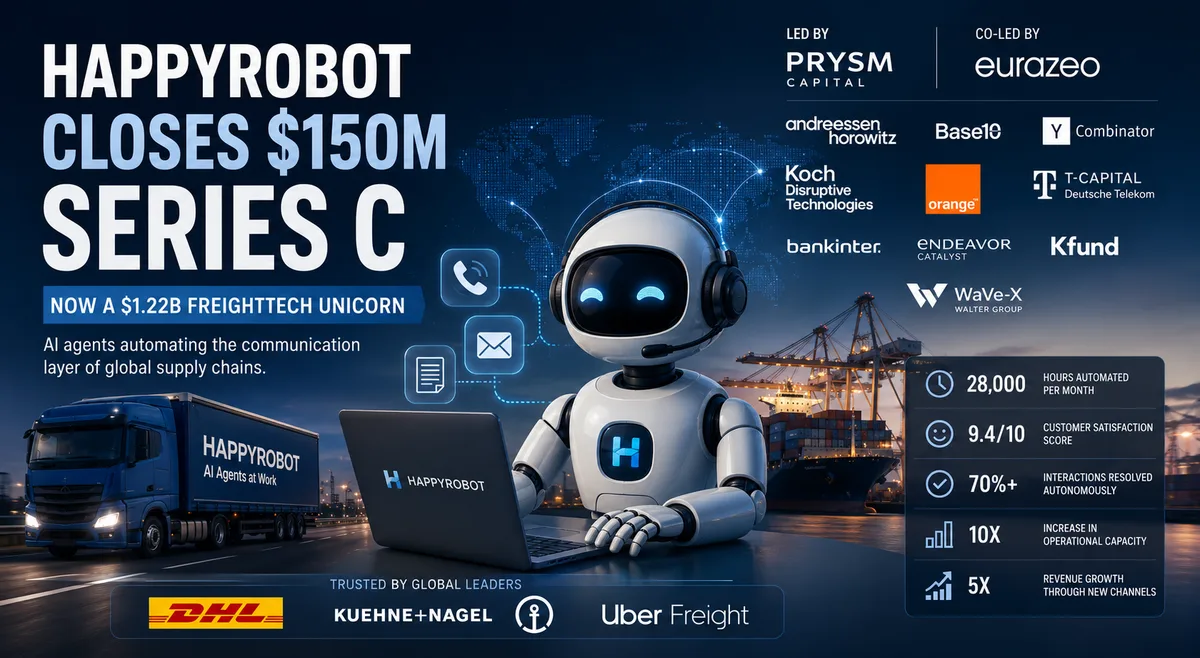
Twenty months. Three funding rounds. Two hundred million dollars raised. And a billion-dollar valuation. HappyRobot — a San Francisco startup that automates the phone calls, emails, and follow-up coordination behind freight operations — closed a $150 million Series C today at a $1.22 billion post-money valuation, making it FreightTech's newest unicorn. Prysm Capital led the round and Eurazeo co-led, with existing investors Andreessen Horowitz (a16z), Base10, and Y Combinator returning alongside strategics including Koch Disruptive Technologies, Orange, Deutsche Telekom's T.Capital, Bankinter, and WaVe-X, the corporate venture arm of Austria's WALTER GROUP.
The raise is one of the largest single bets on enterprise AI agents in logistics history. And for the freight and supply chain industry, the customer list behind the announcement is the part that matters most: DHL, Kuehne+Nagel, and Uber Freight are already deploying HappyRobot's agents inside their live operations — not in pilots, not in proofs of concept, but in production at enterprise scale.
What HappyRobot Actually Does
HappyRobot builds AI agents that handle the operational communication layer of enterprise supply chains — the work that connects systems, people, and shipments through voice, email, documents, and the web. In freight, that means the phone calls to check on loads, the emails to confirm pickup windows, the follow-ups on delayed shipments, the scheduling coordination between carriers, brokers, and customers that happens thousands of times per day across a large logistics operation.
This is not glamorous work. It is also not optional. The entire physical movement of freight depends on a continuous stream of coordination messages that have historically required human operators to generate, send, track, and respond to. HappyRobot's agents do that work autonomously — reasoning within existing enterprise systems, executing multi-step tasks across voice and digital channels, and handing off to human operators only when genuine judgment is required.
The results being reported by customers are specific and measurable. One customer is automating 28,000 hours of work per month through HappyRobot agents. Customer care agents are achieving average satisfaction scores of 9.4 out of 10 and resolving more than 70% of interactions autonomously. Operational teams report 10x capacity increases. Sales teams report 5x revenue growth through channels that were previously underutilised. These are not theoretical projections — they are reported outcomes from live enterprise deployments.
The deployment model is designed for enterprise velocity. Initial agents typically go live within four to twelve weeks of engagement — a significantly faster implementation timeline than traditional enterprise software. Each subsequent sprint refines agents already in production and adds new ones, creating a compounding improvement cycle rather than a one-time deployment event.
The Trajectory — 20 Months to Unicorn
HappyRobot's funding history tells the story of a startup that has moved at an unusual pace even by Silicon Valley standards. The company raised its Series B of $44 million in late 2025 — less than a year ago. Since then, revenue has grown fivefold. The Series C at $1.22 billion brings total funding to approximately $200 million across three rounds in 20 months.
The pace is significant not just as a startup metric but as a signal of enterprise adoption velocity. Revenue growing 5x in under a year means enterprise customers — large, slow-moving companies with complex procurement and IT approval processes — are adopting HappyRobot's agents faster than the funding timeline suggests. DHL, Kuehne+Nagel, and Uber Freight are not small-scale pilots. They are among the largest logistics operations in the world. Their deployments represent production scale commitments, not experimental budgets.
For WaVe-X — the corporate venture arm of WALTER GROUP, one of Europe's largest freight forwarding and logistics companies — the round produced a first: a unicorn return on a portfolio investment. That detail matters because it signals that the strategic investors closest to the logistics industry's operational reality are betting on HappyRobot's model with conviction, not just capital.
Why This Moment — The Agentic AI Inflection
HappyRobot's Series C lands at a specific moment in the development of enterprise AI — the transition from language models that generate text to agents that execute tasks. That distinction is the difference between a tool that drafts an email and an agent that sends it, tracks the response, interprets the reply, and takes the next action in a workflow without human intervention.
As NavilinkGlobal has reported throughout 2026, agentic AI is the category driving the most significant operational changes in logistics right now. SAP's autonomous supply chain agents (May 2026), Nexcade's freight forwarding inbox replacement (June 2026), J.B. Hunt's Overroute platform (July 2026), Uber Freight's DocAI (July 2026 AI Excellence Awards), and now HappyRobot's Series C — all represent different expressions of the same structural shift: AI moving from assistance to autonomous execution in logistics workflows.
HappyRobot CEO Pablo Palafox articulated the company's thesis on this shift directly: "Getting agents to do work is the starting point, not the destination. HappyRobot's thesis is that enterprise superintelligence — where an organization's collective intelligence compounds as agents and people learn from one another — requires far more than task-performing agents. It requires a platform and a deployed motion capable of operationalizing that platform inside a specific business."
The "enterprise superintelligence" framing is ambitious — but it points at a real phenomenon. Each task an AI agent completes in a live enterprise environment generates data about how that business actually operates: what decisions get made, in what sequence, on what inputs, with what outcomes. That data feeds back into the agents, making them progressively more effective at that specific business's specific workflows. The longer HappyRobot's agents run inside DHL or Kuehne+Nagel, the harder it becomes for a competing product to replicate the accumulated operational intelligence.
Beyond Logistics — What the Expansion Signals
The Series C announcement explicitly frames HappyRobot's next phase as expansion beyond logistics into insurance, energy and utilities, telecommunications, airlines, and other sectors that rely on complex operational coordination. That expansion is significant for the logistics industry in two directions.
First, it signals that what HappyRobot built for freight is general enough to work in other operationally complex industries. The phone calls, emails, and fragmented system coordination that make freight operations hard are not unique to freight — they are the operational DNA of every industry that moves, processes, or coordinates physical things at scale. A company that has proven its agents in logistics — arguably the most demanding operational environment available — has a defensible foundation for that expansion.
Second, it means HappyRobot's logistics business will be cross-subsidised by growth in adjacent sectors. Energy and telecommunications revenue funding continued investment in logistics-specific agent capabilities is structurally different from a pure-play logistics startup that must generate all its R&D funding from freight customers alone. For DHL, Kuehne+Nagel, and other enterprise logistics customers, that cross-sector funding dynamic means HappyRobot has more capital to invest in making its logistics agents better — not less.
Key Takeaways — August 5, 2026
- HappyRobot closed a $150 million Series C at a $1.22 billion post-money valuation today — FreightTech's newest unicorn, 20 months after founding and less than a year after its $44 million Series B.
- The round was led by Prysm Capital and co-led by Eurazeo, with a16z, Base10, Y Combinator, Koch Disruptive Technologies, Orange, Deutsche Telekom's T.Capital, Bankinter, Endeavor Catalyst, Kfund, and WaVe-X participating.
- HappyRobot's AI agents automate the voice, email, and document coordination layer of enterprise logistics — currently deployed inside DHL, Kuehne+Nagel, and Uber Freight at production scale.
- Revenue has grown 5x since the Series B in late 2025. One customer automates 28,000 hours of work per month. Customer care agents achieve 9.4/10 satisfaction scores with 70%+ autonomous resolution.
- Total funding reaches approximately $200 million across three rounds in 20 months — one of the fastest funding trajectories in FreightTech history.
- HappyRobot is expanding beyond logistics into insurance, energy, telecommunications, and airlines — using the operational complexity of freight as proof of concept for a broader enterprise AI agent platform.



Comments
No comments yet. Be the first to share your thoughts!