What Was Just Launched?
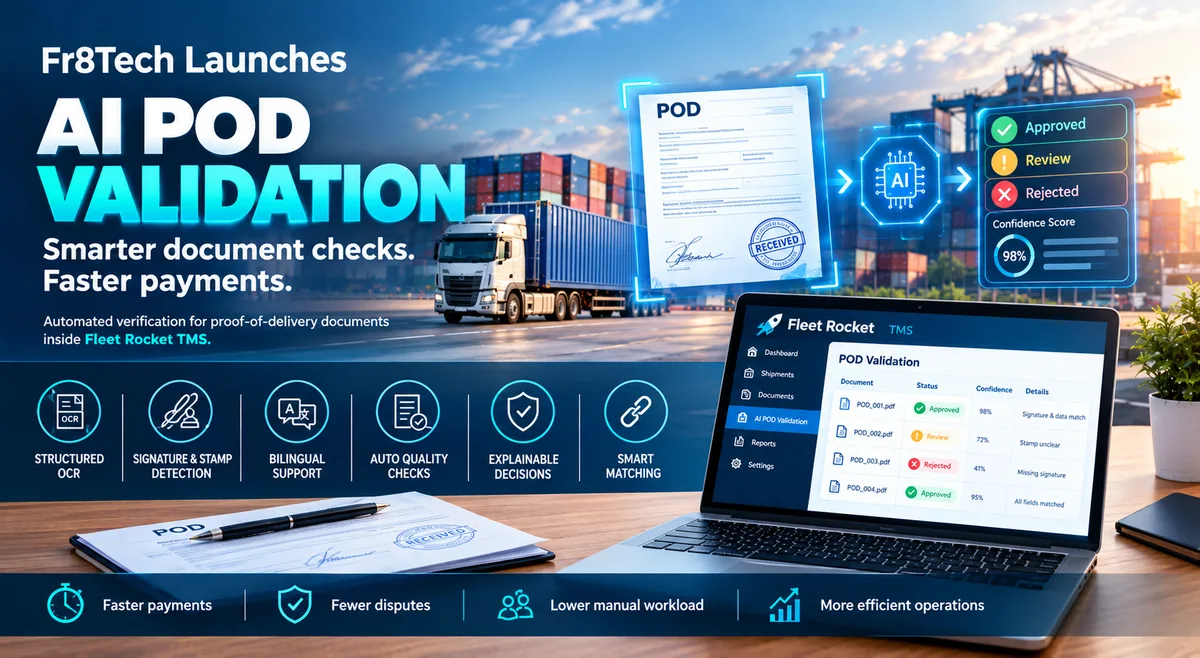
On September 18, 2026, Houston-based Freight Technologies, Inc. (Nasdaq: FRGT), known in the industry as "Fr8Tech," announced the launch of AI POD Validation — a new artificial intelligence module built into its Fleet Rocket Transportation Management System (TMS).
The tool automatically reads and verifies proof-of-delivery ("POD") documents and flags those that do not meet validation requirements. In plain English: instead of a human employee opening every single delivery document, checking the signature, comparing details, and approving it by hand, the software now does that job automatically.
Why Does POD Verification Matter So Much in Freight?
If you have never worked directly in freight operations, it might be hard to appreciate just how big a deal this small-sounding paperwork task actually is.
PODs are essential logistics documents that close out shipments and provide carriers with evidence for payment. Every single shipment — whether it is a truckload of auto parts crossing the US-Mexico border or a pallet of consumer goods moving between warehouses — ends with a physical or digital document proving the delivery happened. That document typically needs a signature, sometimes a stamp, and it needs to match the original shipment record exactly. Only once that document is verified can the carrier actually get paid.
The problem is that warehouses, carriers and customers all use their own formats, complicating data matching, stamping, signatures and other critical approvals. There is no single standard POD format across the industry. Every customer, every warehouse, and every carrier may format things slightly differently — different fields, different stamp placements, different signature requirements. Someone has to manually read each one, compare it against the shipment record, and decide whether it is acceptable.
Fr8Tech CEO Javier Selgas summed up the scale of the problem: "Every shipment ends with a piece of paper that someone has to read, compare and approve. Multiply that by thousands of shipments a month and you have one of the most repetitive, expensive and error-prone tasks in freight operations."
How Does the AI Actually Work?
AI POD Validation, developed by Fr8Tech's in-house AI Lab, is designed to perform those reviews automatically. Here is the process, step by step:
- The system receives the document — whether scanned, photographed, or uploaded electronically.
- It references the shipment record — comparing the POD against the original booking, load details, and expected delivery information already in the Fleet Rocket system.
- It returns a verdict — one of three outcomes: Approved, Review, or Rejected.
- It provides a confidence score and supporting evidence — all displayed next to the POD in the shipment record, so a human reviewer can quickly see exactly why the AI made its decision.
This last point matters a lot. Operations teams can then focus on only those documents requiring review — meaning staff no longer need to check every single POD from scratch. They only need to look closely at the small percentage the AI flags as uncertain or problematic. Everything the AI is confident about gets approved automatically and moves straight to payment processing.
What Specific Technology Is Under the Hood?
According to the company, the module includes several specific technical capabilities working together:
- Multi-model signature and stamp detection with consensus filtering — meaning multiple AI models check each signature or stamp independently, and the system only accepts a result when the models agree, reducing false approvals or false rejections.
- Structured optical character recognition (OCR) that preserves label-to-value relationships — this is a more advanced form of text-reading technology that understands which number or word belongs to which field (for example, correctly identifying which number is the "bill of lading number" versus the "pickup number"), rather than just extracting text as a jumbled block.
- Spatial document understanding — the system matches pickup numbers, bills of lading, carrier names and invoice data against the Fleet Rocket load, cross-referencing multiple data points at once rather than checking just one field.
- Bilingual stamp interpretation of English and Spanish — a critical feature given Fr8Tech's focus on the US-Mexico cross-border freight corridor, where documents frequently appear in either or both languages.
- Automatic document-quality checks — catching blurry, incomplete, or poorly scanned documents before they cause problems downstream.
- Fully explainable decisions — the system shows operations teams exactly why each document was approved, flagged for review, or rejected, rather than acting as an unexplained "black box."
Where Does This Fit Into Fr8Tech's Broader Strategy?
AI POD Validation is available to Fleet Rocket customers as part of the Enterprise version, and it joins the AI Tendering Bot and the Zayren.ai integration as capabilities within Fleet Rocket's transportation management platform.
This is not Fr8Tech's first AI-focused product launch in 2026. The company has been steadily rolling out automation features throughout the year — including a July 2026 announcement that it would advance an "AI-native transformation," expanding Fleet Rocket's GPS provider integrations in July, adding native Mexican tax invoicing (CFDI/Timbrado) in August, and integrating carrier compliance and onboarding automation with Highway in mid-August.
The company says it expects to extend the same document-intelligence approach to other freight documents, including carrier invoices and bills of lading, as part of its transition to a software-first, SaaS-based business serving the US-Mexico corridor. In other words, POD validation is just the first piece — Fr8Tech plans to apply the same automated document-reading technology to other paperwork bottlenecks in freight operations.
What Does This Mean for Freight Brokers, Carriers, and Shippers?
- Faster payment cycles are possible. Since PODs are the trigger for carrier payment, automating and speeding up the verification process could mean carriers get paid faster — reducing cash flow strain for smaller trucking companies that depend on quick turnaround.
- Fewer disputes over documentation errors. With explainable decisions and confidence scores attached to every document, both carriers and brokers have a clear, auditable record of why a POD was approved or rejected — reducing the back-and-forth arguments that often arise over paperwork discrepancies.
- Operations staff can focus on higher-value work. As the CEO noted, the goal is to let "the software handle the mundane reading and matching, and empower people to manage important customer and vendor relationships" — freeing up staff time from repetitive document review toward customer service and relationship management.
- This is part of a broader industry trend. Document automation using AI and computer vision is becoming increasingly common across freight technology platforms, as companies look to reduce the significant administrative overhead that has traditionally accompanied every physical shipment.
- Bilingual capability matters for cross-border operators. Companies moving freight across the US-Mexico border regularly deal with documents in both English and Spanish. A tool specifically built to interpret both languages addresses a real pain point that many generic freight software tools do not handle well.
Key Takeaways — September 19, 2026
- Freight Technologies (Fr8Tech) launched AI POD Validation within its Fleet Rocket TMS on September 18, 2026.
- The tool automatically reads, verifies, and returns a verdict — Approved, Review, or Rejected — on proof-of-delivery documents.
- Technology includes multi-model signature/stamp detection, structured OCR, spatial document matching, and bilingual (English/Spanish) interpretation.
- Every decision includes a confidence score and explainable supporting evidence — not a "black box" system.
- Available now to Fleet Rocket Enterprise customers, alongside the existing AI Tendering Bot and Zayren.ai integration.
- Fr8Tech plans to extend the same AI document-reading approach to carrier invoices and bills of lading next.
- The launch is part of the company's broader shift toward a software-first, SaaS-based model for the US-Mexico freight corridor.
- Practical benefits for the industry: faster carrier payments, fewer documentation disputes, and reduced manual workload for operations teams.
Proof-of-delivery paperwork has long been one of freight's most tedious, repetitive back-office tasks — and one prone to human error given the sheer volume of documents moving through any brokerage or carrier's operations every month. Fr8Tech's new AI POD Validation tool is a clear sign of where freight technology is heading: automating the paperwork so people can focus on the relationships and decisions that actually need a human touch.
Comments
No comments yet. Be the first to share your thoughts!