The Problem AI Is Actually Solving
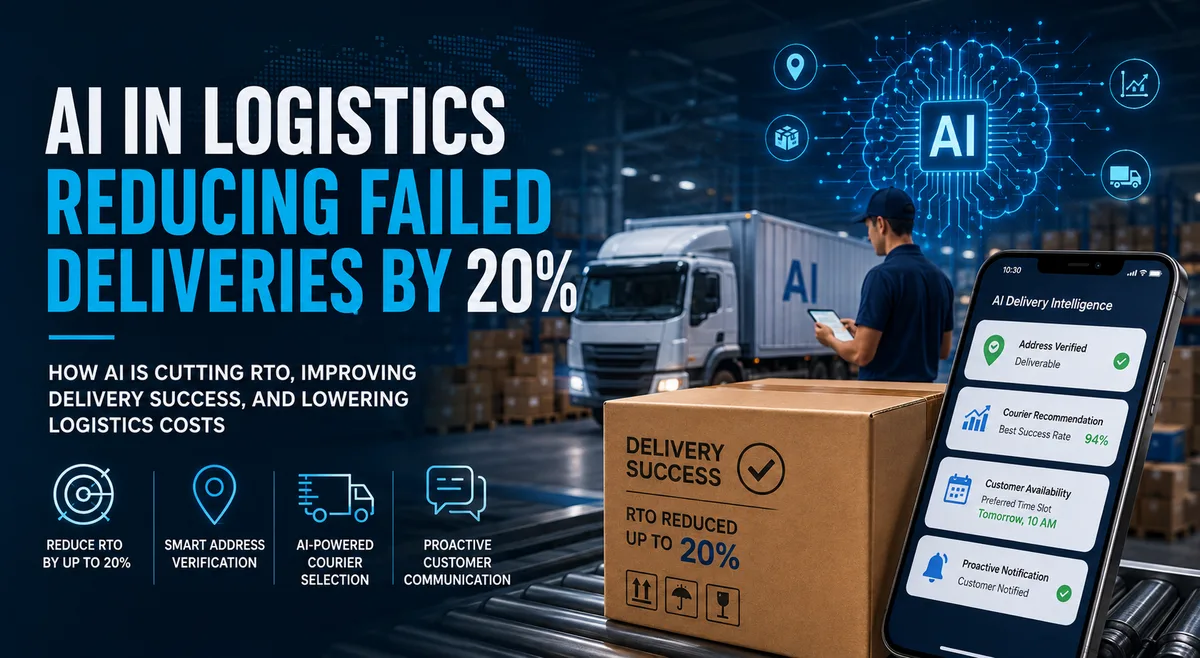
For years, "AI in logistics" has often meant a flashy pilot project — a chatbot here, a demand forecasting demo there — that never quite made it into daily operations. That is changing. Business Standard reported on August 28, 2026 that artificial intelligence is increasingly becoming the backbone of logistics companies, helping direct-to-consumer (D2C) startups and e-commerce companies reduce failed deliveries and return-to-origin (RTO) shipments by up to 20%, while improving delivery success rates and lowering operational costs.
RTO — when a shipped order fails to reach the customer and is sent back to the seller — is one of the most expensive and persistent problems in e-commerce logistics. It is not a minor inconvenience. Every failed delivery means wasted shipping costs in both directions, wasted packaging, wasted warehouse handling, and often a lost customer. For high-volume D2C brands, RTO rates in some markets run as high as 20-35%, and even higher in certain product categories — meaning as much as a third of shipped orders never successfully complete on the first attempt.
A Real Case Study: How One Brand Cut Its Failed Delivery Rate
The scale of the problem — and the AI response to it — is best illustrated through a concrete example. During January-March this year, intimate wellness startup MyMuse was grappling with a surge in failed deliveries. Nearly 30% of its orders were being flagged as non-delivery reports (NDRs), forcing customer support executives to spend long hours on follow-ups. Even then, resolution timelines stretched to 48-72 hours.
The company's response was to deploy an AI-powered tool called Parth. According to the logistics platform ClickPost, which built the tool, brands using Parth have seen RTO rates decline by 15-20%. The tool works by analyzing delivery patterns and customer behavior to flag at-risk shipments before they fail — allowing intervention earlier in the process, rather than after a delivery attempt has already gone wrong.
AI Is No Longer a Bolt-On — It Is the Platform
Perhaps the more significant shift is philosophical rather than technical. Logistics platform Shiprocket, one of India's largest e-commerce shipping providers, has integrated AI across its platform rather than offering it as a standalone product.
"AI is not something we have deployed on top of our operations. It is how the platform was built and continues to evolve," said Prabhat Singh, senior vice-president of product management at Shiprocket. The company's AI capabilities span checkout, courier allocation, and last-mile delivery — three of the highest-friction points in the e-commerce delivery journey.
Two specific applications stand out:
- Address and identity verification at checkout. Shiprocket Checkout verifies customers' last successful delivery address before an order is placed — catching a common source of failed deliveries before the shipment even leaves the warehouse.
- AI-powered courier selection. The platform's Courier Recommendation Engine recommends the most suitable logistics partner for each individual shipment, based on factors like the destination pin code's historical delivery performance with different carriers. Around 40% of sellers on the platform now use the recommendation engine for every single order — a significant adoption rate for a tool that essentially replaces manual carrier selection decisions.
The platform also proactively notifies customers before delivery and allows them to reschedule if they are unavailable — directly addressing one of the leading causes of failed delivery attempts: nobody being available to receive the package at the scheduled time.
Why This Matters Beyond India's D2C Sector
While this specific reporting focuses on the Indian D2C and e-commerce logistics market, the underlying shift is a global one. Failed deliveries, address errors, and inefficient carrier allocation are universal problems in e-commerce logistics — they are not unique to any single country or market.
What makes this development notable is the specificity of the results. Rather than vague claims about "AI transformation," these are measurable, attributable outcomes: a named startup, a documented before-and-after NDR rate, a specific AI tool, and named executives describing exactly how the technology is embedded in daily operations. This is a useful marker for where AI adoption in logistics genuinely stands in mid-to-late 2026 — moving past pilot programs and into measurable, operational impact on core cost centers.
The Broader Pattern: AI Moving From Pilots to Operations
This shift is consistent with what logistics researchers have been observing more broadly through 2026. Industry analysis has pointed to a pattern where isolated AI pilots — a demo here, a proof-of-concept there — have limited real business value in transportation and logistics unless they are integrated into core operational workflows rather than run as side experiments.
The MyMuse and Shiprocket examples reflect exactly this kind of integration: AI is not a separate initiative running alongside normal operations. It is built into the checkout flow, the courier selection process, and the customer communication sequence — the actual mechanics of how a package moves from warehouse to doorstep.
What Does This Mean for Freight Forwarders and Logistics Providers?
- RTO reduction is now a measurable, attainable target — not an aspiration. With documented cases of 15-20% RTO reduction through AI deployment, logistics providers evaluating AI investment now have concrete benchmarks to assess vendor claims against.
- Address verification at checkout is a high-leverage, low-complexity starting point. Compared to more ambitious AI applications like autonomous vehicles or predictive demand forecasting, address and delivery-history verification at the point of order is a relatively simple, immediately actionable AI use case with clear ROI.
- Courier allocation is shifting from human judgment to data-driven recommendation. With 40% of sellers on one major platform already using AI-driven courier recommendations by default, this suggests the logistics industry is moving toward algorithmic carrier selection as a standard practice, not an experimental one.
- Proactive customer communication reduces failed attempts at the source. Rather than treating a failed delivery as something to resolve after the fact, platforms are increasingly intervening beforehand — notifying customers and allowing rescheduling before a driver even attempts delivery.
- Vendor evaluation should focus on integration depth, not feature lists. The clearest signal from this reporting is that AI embedded into core platform architecture (like Shiprocket's approach) appears to be delivering more consistent results than AI offered as an add-on feature. Logistics providers evaluating new technology partners should ask how deeply AI is integrated into actual workflows, not just what AI features are listed on a spec sheet.
Key Takeaways — August 30, 2026
- AI deployment in e-commerce logistics is now producing documented, measurable results — up to 20% reduction in return-to-origin shipments.
- Case study: intimate wellness startup MyMuse cut its 30% NDR rate using an AI tool called Parth, built by logistics platform ClickPost.
- Shiprocket has built AI directly into its core platform architecture — spanning checkout, courier allocation, and last-mile delivery — rather than offering it as an add-on.
- 40% of sellers on Shiprocket's platform now use its AI courier recommendation engine for every order.
- The broader industry pattern shows AI moving from isolated pilot projects into integrated, operational workflows.
- Address verification at checkout and proactive delivery rescheduling are proving to be high-impact, relatively simple AI applications.
- Logistics providers should evaluate AI vendors based on integration depth into core workflows, not standalone feature claims.
The story of AI in logistics in 2026 is not about flashy demonstrations or futuristic promises. It is about a well-known, expensive, everyday problem — failed deliveries — being measurably reduced through AI tools built directly into the platforms that logistics companies already use. For an industry where margins are thin and RTO costs eat directly into profitability, that kind of incremental, embedded AI adoption may prove more consequential than any single headline-grabbing innovation.
Comments
No comments yet. Be the first to share your thoughts!