
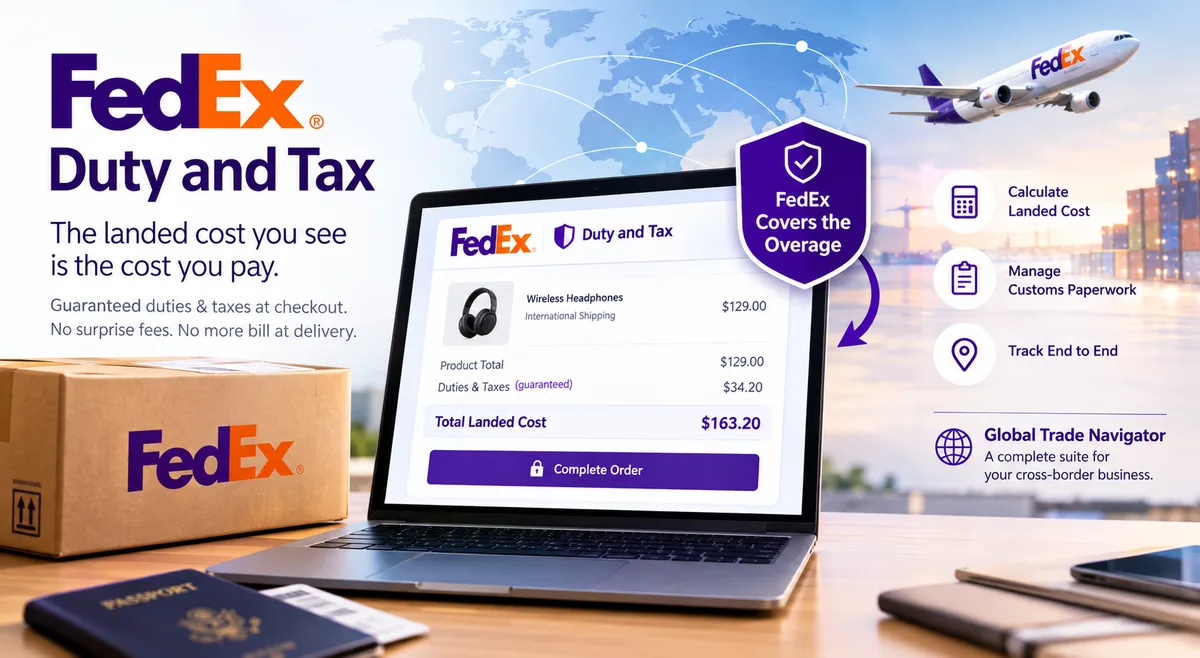
The moment a customer finally receives their international order only to be hit with an unexpected customs bill is one of the most reliable ways to lose that customer forever. FedEx is betting it can eliminate that moment entirely. On September 11, 2026, the company launched FedEx Duty and Tax, an app available on the Shopify platform that displays a guaranteed duty-and-tax total to shoppers at checkout — and if the actual charge comes in higher once the shipment clears customs, FedEx absorbs the overage itself.
What the Tool Actually Does
FedEx Duty and Tax is available as a Shopify app for $99 a month. At checkout, it calculates and displays the expected duties and taxes for a cross-border order, giving the customer a single, guaranteed landed cost before they complete the purchase. If the real duty-and-tax assessment at customs turns out to be higher than what was quoted, FedEx covers the difference rather than passing it back to the merchant or surprising the customer with a follow-up invoice. Notably, the guarantee runs one direction only: if the actual duties and taxes are lower than the checkout estimate, no refund is issued to the customer or the merchant.
The tool is part of a broader suite FedEx is rolling out under the name Global Trade Navigator, described by the company as a set of tools designed to help businesses at each stage of international shipping — from calculating landed cost, to managing customs paperwork, to tracking cross-border shipments end to end.
Why FedEx Is Solving This Specific Problem Now
The business case behind the launch is grounded in FedEx's own research. According to the company's 2026 Small Business Trade Index, an April poll conducted by FedEx, 68% of small and mid-sized businesses report that their customers have been surprised by additional duties, taxes, or fees at delivery at least some of the time. That statistic captures a persistent friction point in cross-border e-commerce: a shopper completes a purchase believing they know the full cost, only to be presented with an unexpected bill by a courier or customs agent days later — often as a condition of releasing the package at all.
That friction has measurable business consequences well beyond a single bad customer experience. Unexpected charges at delivery are a well-documented driver of parcel refusals, where a customer simply declines to accept and pay for a package rather than cover the surprise cost, and of chargebacks, where the customer disputes the original charge with their card issuer. Both outcomes are costly for merchants: refused parcels typically get returned to the shipper at additional freight cost, and chargebacks carry direct fees plus the lost cost of goods and original shipping.
FedEx's timing is also shaped by broader tariff volatility. As NavilinkGlobal has extensively covered throughout 2026 — from the February Supreme Court ruling striking down IEEPA tariffs, to the Section 122 surcharge that followed, to the Section 301 forced-labor tariffs currently being challenged by a 25-state coalition — the rules governing what duty rate applies to a given cross-border shipment have shifted repeatedly this year. That volatility makes it substantially harder for merchants to price landed costs accurately on their own, which is precisely the gap a carrier-backed guarantee tool is designed to fill.
FedEx Is Not First — UPS and Shopify Already Compete Here
FedEx Duty and Tax enters a market that already has established competitors. UPS launched a comparable tool called UPS Global Checkout last year, which similarly shows shoppers a guaranteed total landed cost before they complete a purchase. Shopify itself offers a native Duties & Import Taxes feature as part of Shopify Markets, available to merchants on its Advanced and Plus plans, which calculates and collects duties directly at checkout using product HS codes and country-of-manufacture data already stored in the merchant's catalog. Cross-border technology platform Zonos also operates in this space, offering duty and tax calculation with carrier import-fee discounts across UPS, DHL, and FedEx shipments.
What distinguishes FedEx's specific offering is the overage guarantee itself — Zonos and Shopify's native tool calculate and collect duties, but the financial guarantee that FedEx will personally absorb any shortfall between the quoted and actual charge is the differentiating commercial promise. That guarantee effectively puts FedEx in the position of underwriting customs-classification accuracy on behalf of the merchant, a role closer to an insurance product than a pure calculation tool.
What This Means for Merchants and Logistics Operators
- Small and mid-sized cross-border sellers now have a genuine carrier-backed alternative to third-party duty calculators. Merchants currently relying on tools like Zonos, Calcurates, or Shopify's native feature should compare pricing and, specifically, whether their current provider offers an overage guarantee equivalent to FedEx's — that guarantee is the meaningful point of differentiation, not the calculation itself.
- The one-directional guarantee structure favors FedEx's own risk management, not the merchant's margin. Because FedEx absorbs overages but issues no refunds when actual duties are lower, the company has structured the guarantee to protect customer experience without exposing itself to give back revenue when its estimates run conservative. Merchants should understand this asymmetry when evaluating total cost of the $99 monthly fee against likely overage frequency for their specific product categories and destination markets.
- Tariff volatility makes accurate landed-cost prediction a genuine competitive capability, not a commodity feature. With Section 301 tariffs, ongoing litigation, and country-specific rate changes creating a moving target throughout 2026, the algorithmic prediction engine behind a tool like this carries real value — and real risk of getting it wrong — in a way that would have been far less consequential in a stable tariff environment.
- Reduced parcel refusals and chargebacks are the real ROI case, not customer satisfaction alone. Merchants evaluating whether to adopt FedEx Duty and Tax, UPS Global Checkout, or a competing tool should model the expected reduction in refused parcels and chargeback volume against the $99 monthly cost — for merchants shipping meaningful cross-border volume, that calculation will typically favor adoption.
Key Takeaways — September 13, 2026
- FedEx launched FedEx Duty and Tax on September 11, 2026 — a Shopify app priced at $99 a month that guarantees a landed cost at checkout and covers any shortfall if actual duties and taxes are higher than quoted.
- No refund is issued if actual duties and taxes turn out to be lower than the checkout estimate — the guarantee runs in one direction only.
- The tool is part of FedEx's broader Global Trade Navigator suite, aimed at supporting businesses across each stage of international shipping.
- FedEx's own research found 68% of small and mid-sized businesses report customers surprised by import fees at delivery at least some of the time, per its April 2026 Small Business Trade Index.
- UPS launched a comparable guarantee tool, UPS Global Checkout, last year; Shopify offers a native Duties & Import Taxes calculator on its Advanced and Plus plans; Zonos also competes in cross-border duty calculation with carrier fee discounts.
- FedEx's overage guarantee — rather than the underlying calculation — is the tool's key point of differentiation, effectively positioning the carrier to underwrite customs-classification accuracy on the merchant's behalf.




Comments
No comments yet. Be the first to share your thoughts!