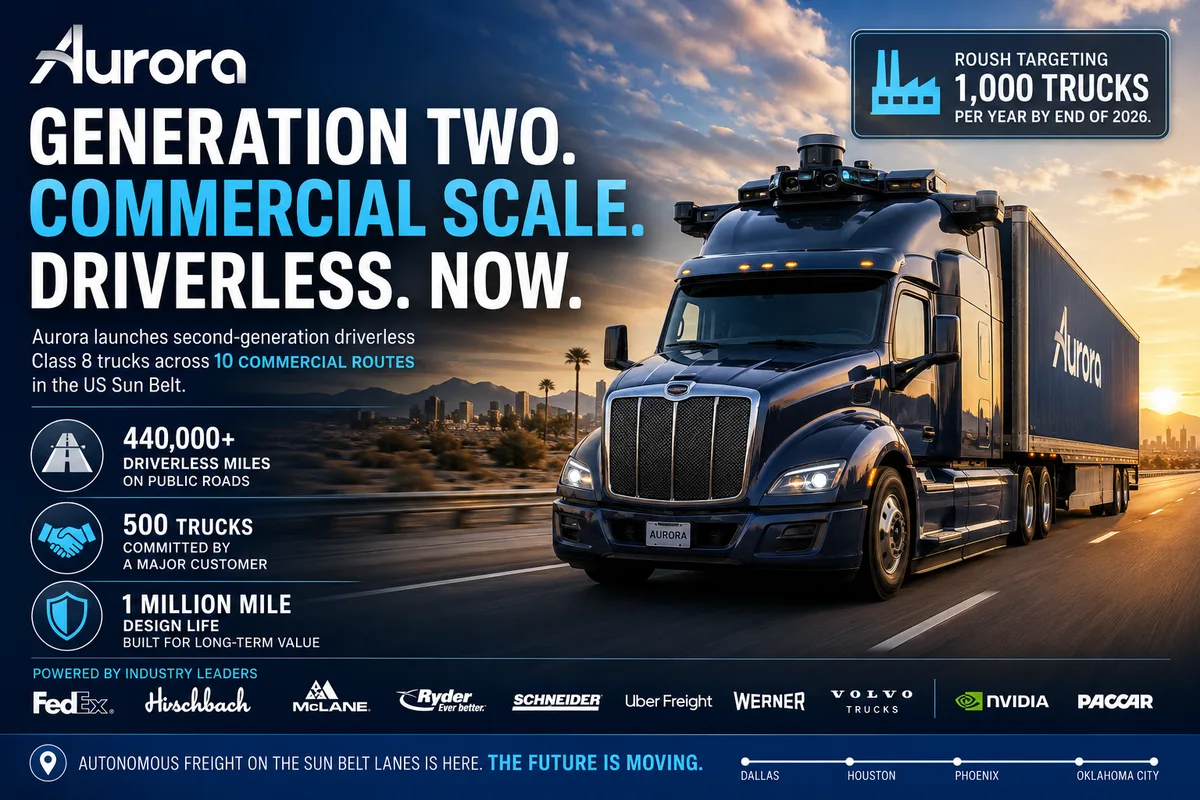
There is a meaningful difference between a company that has proven its autonomous trucks can drive and a company that can build enough of them to matter commercially. On July 22, 2026, Aurora Innovation crossed that line. The Pittsburgh-based autonomous trucking company launched its second-generation driverless Class 8 trucks, deploying them immediately across its commercial network of 10 freight routes in the US Sun Belt — with no safety driver, no remote operator, and no one behind the wheel.
The announcement, made via official press release on the Business Wire newswire, comes as Aurora reaches a milestone that skeptics of autonomous trucking have long cited as the real test: not whether the trucks can drive, but whether they can be manufactured at scale. The answer, as of July 22, is that the infrastructure to do so is now in place — and a customer has already committed to buying 500 of them.
What's Different About Generation Two
Aurora's first-generation autonomous trucks proved the technology could operate safely on public roads. They logged nearly 440,000 driverless miles as of the end of June 2026 across routes including Dallas to Houston, Fort Worth to Phoenix, and a 200-mile Volvo Autonomous Solutions network connecting Dallas to Oklahoma City. That track record is significant — but first-generation hardware was built for proving a concept, not for high-volume commercial deployment.
The second-generation platform is built differently. The new trucks run on Aurora's next-generation Aurora Driver hardware, described by the company as more powerful than its predecessor and engineered for a one-million-mile operating life. That figure matters because it determines the economics of autonomous trucking at scale: a truck that runs one million miles before its autonomous system needs major service can be amortised over a much longer commercial horizon than a first-generation system designed primarily to accumulate test miles.
The vehicles are built on the International LT Series platform — one of the most widely deployed Class 8 truck platforms in North America — with Aurora's autonomous hardware integrated by manufacturing partner Roush. The standardisation onto a single, high-volume OEM platform is itself a scale signal: Aurora is not building bespoke vehicles, it is integrating proven hardware into a proven truck, then producing them in volume.
"Last year's driverless launch proved our technology could operate safely on public roads," said Aurora CEO and co-founder Chris Urmson. "Our new platform now provides the foundation to deliver at scale. Deploying our second-generation truck allows us to put hundreds of autonomous trucks on the road and ultimately into the hands of more customers."
The Production Numbers Behind the Launch
Aurora and Roush have formalised a dedicated upfit process at a production facility specifically configured for Aurora truck integration. Roush is targeting an annual production run-rate of 1,000 Aurora trucks by the end of 2026 — a number that, if achieved, would make Aurora's autonomous fleet larger than the entire driverless vehicle fleets operated by all other US autonomous trucking companies combined.
Customer demand is matching the production ramp. One unnamed customer — described in Aurora's press release as having recently announced plans — has committed to purchasing 500 Aurora Driver-powered trucks. That single order represents half of Roush's targeted annual production capacity. It also represents the kind of commercial commitment that validates a technology at a level that no number of test miles can replicate: a customer putting purchase orders behind their belief that this technology will work reliably enough to anchor their freight operations.
Aurora's commercial partnerships span the major players in US freight: FedEx, Hirschbach, McLane, Ryder, Schneider, Uber Freight, Werner, and Volvo Trucks are all named commercial partners. NVIDIA and PACCAR are technology and manufacturing partners respectively. The breadth of that partner list is significant — Aurora is not a boutique autonomous system serving a single carrier. It is positioned as infrastructure for the broader US freight market.
The Milestones Aurora Has Hit in 2026
The Gen-2 launch is the latest in a series of firsts Aurora has achieved since the start of the year:
- February 2026: Validated a 1,000-mile driverless run from Fort Worth to Phoenix — the longest fully driverless freight haul completed by any autonomous trucking company in North America at that point.
- April 2026: Announced with Hirschbach a plan to deploy 500 autonomous trucks — one of the largest single autonomous fleet commitments in the industry's history.
- May 2026: Announced with McLane Company a partnership to bring autonomous trucks to the US restaurant supply chain — extending autonomous freight beyond general truckload into specialised, time-sensitive distribution.
- May 2026: Expanded the Volvo Autonomous Solutions network with a new 200-mile route connecting Dallas and Oklahoma City.
- June 2026: Passed 440,000 cumulative driverless miles on public roads without a safety driver.
- July 22, 2026: Launched Gen-2 hardware across 10 commercial routes, with Roush targeting 1,000 trucks per year production rate.
That sequence — one major milestone roughly every six to eight weeks throughout 2026 — reflects the pace at which the transition from pilot-scale to commercial-scale autonomous trucking is actually happening. Wall Street is watching: Aurora's stock ticker (NASDAQ: AUR) has been cited in multiple analyst notes this week as one of the most closely followed autonomous vehicle names heading into the second half of 2026.
What This Means for the Freight Industry
Autonomous trucking has been described as "five years away" for the better part of a decade. Aurora's Gen-2 launch is evidence that the timeline has compressed significantly — and that the question is no longer whether autonomous Class 8 trucks will operate commercially on US roads, but how fast the fleet will scale and which carriers will be positioned to benefit.
- For carriers and fleet operators: The 500-truck customer commitment signals that major freight operators are no longer treating autonomous trucking as a future technology to monitor — they are making capital commitments against it now. Carriers that have not yet engaged with Aurora or its competitors on autonomous freight pilots are falling further behind the adoption curve with each quarter that passes.
- For shippers: Autonomous freight on the Sun Belt lanes Aurora operates — Dallas-Houston, Fort Worth-Phoenix, Dallas-Oklahoma City — is now commercially available, not theoretical. Shippers with significant volumes on these lanes should be asking their carrier partners whether autonomous capacity is part of the service offering and what it means for consistency, tracking, and rate structures.
- For drivers and the broader workforce: Aurora's commercial scaling will intensify the policy and labour conversation that has been building since the first autonomous mile was logged. The Hirschbach 500-truck commitment and the Roush 1,000-unit-per-year production target represent the first numbers large enough to quantify potential workforce impact on specific lane segments — a conversation the trucking industry has largely deferred but will need to address as 2026 progresses.
- For logistics technology investors: The Gen-2 hardware's one-million-mile design life is the commercial viability signal the market has been waiting for. First-generation autonomous systems were designed to prove safety. Second-generation systems are designed to generate returns. That distinction — from technology demonstration to revenue-generating asset — is what changes the investment thesis from speculative to structural.
Key Takeaways — July 26, 2026
- Aurora Innovation launched second-generation driverless Class 8 trucks on July 22, 2026, deploying them immediately across 10 commercial freight routes in the US Sun Belt — no driver, no remote operator.
- The new hardware is engineered for a one-million-mile operating life and built for volume production — a fundamental shift from first-generation technology designed to prove safety to second-generation technology designed to generate commercial returns.
- Manufacturing partner Roush is targeting an annual production rate of 1,000 Aurora trucks by the end of 2026. One customer has already committed to purchasing 500 trucks.
- Aurora has logged nearly 440,000 driverless miles on public roads as of end of June 2026, across routes connecting Dallas-Houston, Fort Worth-Phoenix, and Dallas-Oklahoma City.
- Commercial partners include FedEx, Hirschbach, McLane, Ryder, Schneider, Uber Freight, Werner, Volvo Trucks, NVIDIA, and PACCAR — positioning Aurora as industry infrastructure, not a niche operator.
- For freight carriers and shippers: autonomous Class 8 trucking on US Sun Belt lanes is commercially available now. The question is no longer when — it is who will be positioned to use it first.

Comments
No comments yet. Be the first to share your thoughts!