What Is the Autonomous Enterprise — And Why Does It Matter Right Now?
For decades, supply chain professionals have complained about the same problem: data sits in dashboards. AI delivers recommendations. Humans make decisions. Everything moves slowly.
SAP just changed that fundamental model.
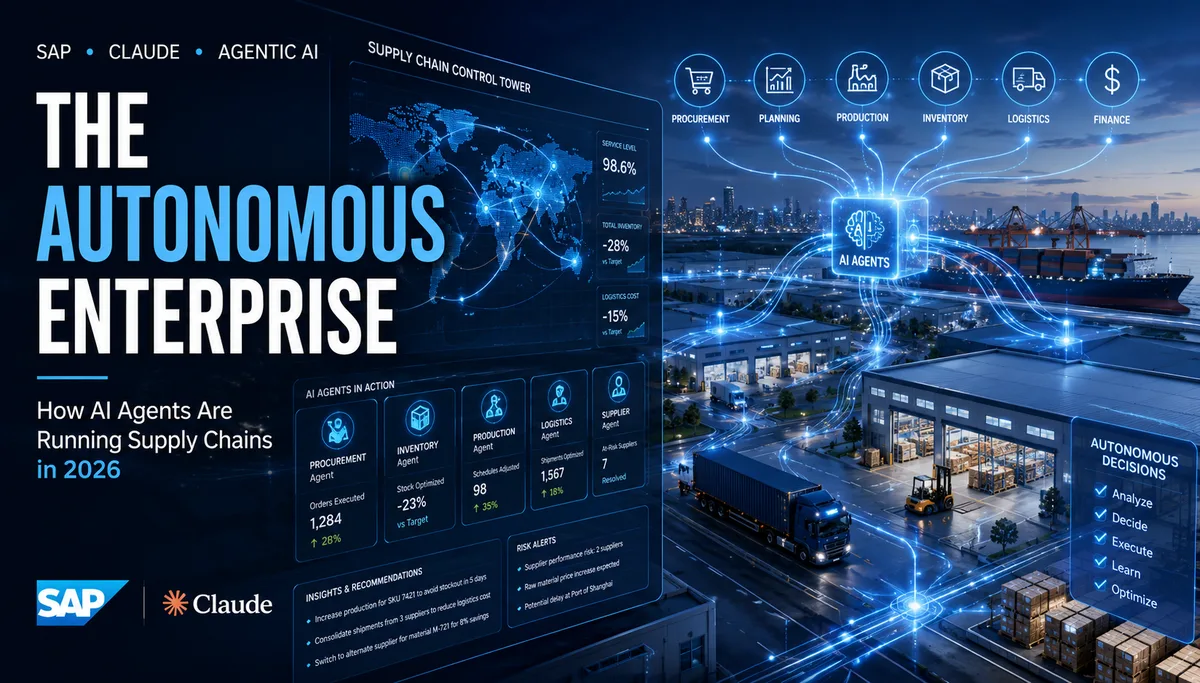
At SAP Sapphire in May 2026, the company announced the Autonomous Enterprise — a new operating model where AI agents embedded directly into supply chain workflows no longer just recommend actions. They execute them. They coordinate with other agents. They learn and improve continuously.
As SAP CEO Christian Klein said at the announcement: "For the mission-critical processes of our customers, 'almost right' just isn't good enough. Agents are only as powerful as the context they operate on."
That context is everything. SAP's agents operate inside a knowledge graph mapping every business entity, relationship, and workflow. When a procurement problem appears, the agent understands not just the immediate issue — but how it cascades across manufacturing schedules, logistics networks, and customer commitments.
The AI Behind This — And Why Claude Matters
SAP is not building this alone. The company announced a strategic partnership with Anthropic, integrating Claude — one of the world's most advanced AI models — directly into the new SAP Business AI Platform.
Claude will power AI agents across:
- Supply chain planning and execution — optimizing sourcing, manufacturing, and logistics decisions
- Procurement automation — handling supplier communications, contract management, and order execution
- Inventory and warehouse management — predicting demand, optimizing storage, automating replenishment
- Transportation and logistics — routing optimization, carrier selection, shipment execution
- Financial close processes — automating journal entries, reconciliation, error resolution
The integration is not a chatbot overlay. Claude is embedded directly into SAP's core business applications — S/4HANA, SuccessFactors, Ariba. The AI understands not just language, but the complete business context: inventory levels, supplier reliability, production schedules, customer orders, and compliance requirements.
What Are These AI Agents Actually Doing Right Now?
The rollout is happening now — throughout June 2026. Here are the confirmed use cases already operational:
1. Autonomous Procurement Agent
The agent analyzes purchase requisitions, evaluates multiple suppliers against predefined criteria (cost, quality, delivery time, sustainability), negotiates within authorized price limits, and executes purchase orders — all without human intervention. If exceptions occur (a supplier is unavailable, prices spike), the agent automatically escalates and proposes alternatives.
Real-world result: 20-30% improvement in procurement workflow efficiency.
2. Production Planning Agent
This agent monitors real-time production data, predicts material shortages 3-4 days before they occur, automatically adjusts production schedules, reallocates labor, and communicates changes to downstream warehouse and logistics teams.
Real-world result: 55% reduction in manufacturing scrap, 80% fewer nonperfect batches.
3. Inventory Replenishment Agent
The agent continuously analyzes demand patterns, adjusts safety stock levels, and automatically initiates replenishment orders for warehouses and distribution centers. It balances conflicting goals — keeping inventory high enough to avoid stockouts while minimizing excess inventory that ties up working capital.
Real-world result: 20-30% reduction in inventory while maintaining service levels.
4. Transportation and Logistics Agent
This agent optimizes shipment routing, selects optimal carriers based on cost/service tradeoffs, tracks shipments in real time, and automatically reroutes when disruptions occur. It learns from each decision, continuously improving route efficiency and cost.
Real-world result: 5-20% reduction in logistics costs through better load consolidation and fewer empty miles.
5. Supplier Performance Agent
The agent monitors supplier quality metrics, delivery performance, and financial stability continuously. When a supplier's performance degrades below thresholds, the agent automatically escalates, proposes alternative suppliers, and can even initiate the process of shifting volume away from underperforming partners.
The "Joule Work" Interface — How Humans Interact With These Agents
One key question: if AI agents are executing supply chain decisions autonomously, what do humans actually do?
The answer is in a new interface called Joule Work.
Instead of navigating multiple SAP screens, planners and logistics coordinators interact primarily with Joule — a conversational interface. A planner might say: "I need to reduce inventory in our North American distribution centers by 15% while maintaining service levels above 98%."
Joule orchestrates the action behind the scenes:
- It signals inventory replenishment agents to slow down ordering
- It tells demand forecasting agents to adjust safety stock calculations
- It alerts logistics agents to optimize warehouse space
- It proactively surfaces risks — for example: if reducing inventory too aggressively would break a customer commitment
Humans remain responsible for strategy, oversight, and decisions requiring judgment. But the repetitive data gathering, analysis, and routine decision-making? That is now handled by agents running 24/7.
How Is SAP Ensuring These Agents Don't Go Rogue?
This is the critical governance question every supply chain leader is asking: if agents are making autonomous decisions, how do we ensure they stay within bounds?
SAP built three layers of control:
1. Business Rules and Constraints
Every agent operates within predefined business rules. A procurement agent cannot approve orders above a certain dollar threshold. A logistics agent cannot reroute shipments across certain geopolitical boundaries without approval. These constraints are not coded — they are specified in natural language that business leaders can understand and modify.
2. AI Agent Hub Governance
SAP launched the AI Agent Hub — a single command center to discover, monitor, and govern ALL agents in an organization (both SAP and non-SAP agents). Every agent decision is logged, auditable, and reversible. For regulated industries like pharmaceuticals, food, and automotive, this audit trail is mandatory.
3. Human-in-the-Loop at Critical Points
Agents operate autonomously for routine decisions. But for high-impact decisions — changing a major supplier, making significant inventory adjustments, or responding to supply chain disruptions — the system automatically escalates to human review. The agent provides recommendations and context, but the human retains final authority.
What Are the Real Financial Results?
SAP published real-world case studies from early deployments. Here is what organizations are actually seeing:
- Agricultural Equipment Manufacturer: Deployed over 1,000 AI agents across the supply chain. Result: 25% reduction in unplanned downtime, 18% improvement in on-time delivery.
- Global Chemicals Company: Embedded agents in planning and scenario management. Result: $45 million in prevented supply disruptions over 6 months.
- Automotive Electronics Company: Centralized procurement and crisis management with agents. Result: disruption response time reduced by 95% (from days to minutes).
- Home Appliance Manufacturer: Agents optimizing forecasting, transport, and warehouse operations. Result: 12% overall supply chain cost reduction.
These are not theoretical projections. They are results from organizations that deployed agents between January and May 2026.
What Should Supply Chain Professionals Do Right Now?
If you work in logistics, procurement, inventory management, or supply chain planning, the Autonomous Enterprise is not coming in 2027. It is rolling out now in June 2026.
- Audit your current workflows. Identify which supply chain decisions are made repeatedly, follow consistent logic, and have clear success metrics. These are the best candidates for autonomous agents.
- Assess your data quality. Agents are only as good as the data they operate on. Before deploying agents, ensure that your demand data, supplier data, inventory data, and logistics data are clean and consistent.
- Talk to your SAP account team.** SAP is phasing agent deployment throughout 2026. If you are an SAP customer, understanding your roadmap for Joule Assistants and agents is critical.
- Plan for change management. The biggest risk of autonomous agents is human resistance. Planners and logistics coordinators need training on how to work alongside AI, when to intervene, and how to oversee agent performance.
- Start with one pilot agent. Do not try to automate your entire supply chain simultaneously. Pick one high-volume, routine decision — procurement ordering, inventory replenishment, or route optimization — and pilot an agent there first.
Key Takeaways — June 21, 2026
- SAP Autonomous Enterprise announced May 2026 — deploying now throughout June.
- Over 50 Joule Assistants powered by Claude (Anthropic) embedded in supply chain workflows.
- Agents now execute decisions autonomously within defined business rules and constraints.
- Real-world results: 20-30% procurement efficiency, 55% scrap reduction, 5-20% logistics cost cuts.
- Joule Work interface allows humans to orchestrate agent actions through natural conversation.
- SAP AI Agent Hub provides governance, audit trails, and human-in-the-loop controls.
- Adoption accelerating: 75% of enterprises expected to invest in agentic AI by end of 2026.
- Competitive gap widening: organizations with autonomous agents will outpace those still running manual processes.
The Autonomous Supply Chain is not a future concept. It is operational, deployed, and delivering measurable business value right now in June 2026. Organizations that understand this shift and move quickly to adopt autonomous agents will have a decisive competitive advantage. Those that wait risk being left behind as the gap between AI-powered and traditional supply chains widens.

Comments
No comments yet. Be the first to share your thoughts!