
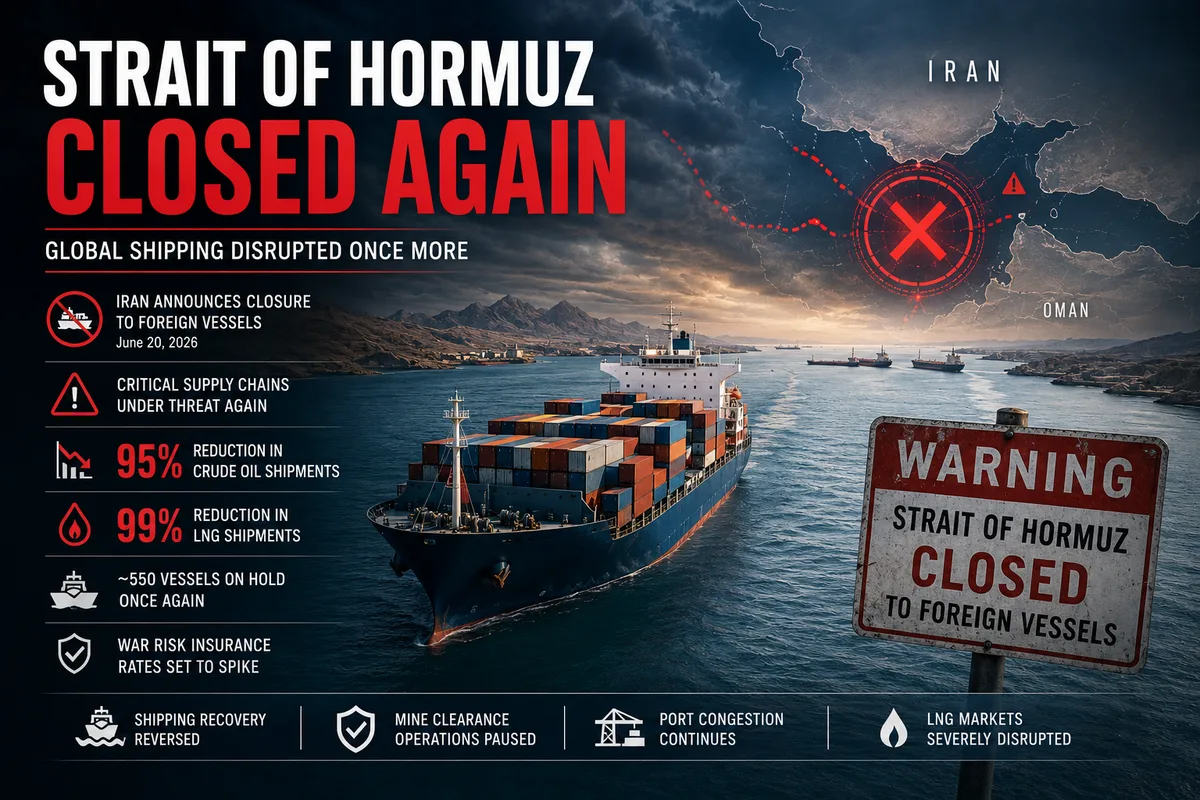
The Strait of Hormuz has closed again. Just days after commercial shipping traffic began cautiously resuming through the world's most critical maritime chokepoint, Iran's joint military command announced on June 20, 2026 that the strait is once again shut to foreign vessels — citing what Tehran calls an "enemy breach of promise" due to continued Israeli military strikes in Lebanon.
The closure is a devastating blow for global supply chains that were already in the early stages of recovery after nearly four months of disruption since the strait was first shut on February 28, 2026.
What Happened in the Last 72 Hours
On June 17–18, the U.S. and Iran signed a Memorandum of Understanding (MoU), triggering a fragile reopening of the strait and raising hopes of a return to normalcy for global shipping. Commercial vessel traffic surged, with 25 ships crossing on June 18 alone — the highest single-day count since mid-April.
But the situation unraveled quickly. Israeli military strikes resumed against Hezbollah targets in Lebanon, which Iran cited as a violation of the broader ceasefire framework. On June 20, Iran's military command announced the strait was closed again, and U.S. Vice President JD Vance stated there was "no evidence" the strait was closed — indicating the two sides have conflicting accounts of the current status of the waterway.
As of this report, the situation remains actively contested and rapidly evolving.
The Logistics Damage Is Already Severe
Even before this latest closure, the House of Commons Library noted that global shipping through Hormuz had suffered a 95% reduction in crude oil shipments and a 99% reduction in LNG shipments compared to pre-conflict levels. The UAE's state-owned oil company has estimated that full flows through the strait are unlikely to resume before 2027, even under the most optimistic scenarios.
At the current moment, the logistics industry faces a compounding set of problems:
- ~550 vessels had been preparing to exit the Gulf — those transit plans are now on hold again
- ~80 sea mines remain in the main central shipping channel, with clearance operations now paused
- War risk insurance rates, which had briefly softened, are expected to spike again immediately
- Jebel Ali port in Dubai continues to face congestion from months of diverted and stranded cargo
- LNG markets remain severely disrupted, with QatarEnergy still operating under force majeure on LNG shipments
What This Means for Shippers Right Now
The brief window of optimism that opened on June 18 has now closed again — possibly just as fast as it appeared. Freight planners, importers, and supply chain managers who had begun preparing to shift back to normal Gulf routing should immediately pause those plans until the situation becomes clearer.
Diplomatic efforts continue. Mediators from Pakistan, Saudi Arabia, Turkey, and Egypt are set to meet in Cairo, and U.S. envoy Steve Witkoff is traveling to Switzerland for nuclear talks with Iran. But the pattern of the past several months — brief ceasefires followed by fresh escalation — suggests that a durable resolution remains uncertain.
Key Takeaway
The Strait of Hormuz crisis has now entered a new and more unpredictable phase. For logistics professionals, the lesson is clear: do not plan around any single diplomatic announcement as a sign of permanent resolution. The situation can reverse within days. Maintain alternative routing plans, keep war risk insurance coverage active, and monitor developments daily. The window for normal Gulf shipping has not yet arrived.


Comments 1
Nice article it should be proper open so things can be smooth