
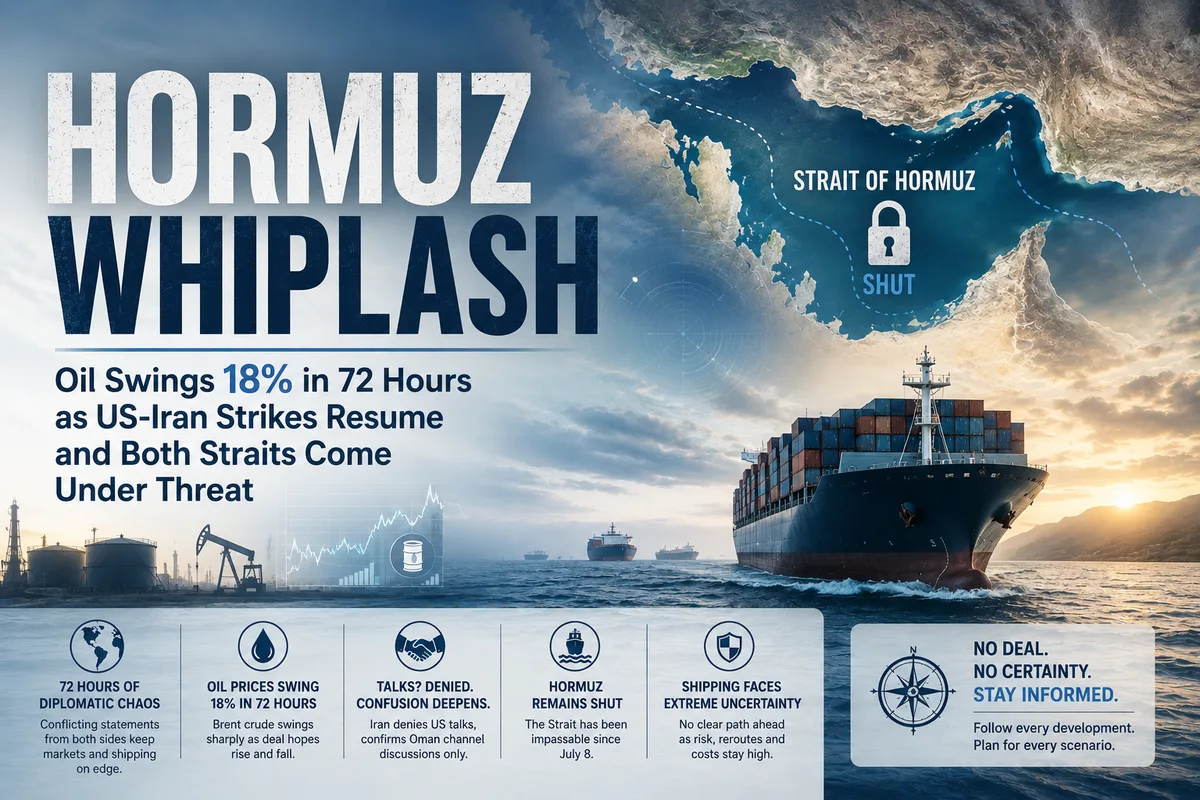
In the past 72 hours, the US-Iran conflict has produced its most confusing diplomatic sequence yet — and for the global shipping industry, which has been waiting for a Hormuz reopening since February, the confusion itself is the most important signal. On August 1, Trump announced Gulf allies had reached the outlines of a deal and called off new strikes. On August 3, he said US-Iran talks would begin Monday. Hours later, Iran's Foreign Ministry announced there were no talks with the United States. The Strait of Hormuz remains shut. Oil prices have swung dramatically in both directions. And shipping companies are no closer to knowing when, if ever, the strait will reopen.
What Happened in the Past 72 Hours — The Full Sequence
Trump said "perimeters of a deal has been agreed to" as he paused attacks on August 1, claiming that Saudi Arabia, the UAE, Qatar and Iran had all asked him to hold off on new strikes. He said there was "a deal on Hormuz, and then there will be a deal on the nuclear." Oil prices fell sharply on the announcement — the market reacted to a potential reopening, not to confirmation of one.
On August 2, oil prices sank further after Trump said he canceled strikes, and he gave an interview on Air Force One saying Iran "wanna make a deal so badly." He said Iran had called and expressed interest in talks but added "I just don't know that they're worthy of making a deal. I don't know that they're going to honor the deal. That's the problem."
On August 3, Trump announced US-Iran negotiations would begin Monday afternoon — a statement that, if true, would represent the first direct talks between the two countries since the conflict began on February 28. However, Iran's Foreign Affairs Ministry spokesperson Esmaeil Baghaei told reporters: "We currently do not have negotiations with America," adding that Iran has no plans to host foreign delegations or send negotiators abroad in the coming days. Trump responded by calling the Iranian leadership "extremely duplicitous."
As of August 4, Iran says it is focused only on negotiations with Oman about the Strait of Hormuz, not with the United States directly. The Strait of Hormuz has been impassable since fighting resumed between the US and Iran on July 8 — weeks after the two sides agreed to the June ceasefire.
What Iran Is Actually Doing — The Oman Channel
The most operationally significant detail in the current diplomatic picture is not what Trump is saying publicly — it is what Iran confirmed it is actually doing: talking to Oman, not the US, about a temporary safe route through the strait.
Iran said it was not holding talks with the US but was in discussions with Oman over a temporary safe route through the Strait of Hormuz. This distinction matters enormously for shipping. A US-Iran bilateral deal on Hormuz would be comprehensive — covering the US naval blockade, Iranian attacks on commercial shipping, fee structures, and lane governance simultaneously. An Oman-brokered temporary safe route is a much narrower arrangement — potentially just a designated corridor and a temporary halt on attacks, without resolving the underlying governance dispute that has kept the strait effectively closed.
The Oman channel also aligns with what NavilinkGlobal reported on August 3: Oman's proposal for a three-lane corridor and voluntary fees modelled on the Strait of Malacca is still the only formal proposal on the table that both Oman and Iran have discussed substantively. Iran rejected that proposal on July 29, but the current diplomatic signals suggest Oman is continuing to work the channel despite the rejection — and Iran is engaging with Oman even while refusing direct US talks.
The Oil Market as a Real-Time Signal
The oil market's reaction to the past 72 hours tells the story more efficiently than any diplomatic statement. Brent crude has moved in both directions multiple times in three days:
- August 1: Oil fell after Trump announced outlines of a deal and called off strikes
- August 2: Oil fell further as Trump's cancellation of strikes held and no new attacks occurred
- August 3: Oil rose after Iran denied negotiations were happening, removing the deal premium
- August 4: Oil prices fell again today after Trump warned Iran of a "last chance" but said he was under no time constraint — the "no time constraint" language removing the urgency premium traders had priced in
What the oil market is doing is pricing the probability of a Hormuz reopening in real time — and that probability is currently unstable, oscillating between "deal imminent" and "deal collapsed" on a 24-hour cycle. For shipping companies making routing and capacity decisions, that instability is itself the operating environment. There is no stable assumption to plan around.
The Pattern That Has Repeated Five Times Since February
This is not the first time the conflict has produced a "deal is close" announcement followed by a breakdown. The pattern has repeated five times since the war began:
- April 8: Two-week ceasefire agreed — collapsed within weeks when Iran resumed attacking commercial vessels
- June 14-17: 60-day MOU signed — collapsed in early July when Iran struck vessels using US-escorted routes
- July 27: US paused strikes — resumed within 48 hours after Iran attempted missile attack on US forces
- August 1: Trump announced outlines of a deal — Iran denied any deal or talks within 48 hours
- August 3: Trump announced Monday talks — Iran denied any negotiations the same day
The consistent pattern is that announcements of progress from the US side have been followed by Iranian denials or resumed attacks within 24-48 hours. That pattern is not a reason for despair — diplomatic processes often work through exactly this kind of public contradiction — but it is a reason to treat every "deal is imminent" headline with rigorous skepticism until a signed, implemented agreement exists and commercial vessel transits are actually occurring.
What Shippers and Logistics Operators Should Know Right Now
- The strait remains shut as of August 4. The Strait of Hormuz has been impassable since fighting resumed July 8. No announcement from either side has changed that operational reality. Until commercial vessels are actually transiting and war risk insurance pricing for Hormuz normalises, the strait is closed for practical planning purposes regardless of what diplomatic statements say.
- Discount "deal is close" announcements until a signed agreement exists. The pattern established across five prior cycles is consistent: public announcements of progress precede breakdowns. The signal that a deal is actually happening is not a Trump social media post or an Iranian foreign ministry statement — it is Lloyd's of London war risk pricing for Hormuz transits falling, and vessel tracking data showing commercial ships successfully completing transits.
- The Oman channel is the one to watch. Iran is talking to Oman, not the US. Oman's three-lane corridor proposal is the only substantive framework that has been exchanged between parties. Movement on that proposal — not on the US-Iran bilateral track — is more likely to produce a workable near-term arrangement for commercial shipping.
- Six Saudi supertankers are still routing around Africa. Six Saudi-operated tankers have diverted around Africa, adding at least two weeks to their journeys, to avoid a blockade in the Red Sea declared by the Houthis. Saudi Arabia's own routing decisions remain the most credible real-time risk assessment available. Until that changes, maintain contingency plans around extended Cape of Good Hope diversions.
- The MOU 60-day expiry on August 16-17 is now secondary. Given that the June MOU has already effectively collapsed and both sides are operating outside its terms, the formal expiry date is less significant than it appeared a week ago. What matters now is whether the Oman channel produces a workable temporary safe route arrangement before or after August 17 — not whether the expired MOU is formally renewed.
Key Takeaways — August 4, 2026
- Iran's Foreign Ministry confirmed August 3 that there are no negotiations with the United States — directly contradicting Trump's announcement that US-Iran talks would begin Monday.
- Iran says it is talking only to Oman about a temporary safe route through the Strait of Hormuz — a narrower arrangement than a full US-Iran bilateral deal.
- Trump called Iranian leadership "extremely duplicitous" and warned of a "last chance" to sign a deal, while saying he is under no time constraint.
- The Strait of Hormuz has been impassable for commercial shipping since July 8 — day 157 of the war.
- Oil prices have swung in both directions multiple times in 72 hours — the market is pricing deal probability in real time, producing an unstable planning environment for shippers.
- The reliable signal that a deal is real is not a diplomatic statement — it is Lloyd's war risk pricing normalising and vessel tracking data confirming actual transits.


Comments
No comments yet. Be the first to share your thoughts!