

What Happened
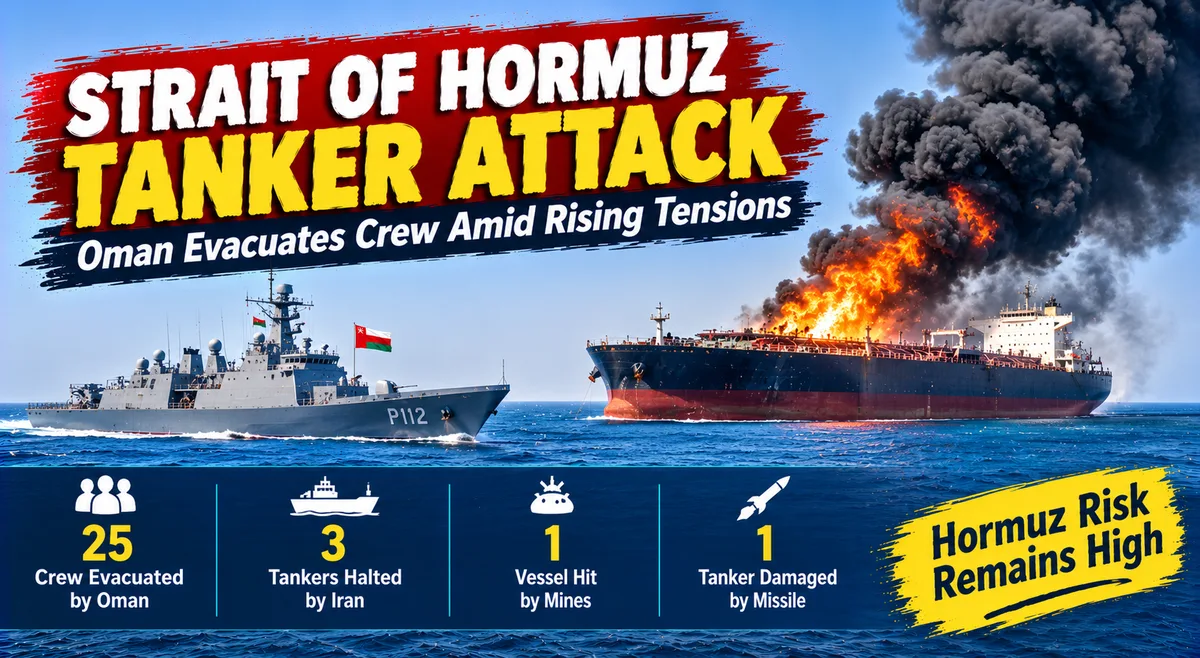
Oman's navy evacuated 25 crew members from a burning tanker in the Strait of Hormuz on Friday, October 30, 2026, according to Oman's Maritime Security Centre. The vessel, identified in multiple reports as the Panama-flagged tanker Riti, was targeted and set ablaze off the coast near Musandam.
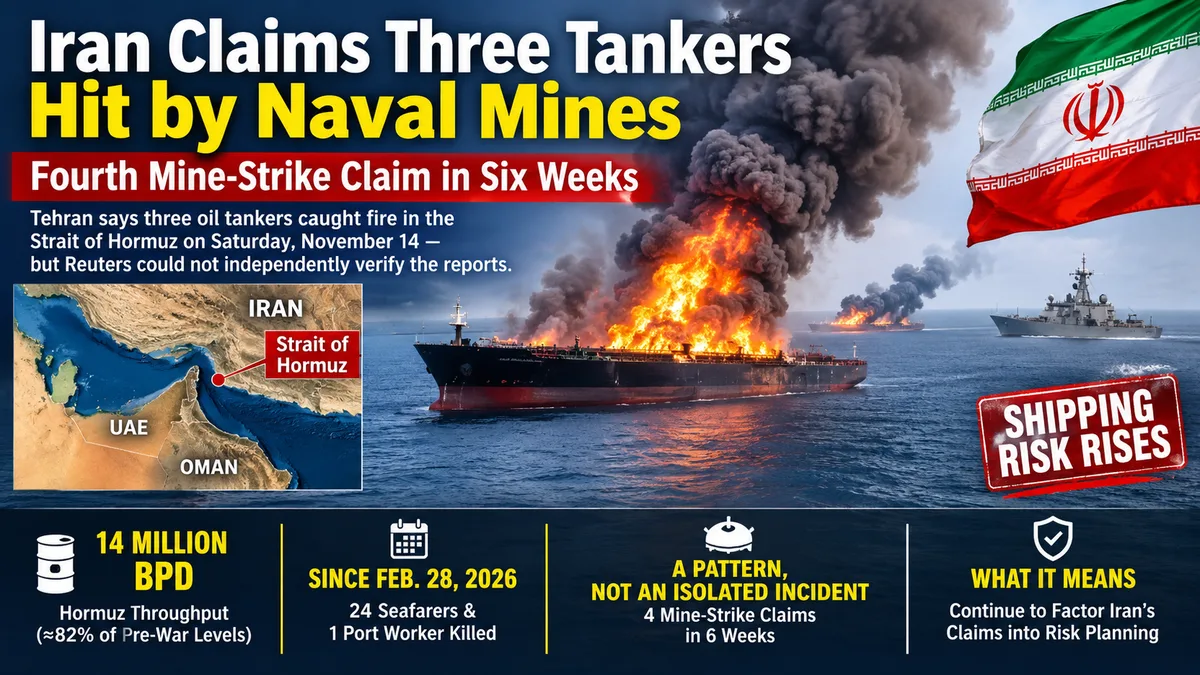
Oman's statement did not provide details on who or what caused the fire. The incident came the same day Iran's Islamic Revolutionary Guard Corps (IRGC) said it had halted three oil tankers attempting to pass through the Strait of Hormuz via what Tehran called "unauthorised routes."
What Iran Is Claiming
In a statement issued Friday, the IRGC said: "Two offending oil tankers, one in the eastern part and the other in the western part of the Strait of Hormuz, which were attempting to pass through the unauthorised route, encountered incidents and were brought to a halt in the waters south of the strait." Iran separately said a third tanker was stopped inside the strait itself, and that one of the vessels involved was carrying roughly 2 million barrels of crude oil.
It is not clear from available reporting whether the Riti — the tanker Oman evacuated — was one of the vessels Iran referenced in its statement. As with previous Iranian claims we've covered throughout this conflict, these statements should be treated as Tehran's official position rather than independently verified fact, since no outside body has confirmed the specific circumstances Iran describes.
Iran has repeatedly warned vessels against transiting the strait without its authorisation, asserting control over much of the waterway since the US and Israel launched their war on Iran on February 28, 2026. Tehran said last month that vessels attempting unauthorised passage would face "destruction."
A Second, Separately Reported Incident
Alongside the Riti evacuation, a separate attack was reported roughly 25 nautical miles northeast of Oman. According to the Maritime Executive, the tanker involved — built in 2004, 159,000 deadweight tonnes, and now under Indian management — was damaged but able to proceed under its own power. Independent analysts tracking the incident attributed the strike to an Iranian missile, though this specific attribution has not been confirmed by any government body.
Separately, maritime trackers reported that a different vessel, the Panama-flagged tanker Louise 1, was disabled the previous night, October 29, after a small boat attached limpet mines roughly 25 nautical miles northeast of Khasab, Oman — a style of attack not referenced in the IRGC's own public statements, which have focused on mine strikes and missile warnings rather than limpet mine attachments.
Why the Details Matter: A Pattern of Disputed Attribution
This cluster of incidents illustrates a pattern we've tracked throughout this conflict: multiple vessels struck through different apparent methods — missiles, limpet mines, unexplained fires — within a short window, with Iran's public statements not always matching the specific details reported by maritime security trackers or the navies responding to distress calls. This gap between official claims and independently observable facts has been a consistent feature of Hormuz reporting since the war began, and UKMTO itself has previously acknowledged struggling to accurately count and verify the true number of attacks in the region.
Shippers and insurers should treat the precise cause and attacker for each specific incident as unresolved until confirmed by an independent source, even when Iran or another party issues a public statement.
What This Means for Shippers, Charterers, and Insurers
- Hormuz transit risk remains acute and multi-method. With incidents this week involving missiles, limpet mines, and unexplained fires within days of each other, shippers should not assume any single defensive measure addresses the full range of current threats in the strait.
- Do not rely on Iranian statements to determine whether a specific vessel was "authorised." Since Iran's own account of which tankers it targeted does not clearly match the vessels independently reported as attacked, companies with cargo or crew in the region should seek confirmation through their flag state, insurer, or UKMTO rather than Iranian state media.
- Indian-flagged and Indian-crewed vessels continue to feature prominently in these incidents. Companies with Indian crew exposure on Gulf-transiting vessels should maintain close coordination with India's Ministry of External Affairs and their own crewing agencies, given the recurring presence of Indian nationals among those evacuated or injured in recent incidents.
- Expect continued elevated war risk insurance costs. A cluster of multiple incidents in a short window, using varied attack methods, typically reinforces rather than eases insurer concerns about the region — budget for continued high premiums on any Hormuz-adjacent routing.
- Oman's role as first responder remains consistent. With Oman's navy and maritime security services repeatedly conducting evacuations near Musandam and Khasab, companies with vessels transiting this specific corridor should understand Omani search-and-rescue capacity may be a relevant factor in contingency planning, even though it does not reduce underlying transit risk.
Key Takeaways
- Oman's navy evacuated 25 crew from the burning Panama-flagged tanker Riti near Musandam on October 30, 2026; the cause of the fire was not specified.
- Iran's IRGC separately claimed it halted three oil tankers attempting "unauthorised" passage through the Strait of Hormuz the same day, one reportedly carrying about 2 million barrels of crude.
- It remains unclear whether the Riti was among the vessels Iran referenced.
- A separate incident roughly 25 nautical miles northeast of Oman involved an Indian-managed tanker that was damaged but able to continue under its own power; independent analysts attributed it to a missile strike, unconfirmed by any government.
- A third vessel, the Louise 1, was reported disabled by limpet mines the previous night — an attack method not referenced in Iran's own public statements.
- This fits an established pattern of disputed attribution in Hormuz incidents, with gaps between official Iranian claims and independently reported details.
- Shippers and insurers should treat specific cause-of-loss claims as unresolved pending independent confirmation, and budget for continued elevated war risk costs.


Comments
No comments yet. Be the first to share your thoughts!