

What Happened
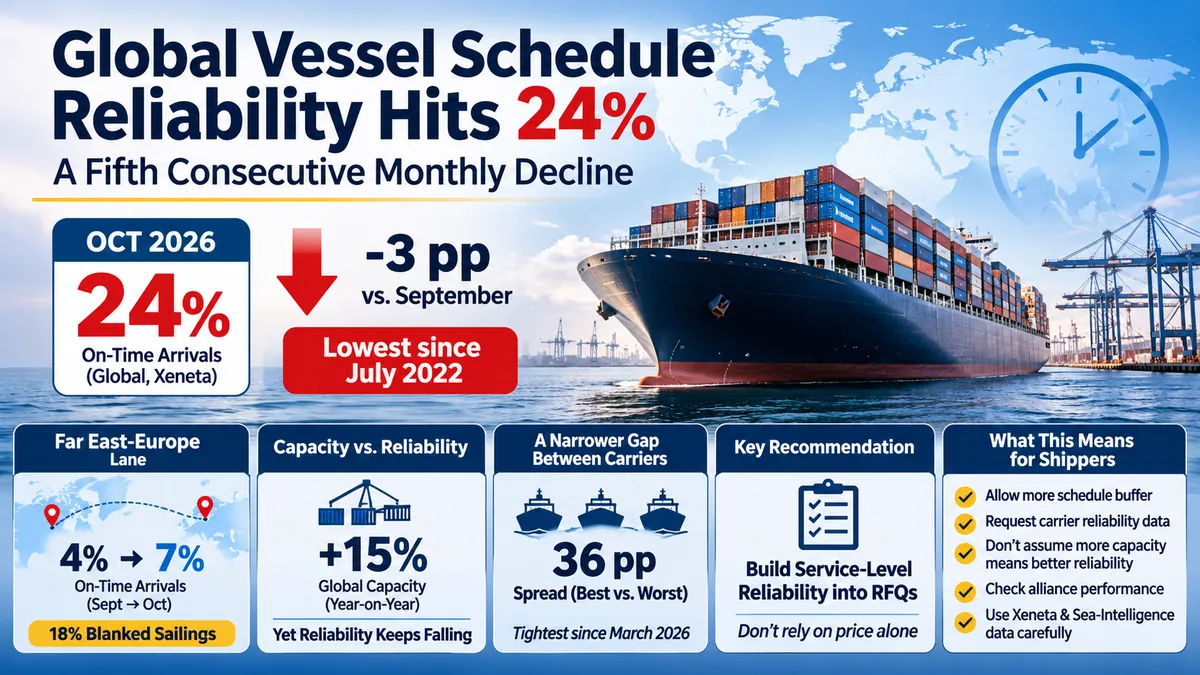
Global on-time vessel arrivals declined for a fifth consecutive month to 24% in October 2026, according to Xeneta's Schedule Reliability Scorecard — three percentage points below September, and now at the lowest monthly average since July 2022. A reading later in October was even weaker, at 25%, before the full-month figure settled slightly lower.
It's worth being clear about methodology here, since different analytics firms track schedule reliability differently and produce noticeably different headline numbers. Xeneta's 24% figure measures the share of vessels arriving within a specific on-time window using its own tracking approach. Separately, Sea-Intelligence — a different firm using its own carrier-reported arrival methodology — reported schedule reliability of 50.6% for September in its own Global Liner Performance report, a figure on an entirely different scale. Both are legitimate, widely cited industry benchmarks, but they are not directly comparable to each other, and shippers should be careful not to average or conflate the two when assessing current conditions.
Far East-Europe: Still the Worst-Performing Major Lane
The Far East to Europe trade remains the most severely affected major route. On-time arrivals on this lane improved marginally from 4% in September to 7% in October — technically an improvement, but still representing a situation where fewer than one in ten vessels arrive on schedule.
Carriers blanking roughly 18% of sailings on this specific lane contributed to that modest uptick, echoing a pattern seen a year earlier: in October 2025, a 21% blanked rate on the same route helped push on-time arrivals from 22% to 25%. In both cases, cancelling sailings outright appears to be propping up the on-time percentage for the vessels that do sail, rather than reflecting genuine operational improvement across the full planned schedule.
Why Is Capacity Growing While Reliability Keeps Falling?
One of the more counterintuitive details in this month's data: planned global capacity grew 15% year-over-year in October, even as reliability hit a four-year-plus low. Blanked TEU volume stayed roughly level — 396,000 TEU in October 2026 versus 407,000 TEU in October 2025 — meaning carriers aren't simply cancelling more sailings than before; the underlying network is carrying substantially more capacity while still struggling to keep that capacity moving on schedule.
This points toward a structural congestion and scheduling problem rather than a pure capacity shortage. Adding more ships and containers to a network that is already struggling with port congestion, vessel bunching, and the broader disruption we've tracked extensively this year — from the Strait of Hormuz crisis to Asian port backlogs — does not automatically restore reliability; if anything, more capacity moving through the same constrained ports and canals can compound existing bottlenecks.
A Narrower Gap Between Carriers — But Not a Good Kind of Narrow
Xeneta's report also noted a narrower 36 percentage-point band between the best- and worst-performing carriers — the tightest spread since March 2026. Rather than signaling broad improvement, a narrowing band in this context likely reflects top-performing carriers losing ground toward the pack, rather than lower-performing carriers catching up to industry leaders.
For context on where individual carriers and alliances have stood recently, Sea-Intelligence's own August/September data (using its separate methodology) found MSC the most reliable alliance at 68.9%, followed by Gemini at 68.4% and Ocean Alliance at 44.8%, with Premier Alliance the least reliable at 41.5%. Xeneta separately noted that Gemini's previous lead on Asian trades specifically has disappeared this month — a notable shift, given Gemini (the Maersk-Hapag Lloyd alliance) had been a comparatively stronger performer earlier in the year.
What Xeneta Recommends
Xeneta's own guidance is direct: with this narrower, lower band across carriers, shippers need to book service-level reliability and work on-time rates, average delay, and cancellation rates directly into their RFQs — rather than relying on headline transit time or price alone when selecting carriers.
What This Means for Shippers and Freight Forwarders
- Build substantial schedule buffer into any Far East-Europe booking. With on-time arrivals at just 7% on this specific lane, treat published transit times as a best-case scenario rather than a reliable planning baseline for Q4 and early 2027 shipments.
- Request carrier-specific reliability data before booking, not just price. Following Xeneta's own recommendation, ask your carrier or forwarder for recent on-time rate, average delay, and cancellation rate figures for the specific service you're booking — the 36pp spread between best and worst performers means carrier choice matters significantly right now.
- Don't assume more capacity means better reliability. With planned capacity up 15% year-over-year while reliability keeps falling, added ships and containers are not translating into more predictable schedules — plan around continued disruption rather than expecting capacity growth to ease delays.
- Watch which alliance you're booking with, especially on Asian trades. With Gemini's previous lead disappearing this month according to Xeneta, don't assume past alliance performance will hold — check current-month data specifically before committing to a carrier based on reputation alone.
- Use two different reliability benchmarks carefully, not interchangeably. If you or your logistics team reference both Xeneta and Sea-Intelligence data, make sure you're not mixing their different percentage scales when comparing month-over-month trends or setting internal KPIs.
Key Takeaways
- Global on-time vessel arrivals fell to 24% in October 2026, per Xeneta — the fifth consecutive monthly decline and the lowest level since July 2022.
- Far East-Europe on-time arrivals improved slightly from 4% to 7%, aided by an 18% blanked sailing rate on that lane.
- Planned global capacity grew 15% year-over-year even as reliability continued falling, pointing to structural congestion rather than pure capacity shortage.
- The gap between best- and worst-performing carriers narrowed to 36 percentage points, the tightest since March 2026 — likely reflecting top performers losing ground rather than broad improvement.
- Gemini's previous lead on Asian trades has disappeared this month, according to Xeneta.
- Xeneta and Sea-Intelligence use different methodologies and produce different headline percentages — shippers should not conflate the two when assessing reliability trends.
- Xeneta recommends shippers build service-level reliability metrics directly into RFQs rather than relying on price or transit time alone.



Comments
No comments yet. Be the first to share your thoughts!