

What's Changing
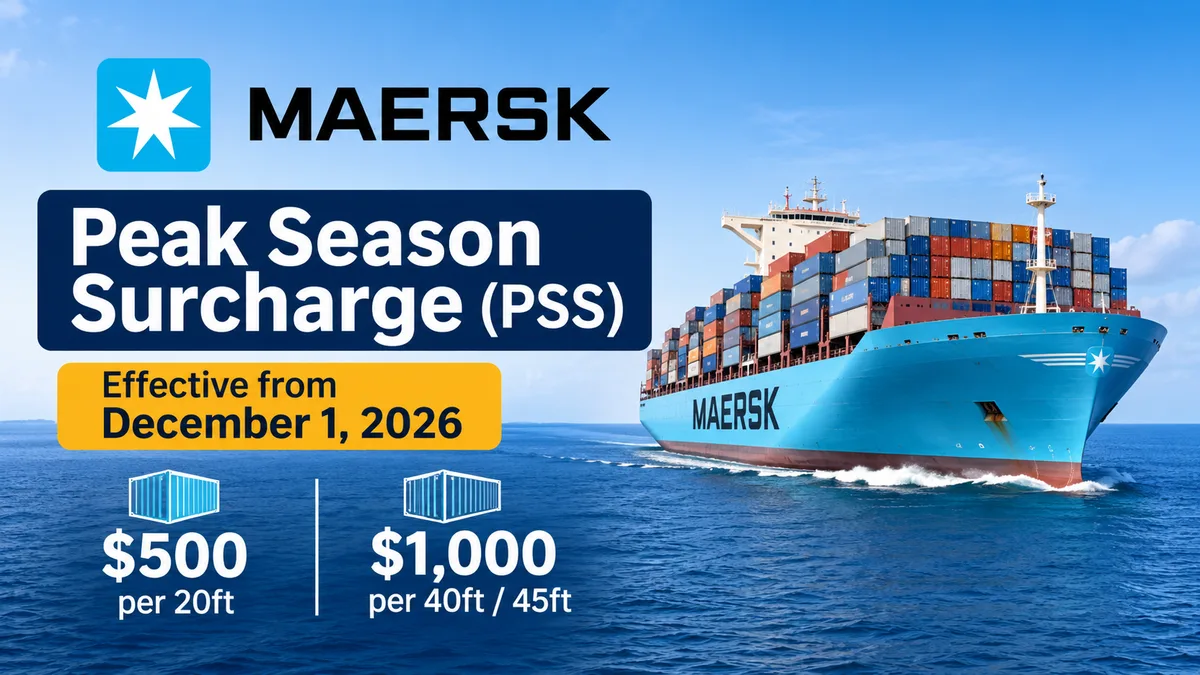
A.P. Moller-Maersk has announced the implementation of a Peak Season Surcharge (PSS) on cargo movements from Far East Asia to North Europe, effective December 1, 2026, based on the applicable Price Calculation Date (PCD).
Under the revised surcharge structure, Maersk will levy $500 per 20-foot container and $1,000 per 40-foot and 45-foot container. The surcharge applies across the Far East Asia-North Europe trade scope and covers all eligible container equipment types, including dry, high cube dry, reefer, high cube reefer, bulk, flat rack, open top, tank and twin deck containers.
For non-spot bookings, the applicable surcharge is determined based on the Price Calculation Date — the scheduled departure date of the first water leg at time of booking confirmation.
Why the Timing Is Notable: Spot Rates Are Actually Falling
This is the detail worth paying closest attention to. Maersk is introducing this surcharge at a moment when spot rates on Asia-Europe lanes have been softening and blank sailings are increasing as demand reduces following the peak season. In other words, the carrier is adding a flat, fixed-cost surcharge even as the underlying market rate environment is trending downward — a pattern industry analysts describe as carriers seeking to maintain margins during the final push of the peak season, rather than a surcharge introduced to manage genuine capacity scarcity.
For shippers, this creates a specific risk worth understanding clearly: the gap between headline spot rates and the real all-in cost (spot rate plus surcharges) can widen precisely when spot rates appear to be falling, because fixed surcharges like this one don't move with the spot market. A shipper tracking spot rate indices alone could reasonably conclude costs are easing, while their actual landed freight bill tells a different story once this surcharge applies from December 1.
Part of a Broader Pattern Across Maersk's European Lanes
This North Europe surcharge is not an isolated move. Maersk separately announced on November 4 a Peak Season Surcharge for the Far East Asia-Mediterranean (E2W) scope, effective November 23, 2026, set at $750 per 20-foot container and $1,500 per 40-foot and 45-foot container — a notably higher rate than the North Europe surcharge, and covering a wide range of Mediterranean destinations including Spain, Italy, Greece, Turkey, Egypt, Israel and others.
Looking at Maersk's surcharge history on these lanes over the past year provides useful context: the carrier removed PSS entirely on both North Europe and Mediterranean routes effective September 1, 2026, following earlier revisions through the summer tied to Cape of Good Hope vessel diversions and capacity disruptions. The reintroduction of these surcharges now, roughly three months later, suggests Maersk views current market conditions — even with softening spot rates — as still warranting the additional charge.
What This Means for Exporters, Importers and Freight Forwarders
- Calculate your true all-in cost, not just the spot rate. With fixed surcharges like this one applying regardless of spot market direction, confirm your total landed freight cost including PSS before assuming falling spot rates translate into lower overall shipping costs for December bookings.
- Mediterranean-bound cargo faces a steeper surcharge than North Europe. At $1,500 per 40ft container versus $1,000 for North Europe, shippers with flexibility between these two destination regions should factor this cost difference into routing decisions where applicable.
- Check your Price Calculation Date carefully for non-spot bookings. Since the applicable surcharge is determined by the vessel's scheduled first-leg departure date at time of booking confirmation (or last container gate-in date for FMC-regulated bookings), confirm with Maersk or your forwarder exactly which rate applies to shipments booked close to the December 1 and November 23 effective dates.
- Request quotes from secondary carriers for December Europe lanes. With this surcharge adding a meaningful fixed cost specifically on Maersk-operated Asia-Europe services, comparing total costs across carriers may reveal better options for time-flexible cargo.
- Watch for whether other major carriers follow with similar surcharges. Maersk's surcharge reintroduction after a September removal suggests the carrier sees current conditions differently than two months ago — monitor whether competitors on the same lanes introduce comparable charges in the coming weeks.
- Don't assume blank sailings mean space is scarce enough to justify the surcharge. With reports indicating demand is actually reducing post-peak season, this surcharge appears tied more to margin management than capacity constraints — a distinction worth raising directly with your account representative if negotiating rates.
Key Takeaways
- Maersk will implement a Peak Season Surcharge of $500 (20ft) / $1,000 (40ft/45ft) on Far East Asia-North Europe cargo, effective December 1, 2026.
- The surcharge applies to all eligible equipment types and is determined by Price Calculation Date for non-spot bookings.
- This arrives even as Asia-Europe spot rates have been softening and blank sailings are increasing post-peak season.
- A separate, higher Peak Season Surcharge of $750 (20ft) / $1,500 (40ft/45ft) applies to the Far East Asia-Mediterranean lane from November 23, 2026.
- Maersk had removed PSS on both these routes effective September 1, 2026, making this a reintroduction rather than a continuation.
- Shippers should calculate true all-in costs, compare carriers, and watch for similar surcharges from competing lines.


Comments
No comments yet. Be the first to share your thoughts!