
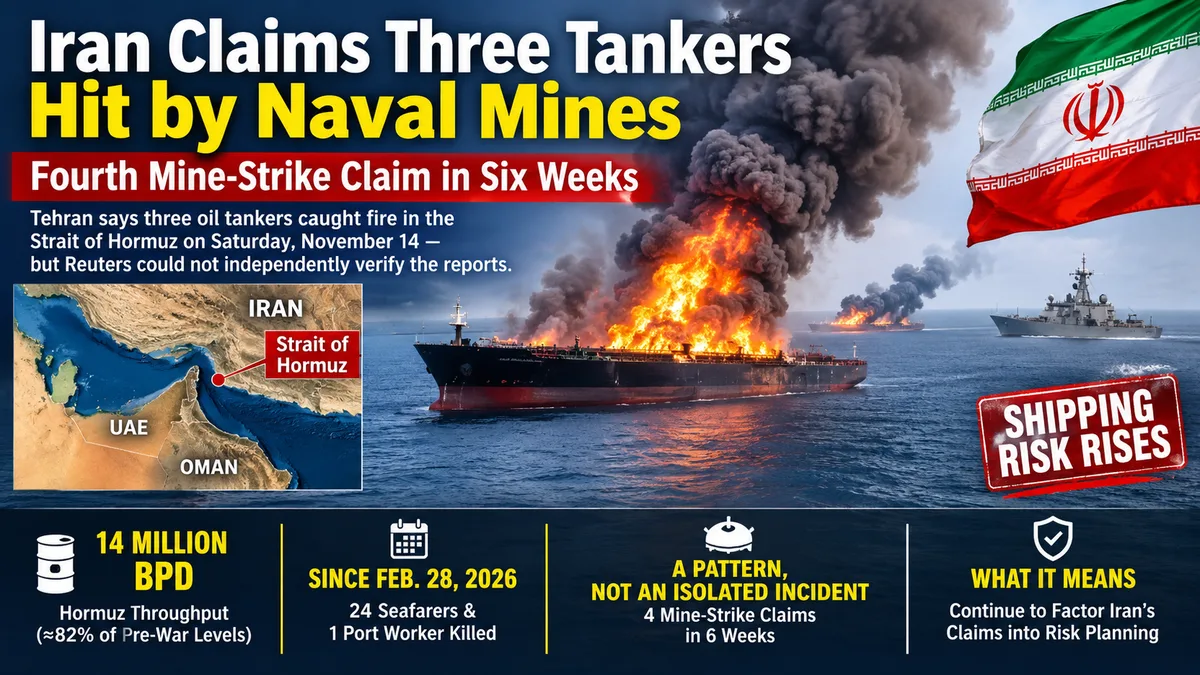

Iran's navy said Saturday that three oil tankers caught fire after hitting naval mines in the Strait of Hormuz — the fourth distinct round of mine-strike claims Tehran has made in just six weeks, and the fourth that Reuters has been unable to independently verify. The pattern is now well established enough to matter on its own, separate from the question of whether any individual claim is accurate: Iran is using repeated, unverifiable mine-strike reports as a running instrument of pressure in the Strait of Hormuz, and the shipping industry has to price that reality regardless of what actually happened to any specific vessel.
What Iran Claimed on Saturday
According to Iran's IRNA news agency, one tanker hit a naval mine in the eastern Strait of Hormuz on Saturday morning. Two more tankers struck mines later the same day. The Revolutionary Guards Navy described the evening incident in a statement: "Two violating tankers ... were attempting to slip through a prohibited route in the Strait of Hormuz when they hit naval mines, exploded, and burst into flames." Reuters stated plainly that it "could not immediately verify the reports." No vessel names, flags, cargo details, casualty figures, or imagery were provided alongside the claim.
A Pattern, Not an Isolated Incident
Saturday's claim is the latest in a sequence that has become a near-weekly feature of the conflict since early October. In mid-October, the IRGC said two tankers carrying roughly 2 million barrels of crude oil caught fire after hitting mines. On November 1, the IRGC said two more tankers exploded after striking mines, with a supertanker left "engulfed in flames" — and on that same day, the UK Maritime Trade Operations agency separately reported that a different tanker in the strait had been hit by an unknown projectile. Earlier this month, the IRGC said four oil tankers had been destroyed after striking mines on a prohibited route south of the strait, and that two other vessels had been seized outright.
Across this entire sequence, only one incident carries anything beyond Iran's own account: an October 30 attack in which maritime security sources said a small boat attached limpet mines to a tanker's hull, causing a fire in the engine room and temporarily disabling the vessel — described as the first successful use of such explosives in the waterway since the US-Iran war began in February. That one event had independent sourcing beyond Iranian state media. The rest, including Saturday's claimed triple strike, rest entirely on statements from Iran's own navy and state broadcaster.
The Awkward Timing Question
Saturday's claims land against a specific prior US statement that deserves attention precisely because of how directly it conflicts with the pattern Iran has now established. In late August, US officials confirmed that the US Navy had cleared mines from the Strait of Hormuz Traffic Separation Scheme, with underwater drones identifying more than 100 suspected mines and private contractors clearing them. At the time, Trump stated the US would destroy any Iranian vessels caught laying additional mines going forward.
If that clearing operation was as thorough as described, a fourth distinct round of mine-strike claims within six weeks raises an obvious question: are these genuinely new mines being laid after the August sweep, old mines missed by that operation, incidents that did not actually involve mines at all, or claims that did not reflect real naval strikes in the first place? None of the available reporting answers that question, and that gap is itself the most important fact for anyone trying to assess real operational risk in the strait right now, as opposed to the risk implied by Iran's messaging.
Why Iran Keeps Making These Claims Regardless of Verification
The strategic logic behind the pattern does not actually depend on each individual claim being true. Iran has imposed its own restrictions on vessels transiting the Strait of Hormuz and has targeted ships it says violated those restrictions, as part of a broader effort to assert control over the waterway and pressure the United States. A steady drumbeat of mine-strike reports — whether or not any particular one is accurate — reinforces the message that unauthorized routes through the strait carry real physical risk, which is precisely the enforcement effect Iran wants from its declared restricted-route policy, independent of whether Western outlets can confirm the underlying event.
Where the Broader Crisis Stands
The Strait of Hormuz crisis has now run for more than eight and a half months since the US-Israeli attacks on Iran began on February 28, with a cumulative toll across the conflict of 24 seafarers and one port worker killed. Despite the ongoing disruption, preliminary estimates have put combined flows through Hormuz and Gulf of Oman offshore transfers at approximately 14 million barrels per day, or roughly 82% of pre-war levels — figures that predate this latest round of claims and will need to be watched for any downward revision if shipping operators respond to Saturday's reports with reduced transits.
What This Means for Shippers, Insurers and Energy Traders
- Treat unverified Iranian mine-strike claims as a recurring input, not a one-off event. With four such claims in six weeks, the operationally relevant question for route planning is not "did this specific strike happen" but "does Iran's demonstrated pattern of claims, true or not, continue to justify avoiding its declared prohibited routes." The answer, based on the pattern alone, is yes.
- War risk insurers should factor in claim frequency, not just confirmed incidents. Underwriters that price risk purely on independently confirmed strikes may be underpricing the strait, since Iran's messaging strategy appears designed to shape shipping behavior regardless of verification status.
- Watch for any independent confirmation emerging in the days after Saturday's claim. Satellite imagery providers, P&I clubs, and vessel tracking firms occasionally surface evidence days after an Iranian claim that either supports or undercuts it — as happened with the October 30 limpet mine incident. That lag period is worth monitoring closely for this latest round.
- The August minesweeping claim's credibility is now directly in question. If the US is confident its clearing operation was effective, a clear public response addressing the gap between that claim and Iran's subsequent four rounds of strike reports would meaningfully help shippers assess real risk. Its absence so far should itself be read as a data point.
- Current 82%-of-prewar flow estimates may not hold if this pattern continues. A fourth claimed mine-strike round in six weeks raises the probability that some carriers quietly reduce transits or divert further, even without confirmed damage — watch for downward revisions to Hormuz throughput estimates over the coming two to three weeks.
Key Takeaways — November 15, 2026
- Iran's navy claimed three oil tankers caught fire after hitting naval mines in the Strait of Hormuz on Saturday, November 14 — one in the morning, two more in the evening. Reuters could not independently verify the reports.
- This is the fourth distinct round of Iranian tanker mine-strike claims since early October, following incidents reported in mid-October, on November 1, and earlier in November — none independently confirmed except a separate October 30 limpet-mine attack sourced to maritime security contacts.
- The claims come five months after the US said in August it had cleared more than 100 suspected mines from the Strait of Hormuz Traffic Separation Scheme — a gap between that claim and the current pattern that remains unaddressed publicly.
- The Strait of Hormuz crisis has run since February 28, 2026, with a cumulative toll of 24 seafarers and one port worker killed across the full eight-and-a-half-month conflict.
- Preliminary flow estimates place current Hormuz and Gulf of Oman throughput at approximately 14 million barrels per day, or roughly 82% of pre-war levels — figures that predate Saturday's claims.
- Shippers and insurers should treat the recurring claim pattern itself, independent of verification, as an operationally relevant input into routing and pricing decisions around Iran's declared prohibited routes.



Comments
No comments yet. Be the first to share your thoughts!