
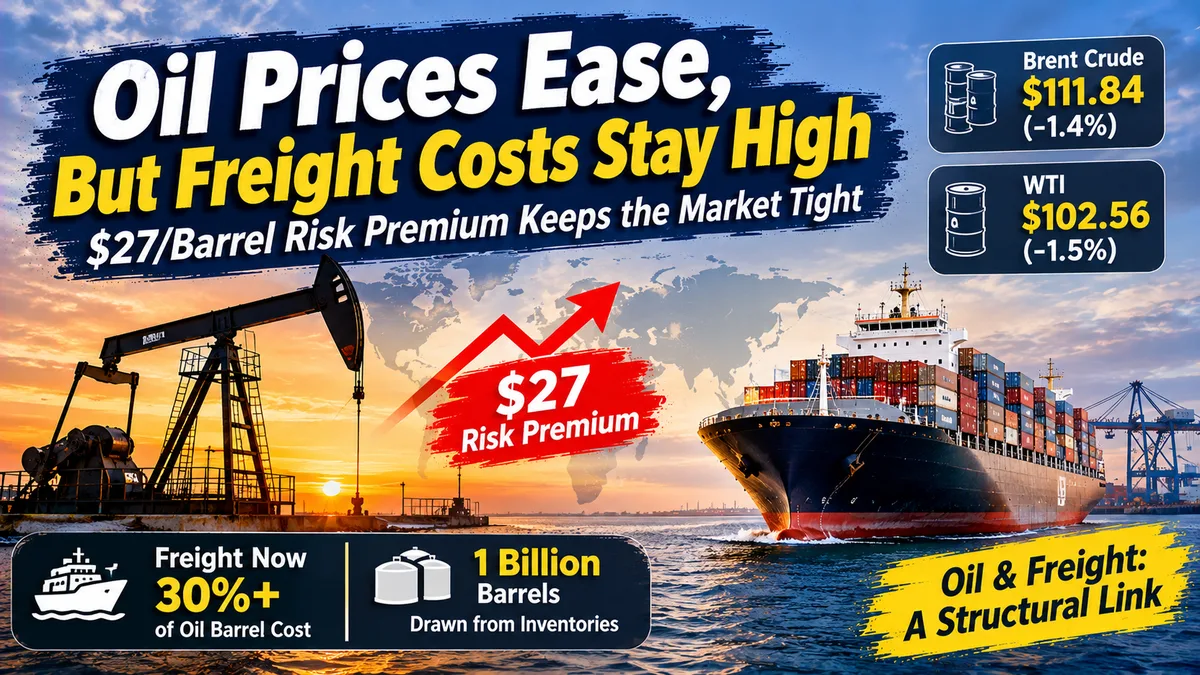

Global oil prices eased modestly on Monday, November 2, 2026, as markets responded to reports of diplomatic talks between Iran and Qatar aimed at regional de-escalation. Brent crude fell approximately 1.4% to $111.84 per barrel, while West Texas Intermediate (WTI) dropped 1.5% to $102.56 per barrel. For logistics and freight professionals, however, the day's price movement tells only part of the story — and the more important one lies beneath the surface.
Why Prices Are Still This High
Historically, restored shipping lanes and increased pipeline capacity in key oil-producing regions would push prices down. That relationship has broken down in 2026. Analysts at Goldman Sachs estimate that a $27-per-barrel geopolitical risk premium is currently embedded in the price of crude — a floor created by the persistent fear of sudden supply disruptions as the Strait of Hormuz crisis enters its ninth month.
Even as Gulf producers have adapted their logistics with new shuttle tanker networks and expanded pipeline bypasses, the underlying uncertainty around supply security — compounded by the upcoming US midterm election cycle and its implications for Iran policy — is keeping that premium firmly in place. Without a verified and durable resolution to the Hormuz crisis, the $27 risk premium is unlikely to narrow materially before year-end.
Freight Has Become a Structural Cost — Not a Variable
The most significant long-term implication of today's market conditions is not the headline oil price. It is what has happened to the cost of delivering oil.
Logistics and freight costs now account for more than 30% of the total cost of a single barrel of oil — compared to less than 5% before the current series of disruptions began in February 2026. This is a structural transformation, not a temporary spike. Even if supply volumes recover fully, the cost of moving that supply through rerouted, insured, and war-risk-priced shipping lanes remains far higher than pre-crisis baselines.
For freight forwarders, shippers, and energy buyers, this means the old model of benchmarking logistics as a minor line item in energy procurement is obsolete. Freight is now a primary cost driver — and one that does not automatically correct when geopolitical tensions ease.
A Billion Barrels Gone — And the Buffer Is Not Coming Back Quickly
Compounding the price pressure is the scale of inventory depletion since the crisis began. Nearly one billion barrels have been drawn from global stockpiles since February 2026 to meet demand during the disruption. This erosion has eliminated the safety buffers that historically helped absorb supply shocks without major price spikes.
With inventories at their thinnest levels in years, the market is now hypersensitive to even minor interruptions. The persistent backwardation in the oil futures curve — where current prices are higher than future delivery prices — is continuing to incentivize further destocking, which risks leaving the market increasingly exposed to any renewed escalation in the Gulf.
What This Means for Logistics and Supply Chain
For the freight and logistics industry, today's oil market dynamics translate into several concrete operational realities:
- Fuel surcharges remain elevated — with bunker fuel prices tied to crude, carriers are unlikely to reduce fuel surcharges materially until both the oil price and freight cost components normalize simultaneously.
- War risk insurance premiums stay high — the $27 risk premium signals that underwriters and markets still see significant probability of renewed disruption, keeping Gulf-route premiums at 3–5% of vessel value.
- Energy cargo logistics costs are repriced permanently — at 30%+ of barrel cost, freight is now a strategic variable that energy companies must factor into supply chain planning at the same level as production costs.
- Any ceasefire must be durable to move markets — today's Iran-Qatar diplomatic talks caused only a 1.4% price dip. The market is no longer moving on diplomatic signals alone; it needs verified operational changes on the ground.
The Road Ahead
Market observers will be watching two variables most closely in the coming weeks: the durability of any regional ceasefire agreements, and whether the current supply chain rerouting arrangements — shuttle tankers, overland bypasses, and expanded pipeline flows — prove sufficient to narrow the risk premium without a full Hormuz reopening.
Until those conditions are met, the energy market's price floor is real, structural, and directly connected to the logistics costs that every freight professional is managing daily. In 2026, oil and freight are no longer separate conversations.
🔑 Key Takeaways — November 2, 2026
- Brent crude at $111.84, WTI at $102.56 — modest 1.4–1.5% dip today on Iran-Qatar diplomatic talks, but no major correction in sight.
- $27/barrel geopolitical risk premium — Goldman Sachs estimate. This is the floor built into every barrel traded today and it is not going away without a verified Hormuz resolution.
- Freight now 30%+ of oil barrel cost — vs less than 5% pre-crisis. A structural transformation, not a temporary spike.
- 1 billion barrels drawn from global inventories since February 2026 — safety buffers are gone, making the market hypersensitive to any new disruption.
- Futures backwardation continues — incentivizing further destocking, which deepens vulnerability to supply shocks.
- Fuel surcharges and war risk premiums remain elevated — shippers and forwarders should not expect meaningful relief on Gulf-route costs before Q1 2027 at the earliest.
- Oil and freight are now one conversation — logistics professionals must track crude markets as closely as cargo markets in the current environment.
Source date: November 2, 2026 | Published: November 2, 2026



Comments
No comments yet. Be the first to share your thoughts!