

What Happened
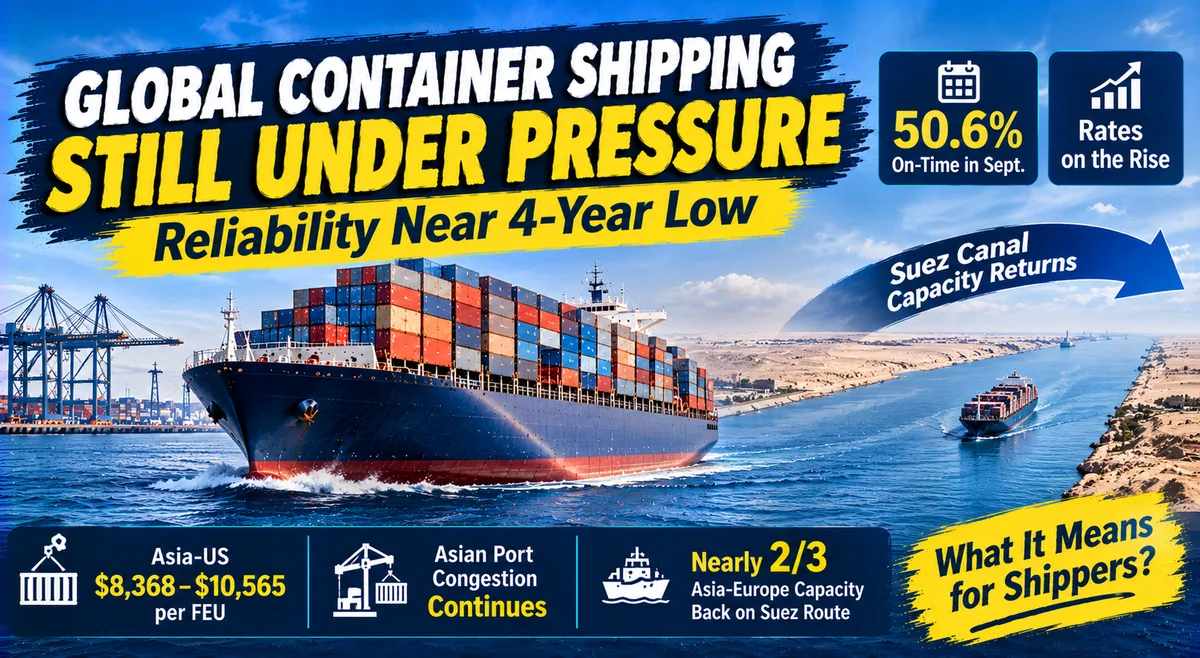
Global container shipping remains under severe pressure, with only 50.6% of vessels arriving on schedule in September, while nearly two-thirds of Asia-Europe container capacity has returned to Red Sea-Suez routing — a combination signalling a major shift in international shipping operations and freight economics.
The latest Sea-Intelligence report, released October 28, showed reliability recovering only marginally from 49.9% in August — the lowest reading since September 2022 — and remaining far below May's 64.5%. Late-arriving vessels averaged 6.65 days behind schedule, slightly improved from 6.81 days in August. None of the world's 13 largest carriers recorded a year-on-year reliability improvement.
Where the Disruption Is Concentrated
Asian port congestion remains the principal source of disruption. Regional reliability collapsed to 32.3% in August, with China's performance falling to 23.9%. Shanghai and Ningbo recorded particularly severe declines, with just 12.2% and 16.9% of vessels, respectively, arriving on time. Although congestion has begun easing at major Chinese ports, backlogs and vessel bunching continue to disrupt shipping schedules — a pattern consistent with what we've tracked in our own coverage of Asian port congestion potentially persisting into 2027.
Rates Are Rising Despite Shorter Routes Returning
Freightos data released October 28 showed Asia-US East Coast rates climbing 9% to $10,565 per 40-foot container, while West Coast rates increased 3% to $8,368. Asia-Mediterranean rates rose 8% to $4,252, and Asia-Northern Europe rates gained 3% to $3,551. Separately, Drewry's global World Container Index reached $4,585 on October 22 — its highest level in 15 weeks, a figure we independently noted in our own coverage of carrier FAK hikes earlier this month.
The increases reflect continuing congestion, cancelled sailings and carrier pricing strategies, even amid softer demand on some routes. Freight forwarders are already reporting discounts on the ground, raising real doubts over whether further planned November rate increases can actually be sustained.
The Structural Shift: Suez Canal Return Accelerates
The most consequential structural development is the accelerating return to the Suez Canal. Alphaliner estimates, cited by Freightos on October 28, indicate that nearly two-thirds of Asia-Europe container capacity has resumed Red Sea-Suez routing. Maersk and Hapag-Lloyd are progressively restoring services previously diverted around Africa's Cape of Good Hope.
For Egypt, the recovery is already measurable in hard numbers. According to the Suez Canal Authority, Maersk's canal transits increased from 146 to 276 vessels during January-September 2026, while their combined net tonnage climbed from 7 million to 23.3 million tonnes over the same period.
Further network changes are scheduled for November, introducing new calls at Port Said and Damietta, while a direct Northern Europe-Jeddah connection is planned for December. Maersk aims to restore its full Suez network by March 2027, subject to regional security and operational conditions holding.
Two Opposing Forces Now in Play
The shift carries genuinely opposing economic consequences for the industry. Shorter Suez voyages reduce fuel consumption, accelerate cargo deliveries, and release vessel capacity that had previously been absorbed by longer African diversions. Over time, this effective capacity increase could pressure freight rates and shipping company profits downward — even as current congestion and capacity restrictions continue supporting higher prices today.
In other words, the market is currently caught between two forces pulling in opposite directions: congestion-driven scarcity pushing rates up, and Suez-driven capacity return pulling them back down. Which force wins out over the coming months will likely determine whether the November rate increases carriers have planned actually stick.
Who Faces What Risk
For manufacturers and consumers, the immediate challenge remains unpredictable deliveries and elevated transport costs — reliability near a four-year low means shipment timing itself has become harder to plan around, regardless of what headline rates show. For shipping companies, the next risk could be surplus capacity as disruptions ease and more Suez-routed vessels re-enter active service. For Egypt specifically, the opportunity is to convert returning Suez traffic into lasting gains in canal revenues, port activity, and broader international logistics positioning.
What This Means for Shippers and Freight Forwarders
- Do not assume lower reliability means lower cost, or vice versa — track both separately. With rates still rising even as on-time performance sits near a four-year low, shippers should budget for both elevated costs and schedule unpredictability simultaneously, rather than assuming one problem implies relief on the other.
- Treat November rate increases with scepticism until confirmed. With forwarders already reporting discounts on current rates, and softening demand on some routes, carriers' planned November increases may not fully materialise — hold off locking in long-term contracts at the headline rate if you have flexibility to wait.
- Watch Shanghai and Ningbo on-time performance closely if you source from China. With these two ports recording among the worst reliability figures globally (12.2% and 16.9% on-time respectively), shippers sourcing through these specific gateways should build significant schedule buffer into any time-sensitive bookings.
- Monitor Maersk and Hapag-Lloyd's Suez network restoration timeline. With new Port Said and Damietta calls coming in November, and a direct Northern Europe-Jeddah connection in December, shippers on these specific routes should check whether new service options become available that better fit their cargo flows.
- Prepare for a possible rate reversal if Suez capacity return accelerates further. If the shift toward Suez continues at its current pace, the resulting capacity surplus could eventually push rates down meaningfully — shippers with contract renewals coming up in Q1 2027 may want to avoid locking in multi-year rates at today's elevated levels.
Key Takeaways
- Global container shipping reliability stood at just 50.6% in September, per Sea-Intelligence data released October 28 — near its lowest level since September 2022.
- Late vessels averaged 6.65 days behind schedule; none of the world's 13 largest carriers improved year-on-year.
- Asian port congestion remains the principal disruption source, with China's regional reliability at 23.9% and Shanghai/Ningbo at just 12.2%/16.9% on-time respectively.
- Freight rates rose across major lanes in late October: Asia-US East Coast up 9% to $10,565/FEU, West Coast up 3% to $8,368/FEU, Asia-Mediterranean up 8% to $4,252/FEU, Asia-N. Europe up 3% to $3,551/FEU.
- Drewry's World Container Index hit $4,585 on October 22 — a 15-week high.
- Nearly two-thirds of Asia-Europe container capacity has returned to Suez Canal routing, per Alphaliner estimates.
- Maersk's Suez transits rose from 146 to 276 vessels (Jan-Sept 2026), with tonnage up from 7 million to 23.3 million tonnes.
- New Port Said and Damietta calls launch in November; a direct Northern Europe-Jeddah service is planned for December; Maersk targets full Suez network restoration by March 2027.
- Forwarders are already discounting current rates, raising doubts over whether planned November increases will hold.


Comments
No comments yet. Be the first to share your thoughts!