
What's Changing
Emirates Shipping Line (ESL) is reorganising its network connecting India with the Red Sea into two separate, dedicated services, according to DynaLiners. The restructuring splits what had previously been a combined rotation into a focused point-to-point shuttle and a broader multi-port service.
The New South Red Sea Service (SRS)
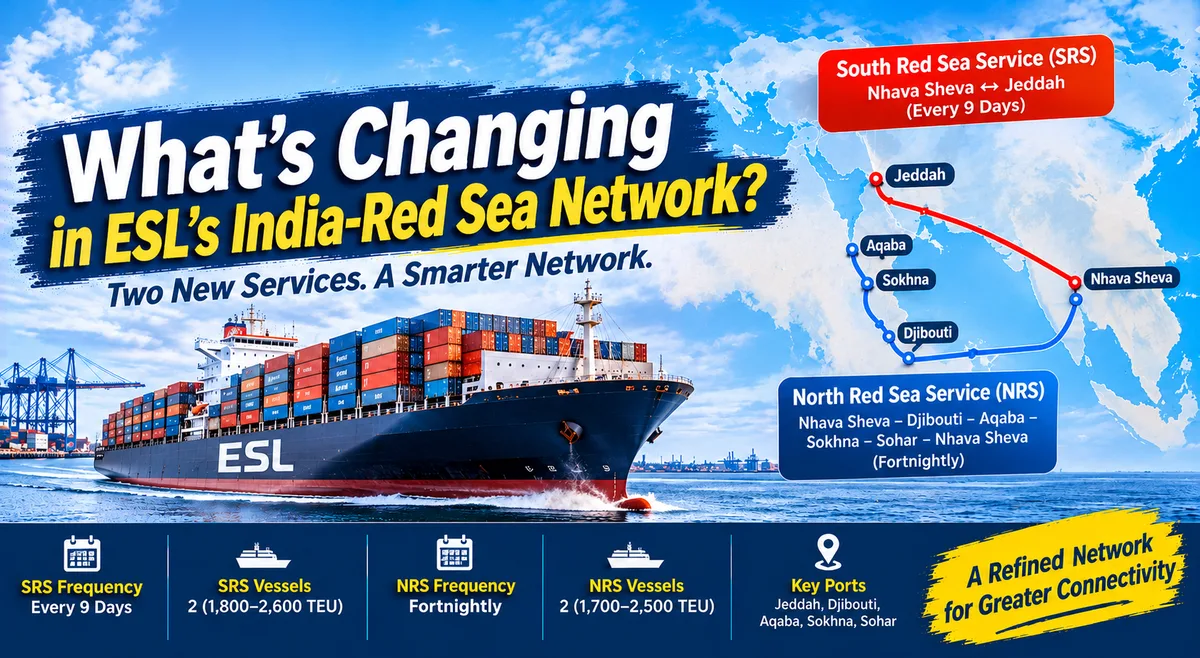
The South Red Sea Service will become a dedicated shuttle operating exclusively between Nhava Sheva and Jeddah. Two vessels, ranging from 1,800 to 2,600 TEU, will run the route every nine days.
The rotation: Nhava Sheva – Jeddah – Nhava Sheva.
Stripping this service down to a single-pair shuttle is a notable design choice — rather than combining the Jeddah call with other regional stops, ESL is offering a faster, more predictable, point-to-point connection on what is likely one of its higher-volume city pairs on this trade.
The New North Red Sea Service (NRS)
The North Red Sea Service will absorb the remaining regional port calls previously bundled into ESL's combined rotation. Two vessels, ranging from 1,700 to 2,500 TEU, will provide sailings at approximately fortnightly intervals.
The rotation: Nhava Sheva – Djibouti – Aqaba – Sokhna – Sohar – Nhava Sheva.
This service retains the broader geographic spread of ESL's original offering, covering Djibouti on the Horn of Africa, Jordan's Aqaba, Egypt's Sokhna (at the northern end of the Red Sea near the Suez Canal), and Oman's Sohar — a wider net of secondary and strategically positioned ports, but at roughly half the frequency of the dedicated Jeddah shuttle.
How ESL's India-Red Sea Network Has Evolved
This restructuring is the latest step in a network ESL has been actively building out since early 2024. The carrier first announced its India Red Sea Connector (IRC) in March 2024, with its first voyage on March 2 that year. That original rotation — Mundra, Nhava Sheva, Jebel Ali, Jeddah, Sokhna, Jebel Ali, Mundra — combined Indian, Gulf and Red Sea calls within a single service, using Jebel Ali as a transshipment hub for onward connections to additional Asian markets.
Since then, ESL has layered on additional regional services, including a China Red Sea Connector (CRC), a Gulf Red Sea Connector (GRC) adding Aqaba, Jordan — which the carrier highlighted as the second-busiest container port in the Red Sea — and, in June 2026, a weekly China Subcontinent Express 2 (CSX2) service positioning Mundra as a Red Sea transshipment hub for China-India trade. Separately, Saudi Arabia's port authority Mawani confirmed an ESL-operated service connecting Jeddah with Mundra and Djibouti, with capacity of up to 2,144 TEU.
Taken together, this latest SRS/NRS split represents ESL consolidating and refining a network that had grown somewhat organically through a series of individual service launches over the past two and a half years, into a cleaner structure built around one high-frequency shuttle and one broader-coverage service.
Why Now? The Operating Environment Context
Maritime Gateway's reporting noted that ESL's regional network has faced operational adjustments during 2026, with earlier advisories pointing to additional precautionary and operational measures in the Middle East that had increased costs — a reference to the broader security and routing disruptions around the Red Sea and Strait of Hormuz we've covered extensively throughout the year. It is worth being precise here: this latest network update does not explicitly state that those cost and security pressures are the specific reason for this restructuring, so readers should treat the connection as useful background context rather than a confirmed cause.
What This Means for Shippers
- Faster, more frequent options now exist specifically for Nhava Sheva-Jeddah cargo. If your shipments move primarily between these two ports, the dedicated nine-day shuttle offers more predictable scheduling than the previous combined, multi-stop rotation.
- Djibouti, Aqaba, Sokhna and Sohar shippers should expect roughly fortnightly service. With the North Red Sea Service now covering a broader set of ports at a lower frequency than the dedicated Jeddah shuttle, cargo bound for these destinations should plan around approximately two-week sailing intervals rather than the previous combined schedule.
- Confirm which service now covers your specific port pair. With ESL's network having expanded significantly since 2024 across multiple named services (IRC, CRC, GRC, CSX2, and now SRS/NRS), shippers and forwarders should verify directly with ESL or their booking agent which specific service and rotation now applies to their cargo, rather than assuming continuity with an older named service.
- Watch for Jebel Ali transshipment connectivity details. ESL's earlier India Red Sea Connector relied on Jebel Ali as a hub for onward Asian connections; confirm whether this restructuring preserves similar transshipment options for cargo needing to reach markets beyond the direct SRS/NRS port calls.
- Factor in continued Red Sea operational uncertainty. Given the broader context of elevated costs and precautionary measures affecting Middle East shipping this year, build some schedule flexibility into bookings on either service, even with the more structured rotation now in place.
Key Takeaways
- Emirates Shipping Line is splitting its India-Red Sea network into two dedicated services, per DynaLiners.
- South Red Sea Service (SRS): dedicated Nhava Sheva-Jeddah shuttle, two vessels (1,800-2,600 TEU), every nine days.
- North Red Sea Service (NRS): Nhava Sheva-Djibouti-Aqaba-Sokhna-Sohar-Nhava Sheva, two vessels (1,700-2,500 TEU), roughly fortnightly.
- This replaces ESL's original combined India Red Sea Connector (IRC) rotation launched in March 2024.
- ESL has built out several related services since 2024, including CRC, GRC (adding Aqaba), and CSX2 (launched June 2026, positioning Mundra as a Red Sea transshipment hub).
- The restructuring comes amid a year of operational adjustments and elevated Middle East shipping costs, though the announcement itself does not confirm this as the specific cause.
- Shippers should confirm which specific ESL service now covers their port pair, given the carrier's expanded and evolving Red Sea network.


Comments
No comments yet. Be the first to share your thoughts!