
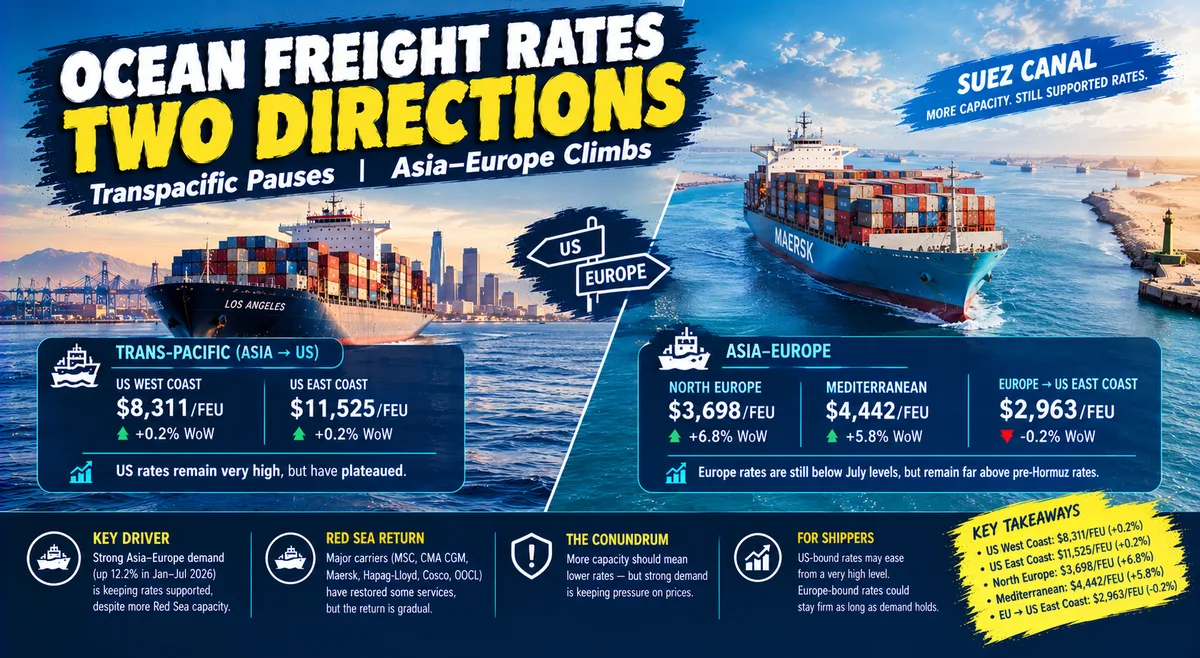

Ocean freight rates are moving in two different directions. Trans-Pacific container spot rates were largely unchanged last week, a sign that the US-bound market has peaked, according to analysts at Xeneta. On the other hand, Asia-Europe rates climbed sharply, even as more container ships return to the Suez Canal and Red Sea route.
Asia-US rates hit a plateau
Average spot rates from Asia to the US West Coast edged up just 0.2% in the week ending October 23, reaching $8,311 per forty-foot container (FEU). Rates to the US East Coast also rose 0.2%, reaching $11,525 per FEU. Compared with July 1, West Coast rates are up 18.9% and East Coast rates are up 31.7%. Compared with February 28, the last benchmark before the Strait of Hormuz crisis began, they are up 342% and 335% respectively.
"This confirms the U.S. trades have peaked and we expect them to soften through the remainder of 2026," said Peter Sand, Xeneta's chief analyst. In simple words, rates are still extremely high, but they have stopped climbing, and the next move is more likely to be down than up.
Europe moves the other way
In contrast to the flat trans-Pacific market, Asia-North Europe spot rates rose 6.8% during the week to $3,698 per FEU, while rates to the Mediterranean climbed 5.8% to $4,442 per FEU. These gains reversed a steady decline that had been running since July.
Even with this rebound, North Europe rates are still 33.2% below their July 1 level and Mediterranean rates are down 36.7%. Compared with February 28, however, they remain up 67% into North Europe and 33% into the Mediterranean. On the Transatlantic lane, rates from North Europe to the US East Coast slipped 0.2% to $2,963 per FEU, still 101% above the pre-Hormuz crisis level.
Why this is a "conundrum"
When ships return to the shorter Suez Canal route, they spend less time at sea, which frees up capacity and normally pushes rates lower. That is not what is happening right now. "This is a conundrum because the release of capacity into the global fleet should ease pressure on rates, but we are seeing the opposite," Sand said.
Strong demand appears to be the answer. Volumes shipped from Asia to Europe increased 12.2% in the first seven months of 2026. "Disruption such as Middle East conflict brings volatility and sudden shocks, but demand is a powerful upward force for rates," Sand added. "If demand is not there, then rates will collapse, but it has been strong enough on the European fronthauls to prevent this."
Carriers return to the Red Sea, but only partly
Major carriers are making a substantial but partial return to the Red Sea and Suez Canal. MSC, CMA CGM, Maersk and Hapag-Lloyd, and Cosco and OOCL have restored some services, while ONE, HMM, and Yang Ming have announced their own returns. The return is gradual, and carriers are still managing capacity carefully, which helps keep rates supported on the Europe trade.
What it means for shippers
For US importers, the news is mixed but leaning positive. Rates are very high compared with early 2026, but the plateau suggests relief may come in the weeks ahead. Waiting too long to book could still be risky if any new disruption appears. For shippers on Asia-Europe lanes, the recent rebound is a reminder that a Red Sea return alone will not guarantee cheaper freight, since demand is a bigger driver than many expected.
Key takeaways
- Asia-US West Coast rates reached $8,311/FEU and East Coast rates reached $11,525/FEU, both up just 0.2% week-on-week.
- Xeneta says the US trades have peaked and expects them to soften through the rest of 2026.
- Asia-North Europe rates rose 6.8% to $3,698/FEU, and Mediterranean rates rose 5.8% to $4,442/FEU.
- Strong Asia-Europe demand, up 12.2% in the first seven months of 2026, is keeping rates supported despite more Red Sea capacity.
- Europe rates are still well below their July levels, but remain far above pre-Hormuz crisis rates.
For freight forwarders and shippers, the main message is to plan bookings carefully: US-bound rates look set to ease from a very high level, while Europe-bound rates may stay firm as long as demand holds up.



Comments
No comments yet. Be the first to share your thoughts!