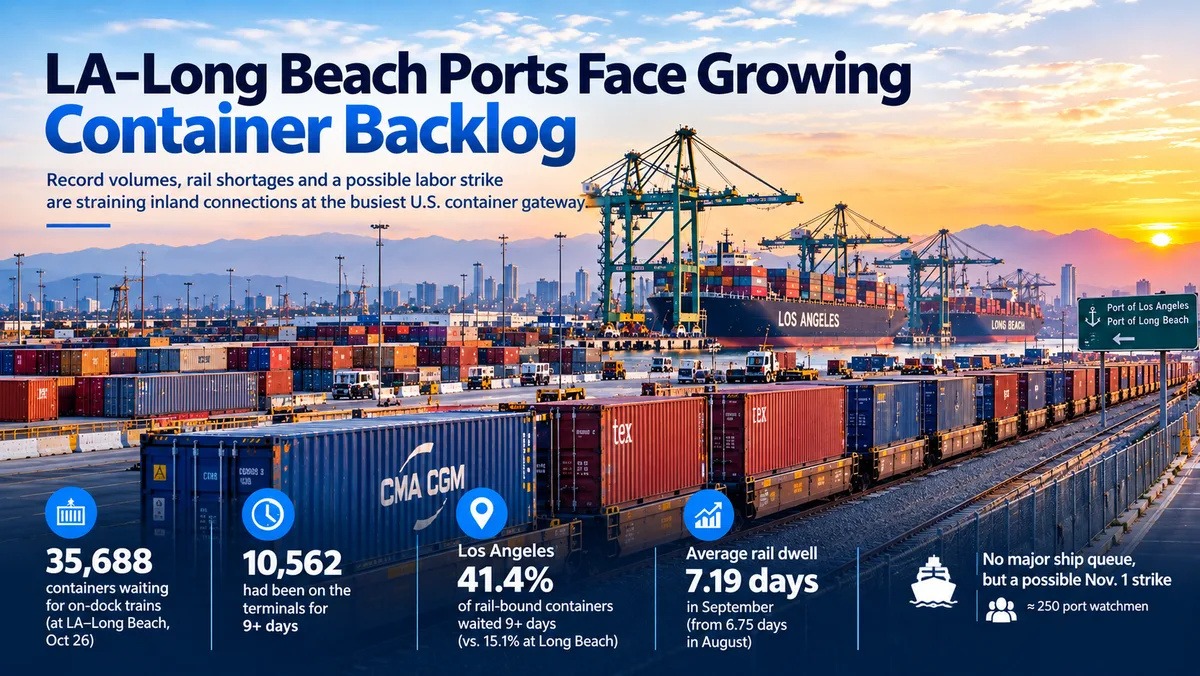

A growing queue of import containers is building up at the San Pedro Bay ports, the busiest container gateway in the United States. According to figures compiled by The Dwell from the ports' daily rail reports, 35,688 containers were waiting for on-dock rail service at the Ports of Los Angeles and Long Beach on October 26. Of those, 10,562 had been on the terminals for at least nine days.
The numbers highlight a bottleneck that is less about ships and more about what happens after cargo is unloaded. Getting containers off the dock and onto inland trains is where the pressure is building, just as peak season shipments for the holiday period are moving through the system.
Los Angeles is hit harder than Long Beach
The backlog is not evenly spread across the two ports. At the Port of Los Angeles, 8,133 of the 19,626 containers awaiting trains had waited nine days or longer, or about 41.4%. At the Port of Long Beach, 2,429 of 16,062 rail-bound containers had reached that threshold, or about 15.1%. In other words, Los Angeles accounts for more than half of the total rail-bound inventory and a much larger share of the longest waits.
It is important to read these figures carefully. The counts measure individual containers rather than TEUs, the standard unit of port cargo volume. They also show a single day's inventory, not an average waiting time, and they do not mean every box in the queue is overdue. Some containers will move out within hours, while others may be held because of equipment shortages, customer pickup timing, or train scheduling.
Record volumes are driving the delays
Both ports handled record monthly volumes in September, with Los Angeles processing about 1.04 million TEUs and Long Beach handling 997,177 TEUs. The Pacific Merchant Shipping Association (PMSA) links the longer dwell times to an extended peak shipping season and heavy cargo flows. Dwell time, the number of days a container sits on a terminal before leaving, is a key measure of how smoothly cargo is moving through a port.
Average rail dwell across the port complex rose to 7.19 days in September from 6.75 days in August. Average dwell for containers leaving by local truck also increased, from 2.95 days to 3.18 days, though truck-bound boxes continue to move relatively normally compared with rail-bound ones. That gap shows the strain is concentrated on the rail side rather than across the whole port.
The surge also follows a busy stretch at the nearby port of Long Beach, where its CEO warned earlier this fall that record volumes were being driven largely by disruption-related cargo diversions and frontloading rather than steady underlying demand. Importers shifting more cargo to West Coast gateways to hedge against Panama Canal draft restrictions and tariff uncertainty has added to the load on terminals and rail links.
Railcar shortages add to the squeeze
C.H. Robinson flagged Southern California intermodal railcar shortages as a constraint in its October market update, saying limited equipment availability is extending import dwell and slowing inland movement. Repositioning empty containers is also complicating equipment flows, since terminals and rail yards must handle empties heading back out as well as loaded imports moving in. The ports are served by two Class I railroads, BNSF and Union Pacific.
This is not the first time the San Pedro Bay ports have seen rail dwell climb during a busy season. In October 2024, CNBC reported that rail delays at Los Angeles and Long Beach had reached a two-year high after record August and September volumes, with the average rail dwell for the port complex having previously been about four days before the surge. Today's average of more than seven days shows how much longer boxes are now waiting compared with that earlier baseline.
No matching ship queue, but a labor risk looms
Unlike the congestion of earlier years, the buildup on the docks has not been matched by a large line of ships offshore. The Dwell's congestion tracker showed just one vessel waiting for a berth during the week of October 26. That suggests the terminals are still able to discharge ships, even as the inland rail connection struggles to keep pace.
However, the situation could worsen. The Pacific Maritime Association warned on October 27 that a potential strike on November 1 involving roughly 250 port watchmen could affect eight container terminals. Members of ILWU Local 26 have voted to approve a walkout as soon as Sunday. According to the employer association, these terminals handle about 85% of Long Beach cargo and 33% of Los Angeles cargo, which explains why even a small group of workers could have an outsized impact on operations.
Why it matters for importers and forwarders
For importers shipping inland through Southern California, the key risk is not a lack of vessel space but delays getting boxes off the terminal and onto trains. Longer dwell times can mean missed delivery windows, extra storage and demurrage charges, and tighter inventory right as retailers stock up for the holiday season. Cargo bound for the Midwest and East Coast by rail is most exposed, while shipments moving by local truck are seeing far less disruption.
Freight forwarders and customs brokers should also keep an eye on how terminal fees and free-time policies are applied while the backlog persists, since extended dwell can translate into additional costs for cargo owners even when the delay is outside their control.
What shippers can do now
- Confirm rail ramp availability and cut-off times with your carrier or forwarder before booking inland moves.
- Build extra transit days into inland delivery plans for rail-bound cargo from Southern California.
- Ask about free time, storage, and demurrage terms, and track container pickup deadlines closely.
- Consider trucking time-sensitive containers locally, where dwell times are much shorter than for rail.
- Watch for updates on the possible November 1 labor action and have contingency plans ready.
Key takeaways
- 35,688 import containers were waiting for on-dock trains at LA–Long Beach on October 26, with 10,562 waiting nine days or longer.
- Los Angeles is more affected, with 41.4% of rail-bound containers waiting nine days or more, versus 15.1% at Long Beach.
- Average rail dwell rose to 7.19 days in September from 6.75 days in August.
- Record September volumes and Southern California intermodal railcar shortages are the main drivers.
- There is no large offshore ship queue, so the pressure is concentrated on the rail side.
- A possible November 1 strike by about 250 port watchmen could affect eight container terminals.
For importers and freight forwarders, the practical advice is to confirm rail availability early, build extra days into inland delivery plans, and watch for demurrage and storage charges while the backlog persists. With peak season still underway and a possible labor disruption on the horizon, the next few weeks will show whether this backlog is a temporary spike or the start of a longer slowdown.


Comments
No comments yet. Be the first to share your thoughts!