

What's Happening
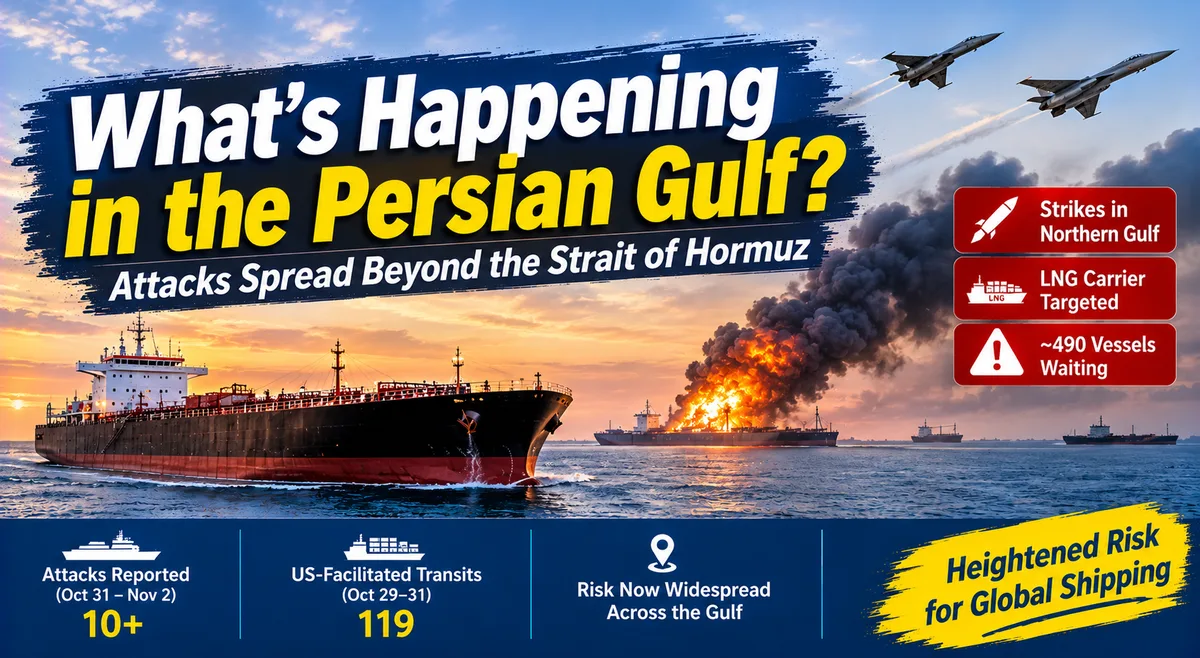
A new wave of attacks on commercial vessels over recent days has extended the security threat facing Gulf shipping beyond the Strait of Hormuz itself, with tankers and at least one LNG carrier struck in wider Gulf waters, including areas off Saudi Arabia that had previously seen comparatively little exposure to this kind of incident.
A tanker was struck by two unidentified projectiles in the Persian Gulf late Sunday, November 1, adding to a series of incidents that have damaged vessels, triggered onboard fires, and forced crew evacuations in recent weeks. According to the Joint Maritime Information Center (JMIC), 119 US-facilitated transits were recorded between October 29 and 31, while approximately 490 vessels were waiting outside the Strait of Hormuz as of November 1.
An LNG Carrier Was Also Targeted
Among the most notable recent incidents, Qatar's state-owned LNG shipping company Nakilat confirmed that its LNG carrier Al Mayeda was struck by unidentified objects while transiting the Gulf on October 30. LNG carriers transport highly flammable cargo and are generally considered higher-consequence targets than standard tankers, given the potential severity if a strike were to breach containment — though Nakilat's confirmation did not indicate the vessel suffered a major breach.
The Geographic Spread: Attacks Reaching the Northern Gulf
Separately, a tanker was struck by two projectiles off the Saudi coast in the northern Gulf — waters near key Saudi and Kuwaiti export routes that are geographically distant from the Strait of Hormuz itself. Maritime security reporting indicated this incident was part of a cluster: at least six incidents were recorded on October 31, three on November 1, and one more on November 2, spread across the Strait of Hormuz, the wider Gulf, and the Gulf of Oman — bringing the total to at least 10 shipping incidents across the region since October 31 alone.
This northern Gulf strike is significant for a specific reason: it suggests the risk to shipping now extends well beyond the strait itself, into areas shippers and insurers had previously treated as comparatively lower-risk compared to the narrow Hormuz chokepoint.
A Reported Diplomatic Timeline — Treated With Appropriate Caution
Amid these attacks, some reporting has referenced mediators discussing a possible reopening of the Strait of Hormuz within a matter of days. Given how frequently diplomatic timelines around this conflict have shifted over the course of the year, and that the attacks have, if anything, intensified rather than eased in the days immediately preceding these reports, any such timeline should be treated as preliminary and unconfirmed rather than a reliable basis for operational planning.
Why the Expanding Footprint Matters
For most of this conflict, the Strait of Hormuz itself — a narrow, 21-mile-wide chokepoint — has been the primary focus of both attacks and the shipping industry's risk mitigation efforts. A pattern of incidents spreading into the broader Persian Gulf, including areas off Saudi Arabia and Kuwait, changes the calculation in a meaningful way: it is no longer sufficient to treat the strait transit itself as the primary danger zone while regarding adjacent Gulf waters as relatively safe staging or waiting areas.
This also connects to risks we've tracked in earlier coverage of the region's ship-to-ship transfer anchorages — hubs like Khor Fakkan, Fujairah, and Sohar that support extensive crude oil transfers specifically to avoid direct Hormuz transits. If attacks continue spreading geographically, the safety margin these alternative staging areas have offered shippers may narrow.
What This Means for Shippers, Charterers, and Insurers
- Do not treat Gulf waters outside the strait as automatically lower-risk. With confirmed strikes now reaching the northern Gulf near Saudi and Kuwaiti export routes, risk assessments that focus primarily on the Hormuz transit itself should be revisited to account for this wider geographic exposure.
- LNG and gas carriers should not assume lower targeting risk than oil tankers. With Qatar's Al Mayeda struck this week, companies operating or chartering LNG vessels in the region should treat their exposure as comparable to, not lower than, conventional crude tankers.
- Monitor vessel queue data as a leading indicator of conditions. With roughly 490 vessels reported waiting outside the strait as of November 1, this backlog figure offers a useful, relatively objective gauge of how severely current conditions are constraining normal transit patterns — worth tracking alongside attack reports themselves.
- Treat reported diplomatic timelines with real skepticism. Given this conflict's history of shifting ceasefire and reopening timelines that have not held, any reports of an imminent resolution should not be used as the basis for scheduling decisions until formally confirmed by relevant authorities.
- Reassess risk around ship-to-ship transfer anchorages. If your operations rely on Khor Fakkan, Fujairah, Sohar, or similar Gulf of Oman staging points specifically to avoid direct Hormuz transit, monitor whether the geographic spread of attacks begins to affect these locations as well.
- Expect continued upward pressure on war risk insurance across a wider area. As incidents spread beyond the strait itself, insurers are likely to reassess geographic risk zones more broadly, potentially affecting premiums for Gulf transits that were not previously considered high-risk.
Key Takeaways
- A new wave of attacks on commercial shipping has spread beyond the Strait of Hormuz into the wider Persian Gulf, including waters off Saudi Arabia.
- Qatar's Nakilat confirmed its LNG carrier Al Mayeda was struck by unidentified objects on October 30.
- A separate tanker was struck by two projectiles off the Saudi coast in the northern Gulf, part of a cluster of at least 10 incidents recorded since October 31.
- JMIC recorded 119 US-facilitated transits between October 29-31 and approximately 490 vessels waiting outside the Strait of Hormuz as of November 1.
- Reports of mediators discussing a possible Hormuz reopening within days should be treated as preliminary and unconfirmed, given the conflict's history of shifting timelines.
- The geographic spread of attacks suggests shippers and insurers should no longer treat wider Gulf waters as meaningfully lower-risk than the strait transit itself.



Comments
No comments yet. Be the first to share your thoughts!