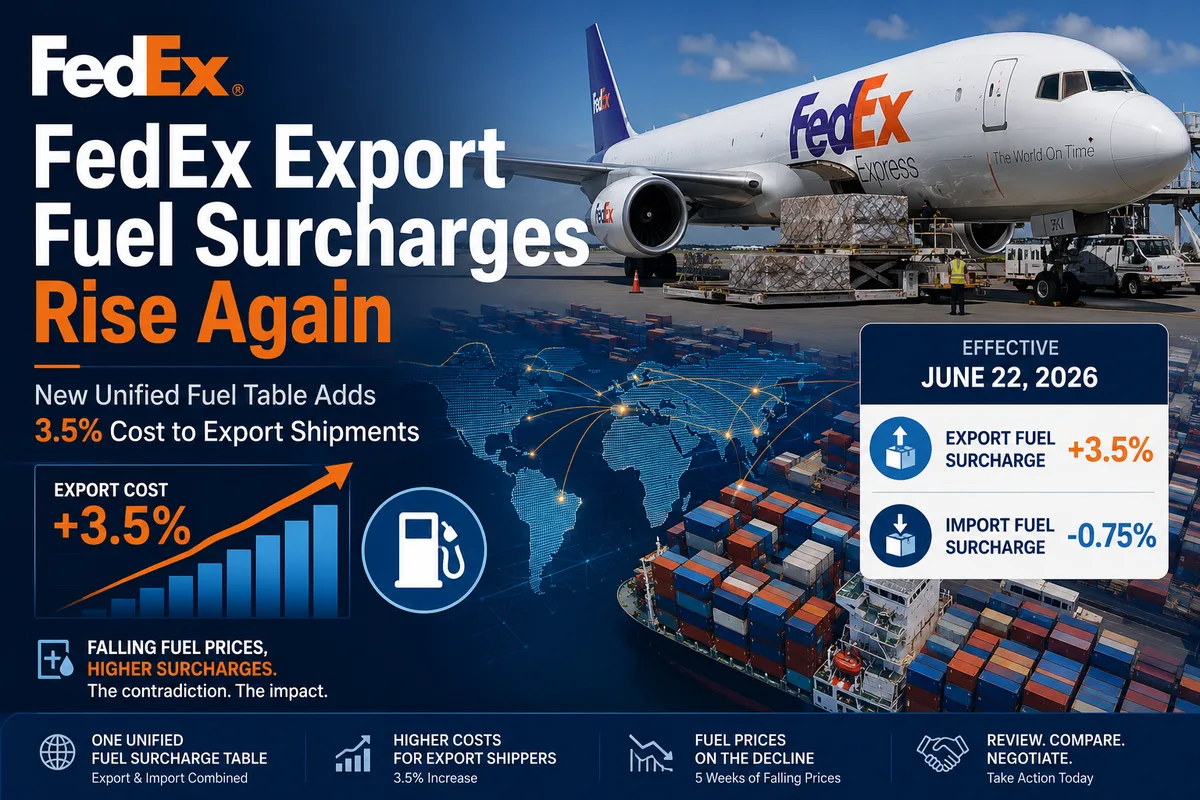
What FedEx Just Changed — The Consolidation Effective Today
For years, FedEx charged different fuel surcharge rates depending on whether your shipment was an export (leaving the US) or an import (arriving in the US). These were tracked in two separate tables with independent percentages.
Effective today — June 22, 2026 — FedEx is consolidating those two tables into one unified fuel surcharge table that applies equally to both exports and imports.
This sounds technical. It is. And it has real money implications for shippers.
The Numbers — What Changed on Your Invoice Today
Here is a concrete example from FedEx's own documentation:
Current structure (before today):
- If jet fuel is $3.31/gallon → exports charged 34.25% fuel surcharge
- If jet fuel is $3.31/gallon → imports charged 38.5% fuel surcharge
New unified structure (starting today):
- If jet fuel is $3.31/gallon → both exports AND imports charged 37.75% fuel surcharge
The effect of this consolidation:
- Exports: Rise from 34.25% to 37.75% = +3.5% increase
- Imports: Fall from 38.5% to 37.75% = -0.75% decrease
In dollar terms, this means roughly $35 more per $1,000 in export freight costs with the new surcharge structure — assuming your base rate stays the same.
This Is the Second Export Surcharge Increase in 6 Weeks
The timing of this change is worth examining closely.
On May 11, 2026, FedEx raised export surcharges by 2% and import surcharges by 2.5%. Now, on June 22, it is hitting exports with another effective 3.5% increase through the consolidation.
Combined impact: in the span of 42 days, FedEx export shippers have absorbed approximately a 5.5% cumulative increase in fuel surcharge costs.
For a company shipping $1 million per month in international exports, that is roughly $55,000 in additional annual fuel surcharge costs — driven not by actual fuel price changes, but by FedEx's restructuring of how it calculates surcharges.
The Timing Raises Questions — Falling Diesel Prices, Rising Export Surcharges
Here is what makes this change interesting — and slightly suspicious from a shipper perspective:
Diesel and jet fuel prices have been declining for the past five weeks. Last week, diesel hit its lowest price since March 9, 2026. FreightWaves reported that the trend is downward — fuel costs are coming down.
Normally, falling fuel prices would mean lower surcharges. Carriers would pass those savings back to shippers.
Instead, FedEx is raising export surcharges while fuel prices are falling.
Industry experts are interpreting this as a "revenue protection move" — FedEx locking in higher surcharge rates now so that if fuel prices continue to decline, the higher baseline keeps the carrier's surcharge revenue from dropping below desired levels.
In other words: FedEx is insulating itself against future fuel price decreases by raising the surcharge baseline today.
FedEx Is Not Alone — UPS and DHL Have Made Similar Moves
FedEx's consolidation is notable, but it is not unique in the industry.
UPS maintains separate export and import fuel surcharges — and as of Thursday morning, UPS has not announced plans to consolidate them. But UPS has made other surcharge adjustments.
DHL eCommerce increased its domestic fuel surcharge calculations effective May 30, 2026.
The trend across the entire parcel carrier industry is clear: consolidating surcharge tables, raising baseline percentages, and creating new structures that result in higher costs for shippers — all while framing these changes as technical adjustments rather than rate increases.
What This Really Costs — A Real-World Calculation
Let's make this concrete with real numbers.
A company shipping $500,000/month in international exports:
- Monthly export volume: $500,000 in freight charges
- Previous fuel surcharge at 34.25%: $171,250 per month
- New fuel surcharge at 37.75%: $188,750 per month
- Monthly increase: $17,500
- Annual impact: $210,000 in additional fuel surcharge costs
That is a substantial cost increase — driven entirely by FedEx's restructuring of how it calculates surcharges, not by actual increases in fuel prices.
What Should Shippers and Freight Forwarders Do Right Now?
- Review your June invoices carefully. Check whether FedEx has applied the new unified surcharge table to your exports. Verify the percentage being charged against the new structure.
- Audit your recent FedEx export invoices. Look at invoices from before today (June 22) and after. The difference in fuel surcharge percentages should be visible if they are tracking separately.
- Evaluate alternative carriers. UPS and other parcel carriers maintain separate export and import surcharge tables. Your export costs might be lower with a competitor. Run a comparison now.
- Negotiate with FedEx. If you have a large export volume, your account rep may have flexibility to negotiate the impact of this change. Do not accept the new rates silently.
- Monitor fuel prices independently. Track jet fuel prices from the EIA (Energy Information Administration). If FedEx's surcharge percentages stay high while fuel prices drop further, you have clear evidence that the carrier is overcharging relative to actual costs.
- Consolidate your FedEx account data. If you split exports across multiple FedEx accounts or departments, consolidate volume where possible. Larger customers have more negotiating power.
Key Takeaways — June 22, 2026
- FedEx consolidated export and import fuel surcharge tables effective today, June 22, 2026.
- Export surcharges increase by 3.5% under the new unified structure.
- Import surcharges decrease by 0.75%.
- This is the second export surcharge increase in 6 weeks — cumulative impact now 5.5%.
- The timing is notable: fuel prices are falling, but export surcharges are rising.
- Industry experts view this as a "revenue protection move" to insulate FedEx from falling fuel costs.
- UPS has not announced similar consolidation plans as of today.
- For heavy exporters, this change could mean $200,000+ in annual additional costs.
FedEx's consolidation of fuel surcharge tables is not presented as a rate increase — it is framed as a "technical restructuring." But for export-heavy shippers, the financial impact is very real. With fuel prices declining and FedEx simultaneously raising export surcharge baselines, shippers need to pay close attention to their invoices and be prepared to challenge these charges with FedEx directly or explore alternatives with competing carriers.



Comments
No comments yet. Be the first to share your thoughts!