

What's Happening
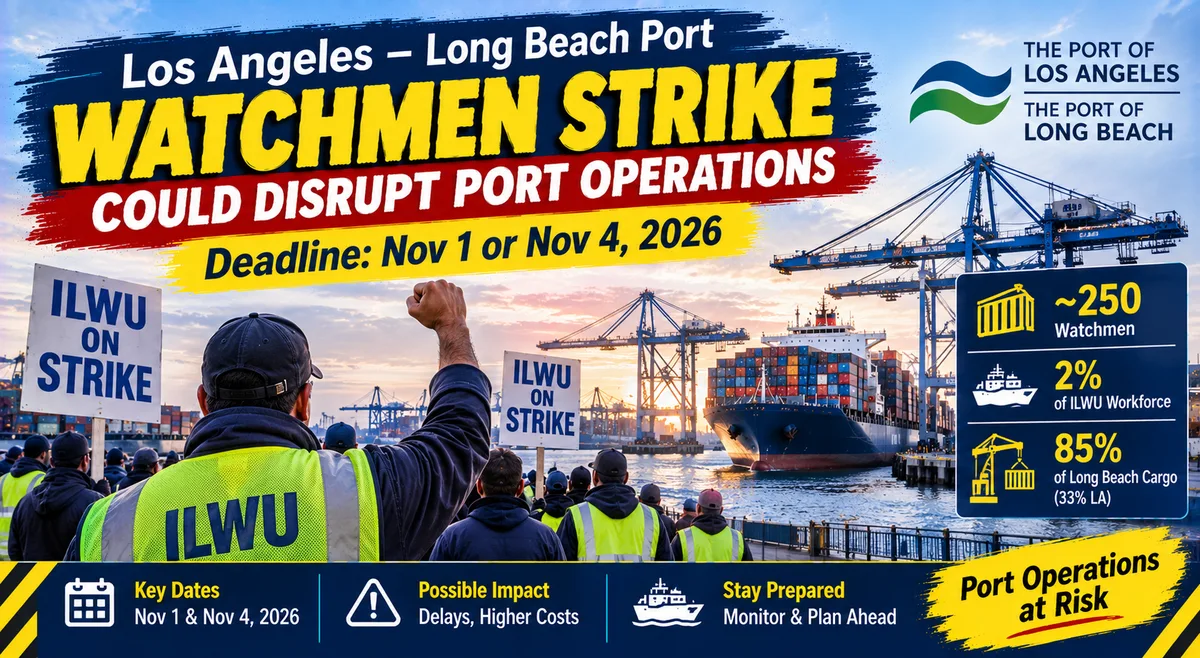
About 250 port watchmen represented by the International Longshore and Warehouse Union (ILWU) Local 26 could strike at eight container terminals in Los Angeles and Long Beach when their contract extension expires. The Pacific Maritime Association (PMA), which represents employers, said negotiations are continuing with the assistance of federal mediators.
"The Pacific Maritime Association remains committed to reaching a fair agreement with ILWU Local 26 at the bargaining table, and we will continue to negotiate in good faith through the November 1 deadline and beyond if necessary," the association said in a statement to FreightWaves.
A Small Union With an Outsized Impact
The watchmen represent only about 2% of the ILWU workforce across the two ports, but the terminals where they work handle a disproportionate share of cargo: roughly 85% of Long Beach's volume and 33% of Los Angeles'. The strike notice lists terminals including APM Terminals, Long Beach Container Terminal, Total Terminals International, Pacific Container Terminal, and SSA Marine facilities (C-60, A-90, LB206), among others.
PMA expects that other ILWU members — longshoremen, clerks and foremen — would honor Local 26's picket lines if a strike begins, which could halt vessel, yard, and gate operations at the affected terminals. Given that the LA/Long Beach complex moves 31% of all US containerized cargo passing through seaports, a work stoppage at terminals representing more than half the complex's volume carries implications well beyond the watchmen's own numbers.
It's worth being precise about what this dispute covers: the watchmen's contract is entirely separate from the coastwide ILWU agreement covering longshore workers and marine clerks, which runs through 2028 and is not affected by this specific negotiation.
A Conflicting Timeline: Is the Deadline November 1 or November 4?
Here the picture gets genuinely uncertain, and it's important to be transparent about that uncertainty rather than present a single confident date. FreightWaves, Yahoo News, and Trains.com all continued to cite a strike that "could begin as early as 5 p.m. Pacific time Sunday, Nov. 1" in reporting published through October 30-31. Shapiro's shipper advisory likewise cited the same 5 p.m. Sunday, November 1 trigger point.
However, freight forwarders Kuehne+Nagel and Dimerco both reported, citing the Journal of Commerce on October 29, that the potential strike deadline was expected to extend to November 4, 2026, as negotiations continued — though Dimerco specifically noted "the extension remains unconfirmed, and a final labor agreement has not been announced" as of its October 30 update.
Given this conflict between sources, shippers should treat both November 1 and November 4 as live possibilities and monitor PMA and ILWU Local 26 statements directly for confirmation, rather than relying on any single reported deadline.
Background: Negotiations Have Dragged Since 2025
The watchmen's previous agreement expired in July 2025, with the workforce continuing under a series of extensions since then. ILWU Local 26 President Luisa Gratz said in a letter dated October 23 that negotiations with employers and PMA had been under way since 2025 without producing an agreement.
This dispute is also landing at a difficult operational moment for the port complex. The strike threat comes as the LA-Long Beach gateway is already contending with a backlog of containers awaiting inland rail transportation — one advisory put the figure at roughly 35,000 containers on rail — meaning any additional disruption from a strike would compound an already-strained situation rather than hit a clean operational baseline.
A Historical Precedent Worth Noting
This is not the first time a small group of specialized ILWU workers has triggered outsized disruption at this port complex. In November 2012, a few hundred ILWU clerical workers walked out at the same complex. About 10,000 ILWU members honored the picket lines, shutting down 10 of the 14 container terminals. Ships sat offshore or diverted to Oakland and Mexico, and the resulting eight-day strike cost the local economy billions of dollars.
While there is no guarantee history repeats, that precedent is a useful reference point for understanding why employers and shippers alike are treating this relatively small watchmen's dispute with real urgency.
What Could Happen If a Strike Begins
Multiple shipper advisories outlined consistent potential impacts: vessel berthing delays, disrupted truck turn times and gate operations, worsening rail dwell times — particularly toward inland destinations such as Chicago, Memphis and Detroit — and increased exposure to demurrage and detention charges as containers sit longer than planned.
Importantly, several advisories stressed this is not confirmed to be a full port-wide shutdown. Other terminals not named in the strike notice may continue operating, and the actual scope will depend heavily on which ILWU members choose to honor picket lines and at which specific facilities.
What This Means for Shippers and Freight Forwarders
- Pick up already-discharged cargo now, before any strike begins. Multiple forwarders are advising clients to retrieve containers already landed at affected terminals as a priority, regardless of which deadline ultimately applies.
- Identify exactly which terminal your cargo is moving through. Since the strike notice names specific facilities — APM Terminals, LBCT, TTI, PCT, and specific SSA Marine locations — check whether your current or upcoming shipments route through one of these named terminals versus an unaffected one.
- Flag time-sensitive freight to your logistics provider immediately. With holiday peak season building and rail backlogs already elevated, time-critical shipments through this gateway deserve priority attention and contingency planning now, not after a strike starts.
- Budget for demurrage and detention exposure even if a strike is brief. Based on the 2012 precedent and current advisories, even a short disruption can generate charges and congestion effects that outlast the strike itself.
- Do not assume a confirmed deadline — monitor both November 1 and November 4. Given the genuine conflict in reporting about whether the deadline has been extended, check directly with PMA, ILWU Local 26, or your carrier/forwarder for the most current status rather than relying on any single date.
- Consider alternative West Coast or East Coast routing for new bookings if your timeline allows. With negotiations having dragged since 2025 without resolution, this dispute may not be fully settled even if the immediate deadline passes without a walkout — building flexibility into near-term routing decisions is a reasonable precaution.
Key Takeaways
- About 250 ILWU Local 26 watchmen have authorized a strike at Los Angeles and Long Beach port terminals as their contract extension expires.
- The watchmen represent only 2% of the ILWU workforce but work at terminals handling roughly 85% of Long Beach's cargo and 33% of Los Angeles'.
- Other ILWU members are expected to honor picket lines if a strike begins, potentially halting vessel, yard, and gate operations.
- The watchmen's contract is separate from the coastwide ILWU agreement, which runs through 2028 and is unaffected.
- Reporting conflicts on the exact deadline: some sources cite 5 p.m. Pacific, Sunday, November 1; others report the deadline was expected to extend to November 4, though unconfirmed as of October 30.
- The dispute comes as the port complex already faces a backlog of roughly 35,000 containers awaiting inland rail transport.
- A 2012 strike by a similarly small ILWU group shut down 10 of 14 terminals for eight days and cost the local economy billions.
- Shippers should pick up discharged cargo now, identify affected terminals, and monitor both potential deadlines directly with PMA and ILWU Local 26.


Comments
No comments yet. Be the first to share your thoughts!