
Mexico's trucking industry has called off a national strike after just one day, reaching an agreement with the federal government on October 27 to open permanent talks on the issues that drove thousands of drivers onto the country's highways. The protest, led by the national trucking chamber CANACAR, began on October 26 under the slogan "México no aguanta más" ("Mexico can no longer endure").
What happened
The Interior Ministry reported 38 protest points across 19 states on the first day, with 691 vehicles and 858 participants logged by mid-morning. CANACAR disputed those figures, saying mobilizations reached all 32 states. Caravans rolled onto major routes around Mexico City, including the highways to Querétaro, Pachuca, Toluca, Cuernavaca, and Puebla, while Veracruz recorded the most protest points of any state. Other groups involved included INDECO, FEMATRAC, and HAMOTAC.
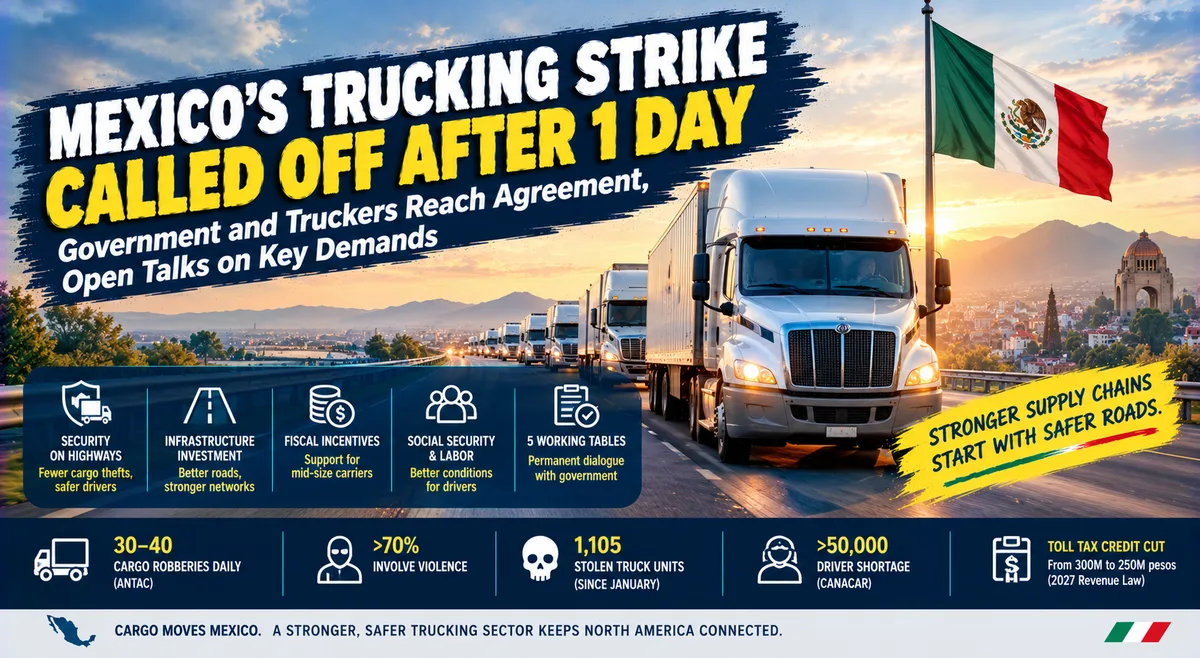
By Tuesday, the participating organizations agreed to lift all blockades in return for five permanent working tables covering highway security, infrastructure, fiscal incentives, social security, and labor conditions, coordinated with the National Guard and relevant federal agencies. The Interior Ministry said there was no need to use highway blockades to present demands. Notably, the main protest groups had declined to meet with the Interior and Finance secretaries, arguing that decisions had to come from the president's level, and the talks concluded without President Claudia Sheinbaum attending in person. Some other trucking associations rejected the blockades and reached a separate agenda with the government, which split the movement's public unity.
Why truckers took to the highways
The strike was triggered by two pressures arriving at once. The first is cargo theft and violence. According to the National Association of Transporters (ANTAC), between 30 and 40 cargo robberies occur every day on Mexican federal highways, with more than 70% involving violence. CANACAR's own records show roughly 1,105 stolen truck units and 15 operator deaths since January. The insecurity is also worsening a driver shortage that CANACAR says now exceeds 50,000 operators.
The second trigger was a tax change. The 2027 Revenue Law, approved by the Chamber of Deputies on October 14-15, lowers the annual revenue ceiling for a highway toll tax credit, which covers up to 50% of toll costs, from 300 million to 250 million pesos. That effectively removes the benefit for mid-size freight carriers that sit above the new cutoff. The measure was still under review in the Senate when the strike ended.
The government's response so far
The Sheinbaum administration's "Plan Cero Robos" has deployed more than 1,180 security personnel across three priority corridors: Mexico City-Puebla, Mexico City-Querétaro, and Culiacán-Mazatlán, which together account for about a third of all cargo theft. Truckers say that coverage is far too narrow, since many other dangerous routes remain unprotected. CANACAR data does show cargo incidents involving violence falling from 41% to 24% after the plan launched, though the industry argues the worst cases are concentrated in organized-crime corridors.
Why it matters for cross-border logistics
Trucks carry roughly 80% of everything Mexico consumes, and industry leaders had warned that a prolonged stoppage could cost up to 21.5 billion pesos per day, roughly $1 billion. For US importers, exporters, and freight forwarders moving goods across the border, even a short disruption is a reminder of how dependent North American supply chains are on Mexican highway reliability, especially while trade rules remain uncertain.
Key takeaways
- Mexico's national trucking strike began October 26 and ended October 27 after an agreement with the Interior Ministry.
- The Interior Ministry logged 38 protest points across 19 states, while CANACAR claimed protests in all 32 states.
- The government agreed to five permanent working tables on security, infrastructure, fiscal policy, social security, and labor conditions.
- Truckers cite 30-40 daily cargo robberies and a cut to the toll tax credit for mid-size carriers as their main grievances.
- Industry leaders say the core problems remain unresolved, so further protests remain possible if talks stall.
For shippers and forwarders with cargo moving through Mexico, the strike has ended, but the risk has not. Keeping flexible routing options, confirming delivery windows with carriers, and monitoring the outcome of the new working groups are sensible steps heading into the final weeks of peak season.


Comments
No comments yet. Be the first to share your thoughts!