

What Happened
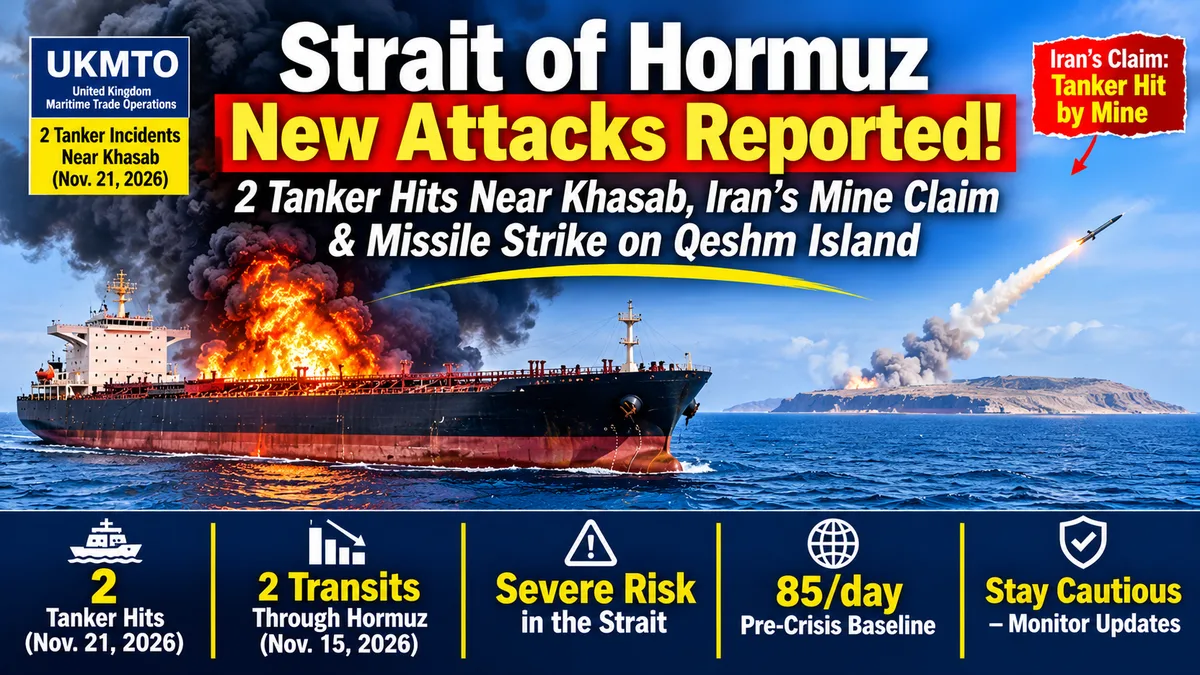
A tanker sailing outbound through the Strait of Hormuz was hit on its stern by an unidentified projectile about 11 nautical miles north of Oman's Khasab, the United Kingdom Maritime Trade Operations (UKMTO) reported on Saturday, November 21, 2026. UKMTO later reported a second incident involving a tanker hit in its engine room by an unidentified projectile 17 nautical miles east of Khasab. It was not immediately clear whether the two reports involved the same vessel or two separate ships.
No casualties were reported in either incident, while the environmental impact remained unknown, according to UKMTO.
Iran's Separate, Unverified Claim
Iran's navy said separately on Saturday that an oil tanker caught fire after hitting a naval mine in a restricted area east of the Strait of Hormuz. Reuters reported it could not independently verify the Iranian account, nor establish whether it referred to either of the incidents UKMTO reported. As with previous Iranian military claims we've covered throughout this conflict, this should be treated as Tehran's official position rather than an independently confirmed fact.
Separately, Iranian state media reported that a missile had struck Iran's own Qeshm Island, on the northern side of the strait, though no immediate information on damage was available. This detail — if accurate — would represent a notable escalation, as it suggests Iranian territory itself, rather than only passing commercial vessels, came under attack.
The Broader Context: A Strait Operating Near a Standstill
These latest incidents arrive against a backdrop of traffic data showing just how severely disrupted the Strait of Hormuz has become. According to IMF PortWatch, just 2 vessel transits were recorded on November 15 — compared with a pre-crisis baseline of 85 transits per day. Khasab itself, where both of this week's incidents occurred, lies on Oman's Musandam Peninsula at the entrance to the strait, which carried nearly one-fifth of global crude oil supplies before the Iran war began.
This is not an isolated week of disruption. We have tracked a sustained pattern of attacks throughout the autumn, including an incident on October 30 when Oman's navy evacuated 25 crew from a burning tanker near Musandam, and further incidents reported through mid-November involving LNG carriers and vessels in the wider Persian Gulf beyond the strait itself.
Iran's Continued Assertion of Control
Regional analysts have characterized Iran's actions as part of a continued effort to demonstrate it remains in control of the strait — a narrow passage connecting the Gulf with international shipping routes. Tehran has repeatedly said the waterway is unsafe for vessels that do not coordinate their passage with its self-declared Persian Gulf Strait Authority, an entity established during the war specifically to manage transit through Hormuz.
What This Means for Shippers, Charterers, and Insurers
- Treat UKMTO's confirmed incidents and Iran's claims as separate information streams. UKMTO's reports of projectile strikes near Khasab are independently sourced and verified by a recognized maritime security body; Iran's mine-strike and missile claims remain unverified by any independent party and should be documented as such in any internal risk notes.
- The near-total traffic collapse is the clearest single indicator of current conditions. With just 2 transits recorded on a day where 85 would be typical pre-crisis, any company still considering a Hormuz transit should treat this volume data — rather than any single incident report — as the most reliable measure of how extreme current conditions are.
- Khasab and the Musandam Peninsula continue to be a recurring incident location. With multiple attacks reported in this same specific area over recent months, companies with vessels transiting near Oman's northern coast should treat this stretch as a particularly active risk zone within an already dangerous waterway.
- Watch for confirmation of the Qeshm Island strike. If Iranian territory itself has come under attack, this would represent a meaningful escalation beyond the pattern of commercial vessel strikes seen throughout the conflict, with potential implications for the broader security environment in the region.
- Maintain the same risk posture regardless of whether incidents are confirmed or disputed. Given the consistent pattern of attacks and counter-claims throughout this conflict, shippers should not wait for full verification of any single incident before applying appropriate caution — the overall environment remains assessed at severe risk by UKMTO and other maritime security bodies regardless of any individual incident's disputed details.
Key Takeaways
- UKMTO reported two separate tanker incidents near Oman's Khasab on November 21, 2026, both involving unidentified projectiles; no casualties were reported.
- Iran's navy separately claimed a tanker caught fire after hitting a naval mine — a claim Reuters could not independently verify or link to the UKMTO reports.
- Iranian state media separately reported a missile strike on Iran's own Qeshm Island, with no confirmed damage details available.
- IMF PortWatch recorded just 2 vessel transits through the strait on November 15, against a pre-crisis baseline of 85 per day.
- This continues a sustained pattern of incidents throughout the autumn, including the October 30 evacuation of 25 crew from a burning tanker near the same region.
- Shippers and insurers should treat UKMTO-confirmed incidents and Iranian claims as separate information streams, and rely on traffic volume data as the clearest overall indicator of current conditions.



Comments
No comments yet. Be the first to share your thoughts!