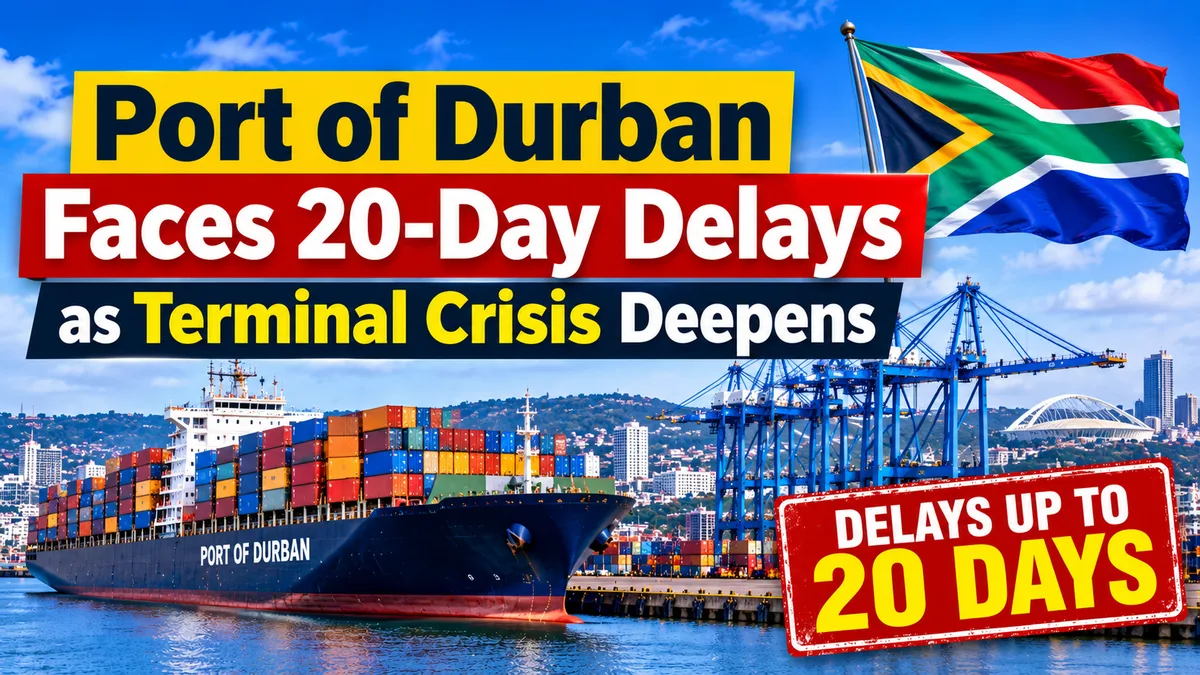
Africa's busiest container terminal is in crisis. Durban Gateway Terminal (DGT) and Transnet are scrambling to clear a growing backlog of vessels at the Port of Durban, with businesses reporting delays of up to 20 days before transhipment can take place — a figure that has sent alarm signals through South African trade and manufacturing sectors.
DGT — which is 51% Transnet-controlled and 49% owned by International Container Services Inc. (ICTSI) of the Philippines — acknowledged the crisis in a statement, saying it was aware of the difficulties customers had faced as a result of reforms undertaken during the year.
"While the different actions taken have been necessary, we acknowledge the continued service shortcomings and the unfortunate impact on our clients and partners. All efforts are being undertaken to clear the vessel backlog as soon as possible," DGT said.
Root Cause: Years of Underinvestment
DGT identified the core problem as poor and unsafe equipment conditions caused by years of underinvestment and inadequate maintenance. Ship-to-shore cranes and straddle carriers have suffered chronic breakdowns, severely limiting the terminal's ability to discharge and move containers efficiently.
In response, DGT has launched a multi-phase fleet renewal programme. Emergency measures now underway include:
- Original equipment manufacturers deployed on-site to refurbish and repair existing ship-to-shore cranes and straddle carriers — with equipment availability reported as steadily improving
- 16 new reach stackers and empty-container handlers expected by end of November 2026
- 26 second-hand straddle carriers arriving in two batches by Q1 2027
- 12 new straddle carriers expected by Q3 2027
- 16 new rubber-tyred gantry cranes to be delivered in December 2027 and March 2028
- Additional generators and uninterruptible power supplies to address power supply instability at the terminal
DGT also confirmed that its new terminal operating system, NAVIS N4, is now running smoothly and assisting in the operational recovery. A new truck appointment system is also being implemented. The terminal says current dwell time for full import containers — from discharge to release — is three days.
Pharmaceutical Cargo: A Medical Emergency Within the Logistics Crisis
The human cost of the backlog came into sharp focus this week when Transnet confirmed it had received a list from South Africa's Department of Health identifying critical pharmaceutical products sitting on 16 vessels in or approaching South African ports requiring urgent evacuation.
As of November 21, the status of those vessels was:
- 6 vessels completed — pharmaceutical containers have left port and are en route to their destinations
- 3 vessels due to berth in coming days — one at DCT Pier 1, two at DGT
- 7 vessels still approaching South African ports and yet to nominate a berth
Transnet said it is working with DGT, the Department of Health, shipping lines and other stakeholders to finalise a proposal to berth and discharge urgently needed containers at alternative terminals to prevent further queuing at Durban.
Alternative Berthing Options Activated
To relieve pressure on DGT, Transnet National Ports Authority is offering shipping lines alternative berthing at DCT Pier 1, Maydon Wharf Berth 102, and Ngqura Container Terminal — dispersing vessel calls across multiple facilities rather than funnelling all traffic through the congested DGT.
Expert Warning: Emergency Measures May Not Be Enough
Dr Simphiwe Madikizela, a senior lecturer at Unisa's Graduate School of Business Leadership, welcomed Transnet's announcement but cautioned against over-optimism.
"Transnet's announcement is a positive development, particularly because it recognises the urgency of the situation and the need for coordinated intervention across the port system. However, I would be cautious about concluding that these measures will be sufficient to resolve the crisis," he said.
Dr Madikizela identified the fundamental challenge at DGT as a combination of operational inefficiencies, equipment constraints, container-handling capacity limitations, landside congestion, and the inability to move cargo efficiently through the terminal.
"My concern is that some of these interventions may provide temporary relief without necessarily resolving the structural weaknesses that have contributed to the current situation," he warned.
The crisis, he said, extends well beyond port operations — with direct implications for international trade, manufacturing, agriculture, employment, investment confidence and the cost of doing business across South Africa.
Why This Matters for Global Freight
Durban is sub-Saharan Africa's busiest and most strategically important container port, handling the majority of South Africa's containerized imports and exports and serving as a transhipment hub for landlocked southern African countries including Zimbabwe, Zambia, and Botswana.
Cargo delays of 20 days at Durban create cascading disruption across regional supply chains — affecting automotive parts, agricultural inputs, retail goods, and now critical pharmaceutical supplies. For international shippers routing cargo through Durban, the advice is clear: check terminal status with your freight forwarder before confirming delivery schedules, and consider alternative discharge options at Ngqura or other regional ports where feasible.
🔑 Key Takeaways — November 21, 2026
- 20-day delays reported — businesses waiting up to 20 days for transhipment at Durban Gateway Terminal.
- Root cause: years of underinvestment — broken cranes and straddle carriers are at the heart of the crisis, not demand surge.
- 16 pharmaceutical vessels caught in backlog — South Africa's Department of Health flagged critical medical supply shortage risk.
- Emergency equipment arriving by end of November — 16 new reach stackers ordered, but full fleet renewal extends to 2028.
- Alternative ports activated — DCT Pier 1, Maydon Wharf Berth 102, and Ngqura Container Terminal now available as overflow berthing.
- NAVIS N4 system now operational — new terminal operating system is running and aiding recovery.
- Expert caution — independent analysts warn emergency measures address symptoms, not structural root causes.
- Action required for shippers — verify terminal status and routing options with forwarders before committing to Durban discharge schedules.
Source date: November 21, 2026 | Published: November 21, 2026

Comments
No comments yet. Be the first to share your thoughts!