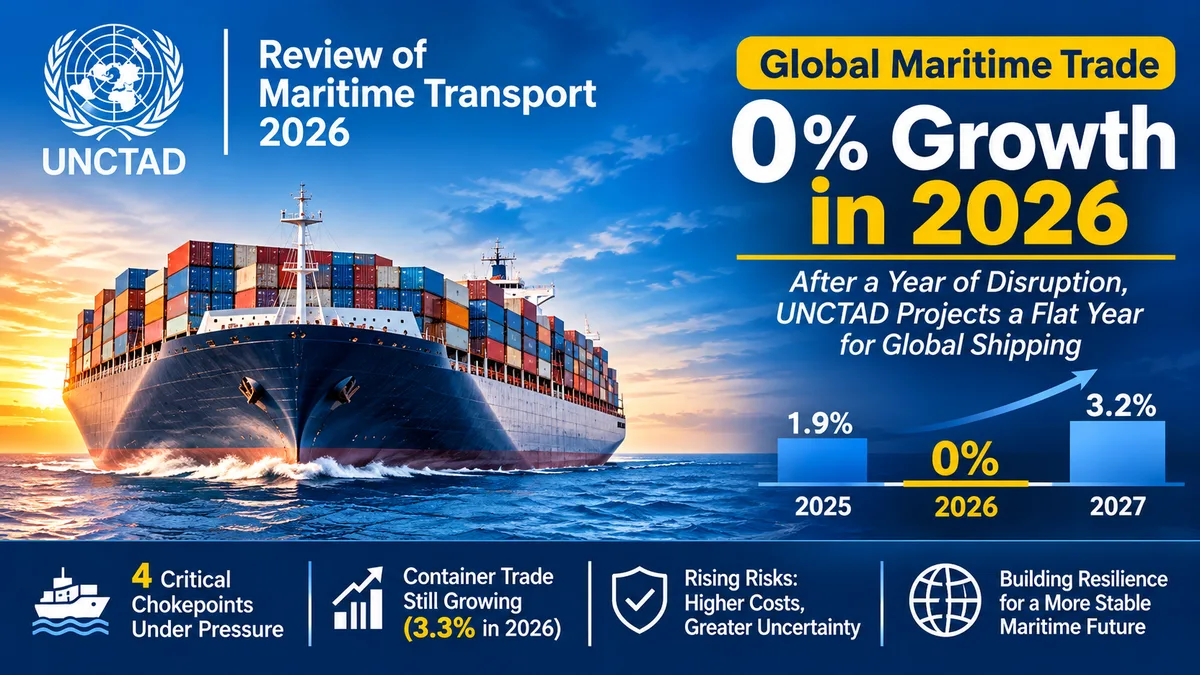

For a year defined by rerouted vessels, emergency fuel surcharges, and attacks on commercial shipping, the UN has now put an official number on the damage. UNCTAD's Review of Maritime Transport 2026, launched Thursday, projects zero growth in global maritime trade for 2026 — a volume carrying more than 80% of the world's goods, essentially frozen in place after a year of simultaneous disruption across four of the world's most critical shipping chokepoints.
The Headline Numbers
Global seaborne trade reached 12.3 billion tonnes in 2025, up 1.9% — already a sharp deceleration from 3.9% growth in 2024. UNCTAD now projects that growth rate falls to zero for 2026, before a tentative 3.2% recovery in 2027. The slowdown is not attributed to a single event but to what UNCTAD describes as four critical maritime chokepoints under simultaneous pressure: the Strait of Hormuz, the Red Sea, the Black Sea, and the Panama Canal — a convergence the agency says has not occurred at this scale before.
One figure complicates the flat headline number, however: containerized trade specifically is still expected to grow 3.3% in 2026, outpacing the broader stagnant market even as it slows from 2025 levels. And while overall cargo volume is flat, ton-miles — a measure that accounts for distance travelled, not just tonnage moved — are projected to rise 1.5% in 2026. That gap between flat volume and rising ton-miles is UNCTAD's way of quantifying rerouting itself: the same amount of cargo is now traveling considerably further to reach its destination.
What UNCTAD Says Happened at Hormuz
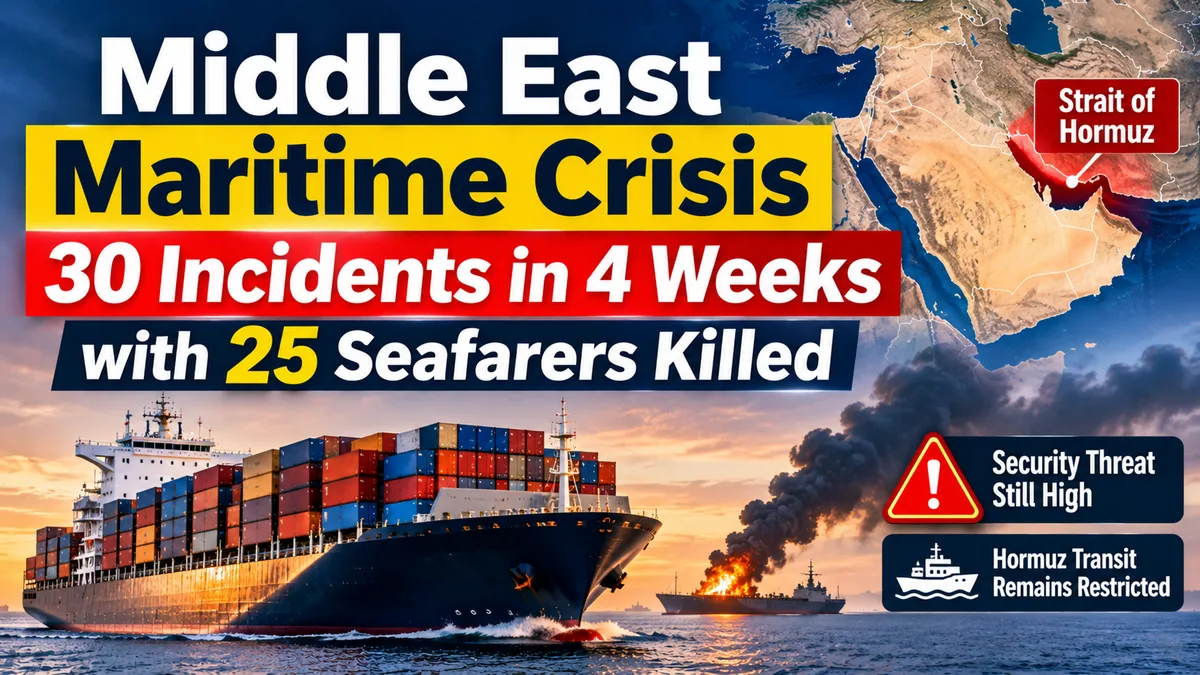
The report's starkest single data point concerns the Strait of Hormuz, a corridor carrying roughly one-fifth of the world's oil supply and other strategic commodities including fertiliser. Before the conflict, UNCTAD notes, around 120 ships crossed the strait daily. By early March — days after fighting began on February 28 — traffic measured by gross tonnage had collapsed by roughly 95%.
The report quantifies the insurance market's reaction to that collapse precisely: war risk premiums for a $100 million tanker reportedly jumped from about $200,000 to $1 million per voyage within days of the disruption beginning. That fivefold premium spike, more than any single freight-rate figure, captures how quickly the maritime insurance market repriced an entire shipping corridor once hostilities began.
The Rate Impact Across the Rest of the Fleet
UNCTAD's figures confirm what shippers have already absorbed through 2026: container spot rates more than doubled between January and August, and crude tanker rates hit record highs on several routes. Container lines, the report notes, layered emergency war risk charges and fuel surcharges directly onto freight bills throughout the year — the same pattern NavilinkGlobal has tracked repeatedly, from CMA CGM's emergency surcharges to the broader fuel-cost pass-through carriers have applied as rerouting around Africa and through alternative corridors added distance, time, and cost to voyages across the network.
An Aging Fleet Meeting Rising Demand
One structural detail in the report deserves attention alongside the disruption narrative: global fleet capacity grew 3.5% in 2025, comfortably outpacing trade growth even before this year's stagnation. Yet UNCTAD also notes that 42% of the world's vessels are now more than 20 years old. That combination — a fleet expanding in raw capacity while aging in average condition — sits underneath the chokepoint disruption as a second, slower-moving pressure on the industry's ability to absorb shocks efficiently, since older tonnage typically carries higher operating costs, lower fuel efficiency, and reduced flexibility for the kind of rapid rerouting 2026 has demanded.
Who Pays the Price — And Who Pays More
UNCTAD Acting Secretary-General Pedro Manuel Moreno framed the report's core finding in direct terms: "When shipping costs rise, consumers ultimately pay the price: but not everybody pays it equally." The agency estimates that if the current fuel-cost shock persists, global consumer prices could rise by roughly 0.19% — but in the world's least developed countries, that figure climbs to nearly 0.35%, almost double the global average. That asymmetry is the report's central equity argument: longer, costlier voyages caused by chokepoint disruption do not distribute their cost evenly, and economies with the least capacity to absorb shipping volatility are absorbing the largest relative hit.
The report also addresses the human toll directly, noting the situation of seafarers working in active risk zones throughout the year — a dimension of the crisis that has run alongside the commercial and economic disruption since February, with Arab News reporting that the Hormuz-related disruption has stranded over 20,000 seafarers as voyages are delayed, rerouted, or halted entirely.
What UNCTAD Is Recommending
The Review of Maritime Transport 2026 does not limit itself to diagnosis. UNCTAD is specifically urging governments and industry to build resilience ahead of the next disruption rather than reacting to each one individually: shared stockpiles of food staples and fuel for vulnerable countries, pre-agreed alternative trade routes, and streamlined customs procedures designed in advance to keep essential goods moving when a primary corridor becomes unusable. Moreno summarized the ambition at the report's launch: "Resilience by design and sustainability by default set the standard: maritime transport that keeps essential goods moving to every port, from the busiest hub to the most remote island."
What This Means for Shippers, Carriers and Policymakers
- The zero-growth figure is a lagging confirmation, not new information for operators. Shippers who have been managing rerouted capacity, elevated rates, and war risk surcharges throughout 2026 will recognize the structural causes UNCTAD describes. The value of this report is less in revealing new disruption and more in giving the industry an authoritative, quantified baseline — a fivefold war risk premium spike, a 95% Hormuz traffic collapse, more-than-doubled container rates — that can now be cited directly in contract negotiations, insurance discussions, and board-level risk reporting.
- Containerized trade's continued 3.3% growth amid overall stagnation is worth isolating in planning. Operators focused specifically on container logistics should not assume the "zero growth" headline applies to their segment — container volumes are still expanding, just more slowly than before, while the flat aggregate figure is driven disproportionately by bulk and tanker trade exposed most directly to Hormuz.
- The rising ton-miles figure is the more useful planning metric than flat tonnage. A 1.5% increase in ton-miles against zero volume growth confirms that vessel-days, fuel consumption, and crew-hours per tonne moved are all rising — meaning capacity planning built around historical tonnage-to-vessel ratios needs adjustment for the longer average voyage length now built into the network.
- The fleet-aging statistic is a medium-term capacity risk worth tracking independently of the Hormuz crisis. With 42% of vessels over 20 years old, operators and charterers should factor accelerated retirement and newbuild delivery schedules into multi-year capacity forecasts, since an aging fleet reduces the industry's flexibility to absorb the next disruption regardless of its geographic origin.
- Developing-economy exposure is a specific commercial risk factor, not just a humanitarian concern. Shippers and forwarders serving trade lanes into least-developed countries should anticipate disproportionate downstream price sensitivity and potential demand effects as the near-doubled relative consumer price impact UNCTAD describes works through those economies.
Key Takeaways — November 27, 2026
- UNCTAD's Review of Maritime Transport 2026 projects zero growth in global maritime trade for 2026, down from 1.9% growth in 2025 and 3.9% in 2024, with a tentative 3.2% recovery projected for 2027.
- The stagnation is attributed to four maritime chokepoints under simultaneous pressure: the Strait of Hormuz, the Red Sea, the Black Sea, and the Panama Canal.
- Hormuz traffic fell roughly 95% by gross tonnage within days of the February 28 conflict's start, down from approximately 120 ships crossing daily beforehand; war risk premiums on a $100 million tanker rose from about $200,000 to $1 million per voyage over the same period.
- Container spot rates more than doubled between January and August 2026, and crude tanker rates hit record highs on several routes; containerized trade specifically is still projected to grow 3.3% despite the overall stagnant market, and ton-miles are projected to rise 1.5% despite flat volume.
- Global fleet capacity grew 3.5% in 2025, outpacing trade growth, while 42% of the world's vessels are now more than 20 years old.
- UNCTAD estimates a persistent fuel shock could raise global consumer prices by roughly 0.19%, nearly doubling to 0.35% in the world's least developed countries, and is recommending shared fuel and food stockpiles plus pre-agreed alternative trade routes for vulnerable economies.

Comments
No comments yet. Be the first to share your thoughts!