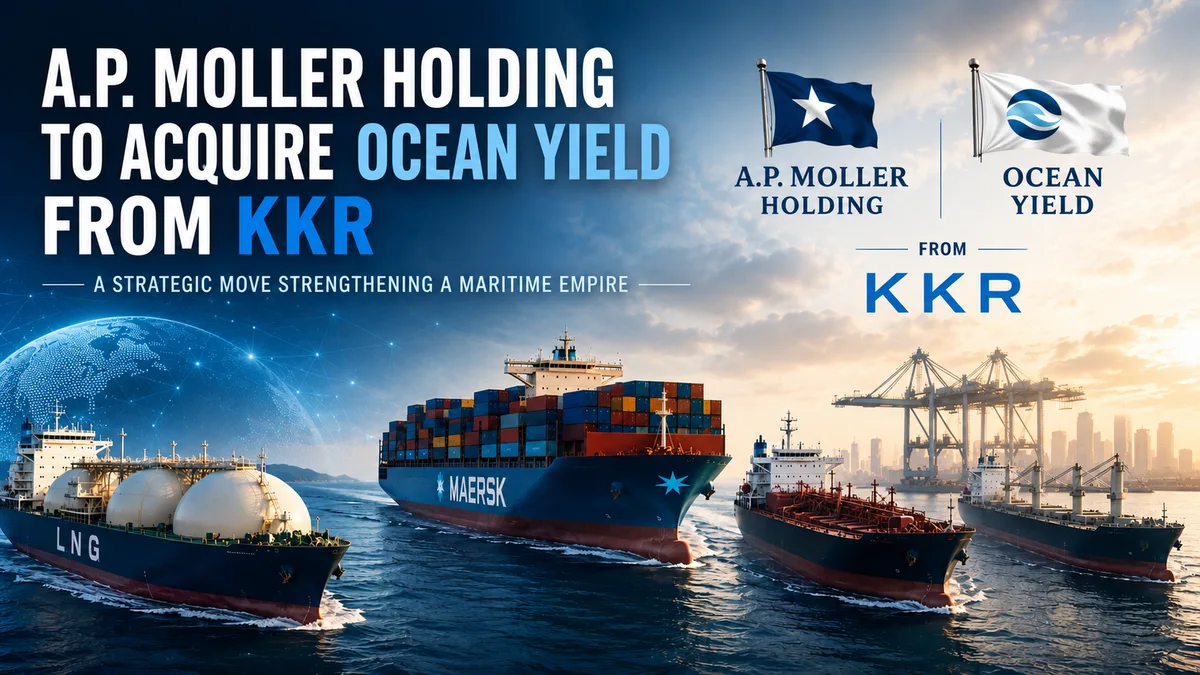
While the shipping industry has been focused on Hormuz closures, container rate swings, and AI deployments, a quieter consolidation story has been building in the background — and it took a significant step forward this week. On July 2, 2026, A.P. Moller Holding and KKR jointly announced that the Maersk family's investment vehicle will acquire 100% of Ocean Yield AS, a Norwegian ship leasing company with interests in over 70 vessels and one of the largest long-term contracted backlogs in maritime finance.
The financial terms of the transaction were not disclosed. Subject to customary regulatory approvals, the deal marks one of the most significant maritime acquisitions of 2026.
What Ocean Yield Actually Is
Ocean Yield is not a household name outside maritime finance circles, but its scale is significant. The Oslo-headquartered company holds interests in over 70 modern vessels across a wide range of shipping sectors: gas carriers, LNG carriers, container ships, crude tankers, product and chemical tankers, and dry bulk carriers. Its business model is built around long-term bareboat charters — it owns vessels and leases them to shipowners and operators on fixed, multi-year contracts, generating highly predictable cash flows.
KKR acquired Ocean Yield in a take-private deal in 2021, valuing the company at approximately $830 million at the time. Under KKR's ownership, Ocean Yield invested more than $3 billion to expand its portfolio, broadened its customer base, and nearly doubled its long-term contracted backlog — from roughly $2.5 billion when KKR took it private to more than $5 billion at the time of this announcement. The company has been particularly active in LNG, building exposure through investments including a joint venture with Japan's NYK and a stake in CapeOmega Gas Transportation, which has exposure to 10 LNG carriers operated by Knutsen LNG fixed to Shell, Engie, and QatarEnergy. KKR will retain its position in CapeOmega as a strategic partner even after the Ocean Yield sale closes.
Why A.P. Moller Holding Is Buying
A.P. Moller Holding is the parent company of the A.P. Moller Group — the conglomerate behind Maersk — but it operates as a distinct investment vehicle, separate from Maersk's liner and logistics business. It generated $61 billion in revenue in 2025 across a portfolio that spans Maersk, Svitzer tugs, DOF offshore, Noble Drilling, Maersk Tankers, Maersk Offshore Wind, and other holdings.
Martin Larsen, CFO of A.P. Moller Holding, said in a statement that Ocean Yield's "stable cash flow" business model is "an excellent complement" to the group's existing maritime portfolio. The framing is deliberate: leasing platforms with locked-in contracted revenue are exactly the kind of asset that offsets volatility elsewhere in a shipping portfolio, particularly in a market where spot freight rates can swing 40% in a quarter, as they have in 2026. Andreas Røde, CEO of Ocean Yield, described the acquisition as the start of a "next chapter of growth" with an owner he said can take long-term positions in maritime assets without the pressures of quarterly public market reporting.
The Bigger Picture: A Pattern of Quiet Consolidation
This deal doesn't stand alone. It's the latest move in what has become a deliberate, multi-year buildout of the A.P. Moller Group's maritime holdings beyond the container shipping business Maersk is best known for. The group acquired Maersk Supply Service in 2023. Maersk Tankers completed its acquisition of Penfield Marine at the beginning of 2024. A.P. Moller Holding took tug owner Svitzer private in 2025. And now Ocean Yield's 70-plus vessel leasing platform joins that growing portfolio.
Taken together, the Moller group is building a vertically integrated maritime empire that spans liner shipping, tankers, tugs, offshore services, wind installation, and now a diversified leasing platform that touches every major cargo type. That's a fundamentally different strategic posture from the "pure-play logistics integrator" narrative Maersk has used to describe itself publicly — and it raises a question worth watching: as the container market faces structural overcapacity through at least 2027, is the Moller group deliberately diversifying its earnings base away from container shipping as a hedge?
The Ocean Yield deal also reflects a broader trend in maritime private equity. KKR, which has been one of the most active infrastructure investors in shipping over the past decade, is taking profits on a well-timed cycle play: it bought Ocean Yield at a discount in 2021, nearly doubled its contracted backlog through a period of rising LNG demand and energy security investment, and is now selling into a market where a strategic buyer values stable, long-term contracted cash flows very highly. For KKR, it's a clean exit at a strong moment. For A.P. Moller Holding, it's an acquisition of exactly the kind of predictable, long-duration income stream that balances a portfolio otherwise heavily exposed to spot market volatility.
What This Means for the Wider Logistics Market
For freight professionals and supply chain operators, the direct operational implications of this deal are limited in the short term — Ocean Yield's vessels are chartered out on long-term contracts, and the change of ownership doesn't affect those arrangements. But the strategic signal is worth reading carefully for a few reasons:
- Consolidation in maritime leasing is accelerating. Ocean Yield's acquisition by a strategic owner removes one of the larger independent ship leasing platforms from the market. As vessel supply remains elevated and carriers face cost pressure, expect more leasing platforms to attract acquisition interest from groups looking for stable cash flows.
- LNG is the growth bet. Ocean Yield's heavy LNG exposure — nearly half its investment portfolio — and the Moller group's active expansion into LNG through Maersk Tankers and now Ocean Yield signals continued conviction that LNG as a transition fuel will remain a dominant shipping sector for at least the next decade, regardless of longer-term energy transition timelines.
- The Maersk family is building something bigger than Maersk. The A.P. Moller Group's consistent acquisition activity across shipping sub-sectors suggests a long-term ambition to be the dominant diversified maritime group globally, not just the world's largest container carrier. Shippers and freight partners building long-term relationships in any maritime sector should be aware of the expanding footprint of this group.
- Private equity is rotating out of maritime at the top of the cycle. KKR's well-timed exit mirrors similar moves by other PE firms across logistics infrastructure over the past 18 months. For anyone tracking maritime asset values, this deal sets a meaningful reference point for where institutional investors see fair value in diversified ship leasing platforms right now.
Key Takeaways — July 3, 2026
- A.P. Moller Holding announced on July 2, 2026 that it will acquire 100% of Ocean Yield AS from KKR. Financial terms were not disclosed.
- Ocean Yield holds interests in over 70 modern vessels across gas, LNG, container, crude, product, chemical tanker, and dry bulk sectors, with a contracted backlog exceeding $5 billion.
- Under KKR's ownership since 2021, Ocean Yield invested more than $3 billion and nearly doubled its contracted backlog from approximately $2.5 billion to over $5 billion.
- The deal is the latest in a series of maritime acquisitions by the A.P. Moller Group, following Maersk Supply Service (2023), Penfield Marine (2024), and Svitzer (2025).
- KKR retains its investment in CapeOmega Gas Transportation as a strategic partner to Ocean Yield post-transaction.
- The acquisition is subject to customary regulatory approvals — no completion date announced.

Comments
No comments yet. Be the first to share your thoughts!