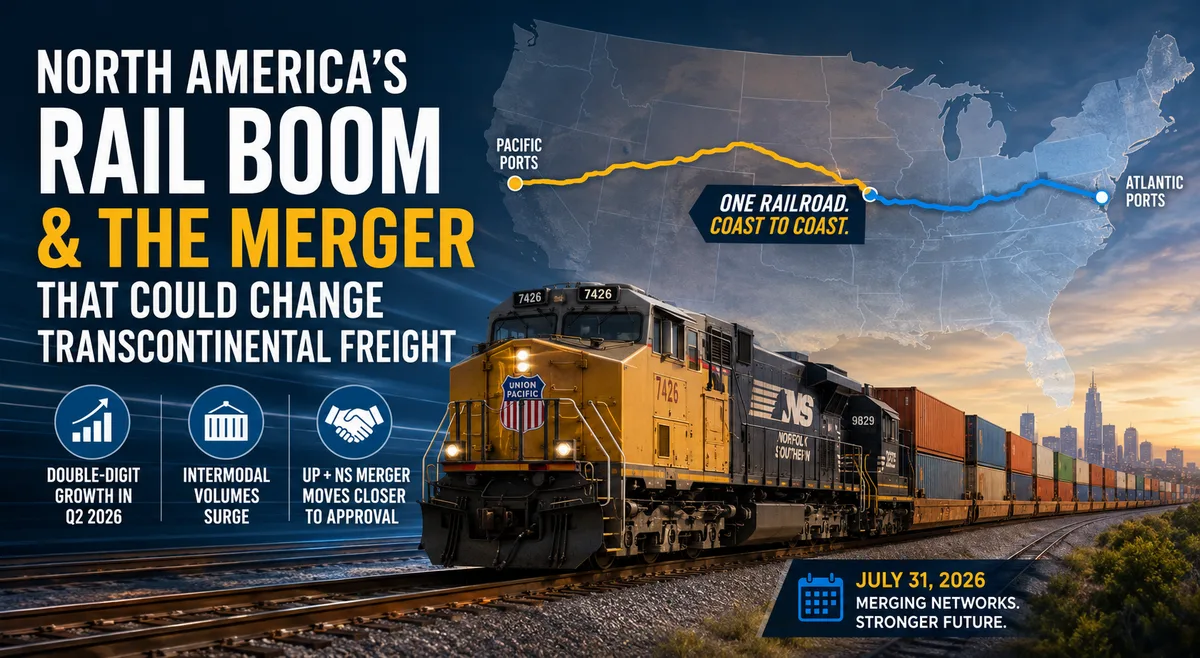
While global shipping headlines have been dominated by Hormuz closures, Houthi blockades, and oil price volatility, something significant has been happening on the ground in North America. The continent's rail freight network has been posting some of the strongest results in years — and the industry is moving closer to a structural change that would reshape how goods move across the entire United States.
Four of North America's largest railroads reported Q2 2026 earnings in the week of July 21-27, and the results were uniformly strong. Union Pacific led revenue growth at 11.5% to $6.9 billion in the quarter, while Norfolk Southern saw revenue jump 11.4% to $3.5 billion, CSX increased 10.1% to $3.9 billion, and Canadian National generated an 11.2% increase to nearly $3.4 billion. Three of the four raised their full-year guidance. And on July 27, Union Pacific and Norfolk Southern filed their responses to the Surface Transportation Board's supplemental information requests — the most significant regulatory milestone yet toward what would be the first US transcontinental railroad merger in history.
The Q2 Rail Boom — What's Driving It
Union Pacific reported record freight revenue, operating revenue, operating income, and net income in Q2 2026. Adjusted diluted EPS of $3.41 was up 13% year-on-year. The company raised its full-year EPS guidance from mid-single digit growth to high-single digit growth — and upgraded its economic outlook from "muted" to "mixed," a significant shift in language from one of the industry's most closely watched economic bellwethers.
The common thread across all four railroads was intermodal volume. June intermodal volumes across the industry jumped 11.6% to 1.64 million units, with domestic containers posting a 15.6% annual gain to 799,069 units. Union Pacific's domestic intermodal volume grew double digits. Norfolk Southern's intermodal units jumped 5% to 1.1 million. CSX posted the strongest overall volume growth at 6% for the quarter, again led by intermodal.
Two forces are driving this intermodal surge simultaneously. The first is the tariff-driven import boom this page reported on July 11 — record container volumes arriving at US ports need to be moved inland, and rail is the most cost-effective mode for doing so at scale. J.B. Hunt handled a record 578,000 intermodal loads in Q2 2026, up 10% year over year, as shippers saved an average of 31% compared with truckload. The second is the structural shift of cargo from ocean to domestic land modes as supply chain professionals reduce their Hormuz exposure by building buffer inventory closer to end markets — which means more domestic freight movement, more often.
The only headwind across the sector was fuel. Higher bunker and diesel costs — a direct consequence of the Hormuz disruption and its effect on global energy prices — compressed operating ratios across all four carriers despite the volume strength. Union Pacific's operating ratio was 59.7%, slightly above the prior year despite record revenues, as fuel costs offset some of the productivity gains from higher volumes.
The Merger That Would Change Everything
The earnings results are strong on their own terms. But the most strategically significant development in North American rail freight right now is not a quarterly result — it is the proposed merger between Union Pacific and Norfolk Southern that, if approved, would create the first US transcontinental railroad in history.
Union Pacific operates approximately 32,000 miles of track across 23 western US states, connecting Pacific Coast ports including Los Angeles, Long Beach, Oakland, Seattle, and Tacoma to major inland markets. Norfolk Southern operates approximately 19,500 miles of track primarily across the eastern US, serving Atlantic Coast ports including New York, Baltimore, Savannah, and Charleston, as well as major manufacturing and distribution centres in the Midwest and Southeast.
Combined, the two railroads would span the continent from Pacific to Atlantic — offering shippers for the first time a single-railroad solution for transcontinental freight that currently requires either truck or an interchange between two competing rail carriers. On July 27, Union Pacific and Norfolk Southern completed their responses to the Surface Transportation Board's supplemental information request — the regulatory milestone that moves the merger application from the initial filing stage to substantive review.
The STB's supplemental information request, filed in May, asked both railroads to provide additional data on competitive impacts, service quality, pricing effects, and workforce implications. Completing those responses on schedule signals that both companies are committed to the regulatory timeline and confident in their ability to address the STB's concerns. Canadian National signed a binding Memorandum of Understanding with Union Pacific on July 22 establishing a framework for CN to secure competitive access in connection with the merger — a move designed to address the STB's likely concerns about reduced competition on certain corridors by guaranteeing CN access to markets it would otherwise lose.
What Approval Would Mean for Supply Chains
The implications of a UP-NS merger for shippers and logistics operators extend well beyond the railroad industry itself:
- A single-railroad transcontinental option changes the economics of domestic freight. Currently, moving freight from Los Angeles to New York by rail requires a handoff between Union Pacific and a Class I eastern railroad. Each interchange adds cost, time, and complexity. A single-line service from Pacific to Atlantic would reduce that friction significantly — and give shippers a new negotiating option against trucking and against the current two-railroad intermodal model on transcontinental lanes.
- Port-to-port connectivity improves. For importers routing cargo through Pacific ports to East Coast distribution centres — or exporters moving manufactured goods from the Midwest to Atlantic ports — a transcontinental railroad creates a more direct, trackable, single-carrier logistics option. In an environment where supply chain visibility and simplicity are increasingly valued after five months of Hormuz disruption, that matters.
- The merger creates a major new competitive dynamic for trucking. Intermodal has already been gaining share from truckload — shippers saved an average of 31% versus truckload by using J.B. Hunt's intermodal service in Q2 2026. A transcontinental railroad that offers seamless coast-to-coast service makes intermodal more attractive on an even broader range of lanes, accelerating that shift.
- Regulatory approval is not guaranteed. The STB has broad authority to impose conditions on railroad mergers, including requiring access agreements for competing carriers, service quality commitments, and pricing restrictions. The CN access MOU is an early signal that UP and NS are prepared to offer concessions to secure approval. But the STB process typically takes 12-18 months from the filing of a complete application — meaning even an optimistic timeline puts final approval in late 2027 or early 2028.
Key Takeaways — July 31, 2026
- Four North American Class I railroads posted double-digit Q2 2026 revenue growth: Union Pacific (+11.5% to $6.9B), Norfolk Southern (+11.4% to $3.5B), CSX (+10.1% to $3.9B), CN (+11.2% to ~$3.4B). Three raised full-year guidance.
- June intermodal volumes jumped 11.6% industry-wide to 1.64 million units — domestic containers up 15.6% — driven by tariff-driven import surge and buffer-stock building against Hormuz disruption.
- Union Pacific reported record freight revenue, operating revenue, operating income, and net income in Q2 2026. Adjusted EPS of $3.41 was up 13% year-on-year.
- On July 27, Union Pacific and Norfolk Southern completed their responses to the STB's supplemental information request — the most significant regulatory milestone yet toward the proposed transcontinental railroad merger.
- CN signed a binding MOU with Union Pacific on July 22 to secure competitive access in connection with the merger — a move designed to address STB concerns about reduced competition on key corridors.
- Final STB approval, even on an optimistic timeline, is expected in late 2027 or early 2028 — but the merger's progression is already reshaping how shippers and logistics planners think about transcontinental freight options.

Comments
No comments yet. Be the first to share your thoughts!