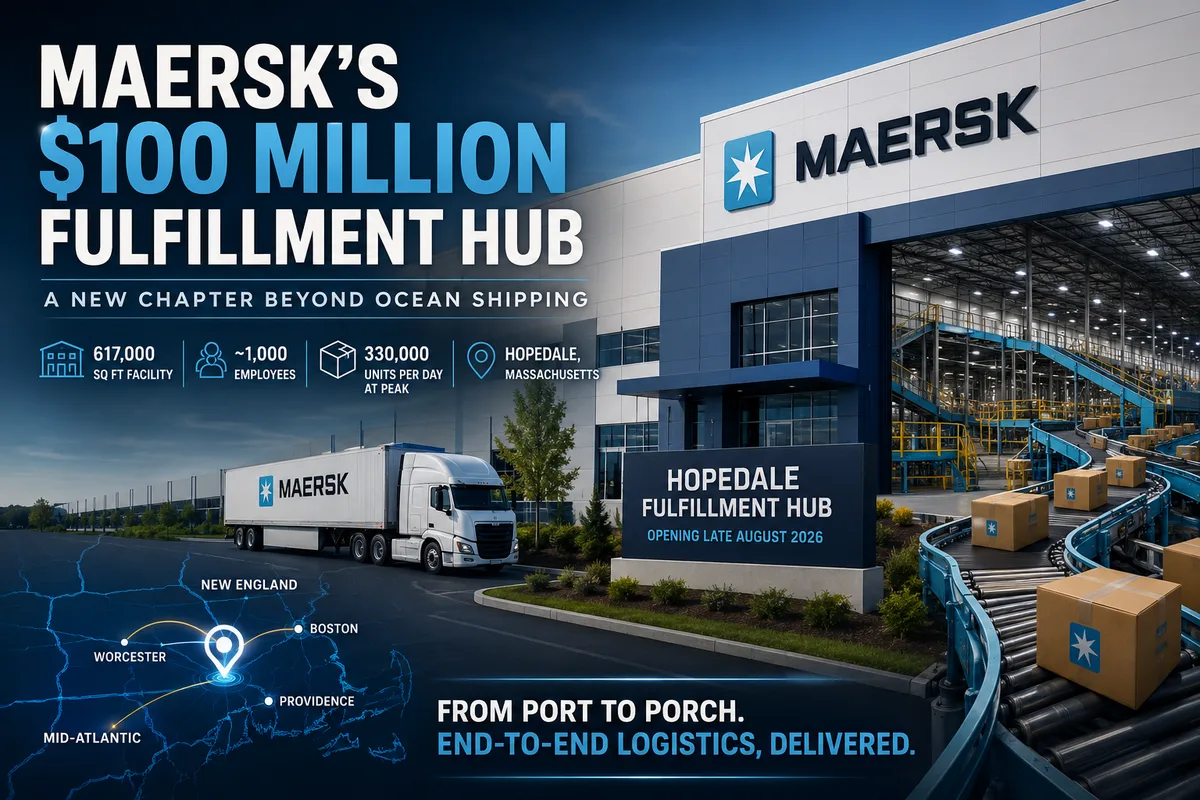
Maersk is known for moving cargo across oceans. But the company's latest $100 million investment has nothing to do with ships. On July 15, 2026, A.P. Moller – Maersk announced the opening of a new fulfillment hub in Hopedale, Massachusetts — a 617,000-square-foot facility set to begin operations in late August and serve as a major node in Maersk's North American Contract Logistics network. It's the clearest signal yet that the world's largest container shipping company is betting its future on what happens after the cargo leaves the port.
What Maersk Is Actually Building
The numbers are significant. The Hopedale facility represents a $100 million capital commitment — invested entirely in outfitting the site with advanced conveyor and sortation technology designed for high-volume, rapid-turnaround operations. At peak capacity, the facility is engineered to process up to 330,000 units per day. It will employ approximately 1,000 people and serve as a dedicated fulfillment and delivery hub for the Northeast region, covering consumers across New England and the Mid-Atlantic.
The facility will serve a single, unnamed large-scale e-commerce customer. Maersk has not disclosed who that customer is, but the scale of the commitment — 617,000 square feet, purpose-built conveyor infrastructure, a dedicated workforce of 1,000 — is consistent with the kind of exclusive, long-term contract logistics arrangement major retailers and e-commerce platforms have been signing with integrated logistics providers.
"Companies today are increasingly looking for logistics partners that can help them position inventory closer to customers and respond to demand with greater speed and flexibility," said Dave Hune, Head of Maersk Contract Logistics North America. "Our investment in Hopedale reflects continued customer demand for modern fulfillment capabilities and reinforces Maersk's commitment to building resilient, scalable supply chains across North America."
Why an Ocean Carrier Is Building Warehouses
The more important story here isn't the facility itself — it's what it represents about the strategic direction of the world's largest shipping lines. Maersk has spent the past several years executing a deliberate pivot away from being a pure ocean carrier toward becoming an end-to-end logistics provider. That means owning or operating assets across the entire supply chain: ships, ports, air freight, customs brokerage, trucking, warehousing, and now last-mile fulfillment.
Hopedale is the latest step in that shift. Maersk's North American Contract Logistics network already spans over 30 million square feet of warehouse and fulfillment space globally. Adding a purpose-built, technology-intensive fulfillment hub in the Northeast — one of the most densely populated and logistics-intensive regions in the US — extends that network into territory where e-commerce delivery expectations are highest and competition for fulfillment capacity is most intense.
The timing is deliberate. The facility opens in late August — just ahead of the holiday peak season, and precisely when the tariff-driven import surge NavilinkGlobal reported earlier this month is expected to clear the ports and land in domestic distribution networks. Having a 330,000-unit-per-day facility positioned between Worcester and Providence puts Maersk squarely in the path of that inventory flow.
What It Means for the Broader Logistics Industry
Maersk is not alone in this direction. CMA CGM — the world's third-largest container carrier, which this page reported earlier deployed AI across 80,000 employees — agreed to purchase FedEx Supply Chain for $1.4 billion, a deal expected to close later in 2026. MSC has been expanding its land-based logistics footprint aggressively. The pattern is consistent: the major ocean carriers are using the profitability of the past two years to buy their way into the higher-margin, stickier parts of the logistics business.
For traditional third-party logistics providers (3PLs), freight forwarders, and regional warehousing operators, this trend has real implications. Maersk's Hopedale hub is not just a warehouse — it's a fulfillment operation designed to compete directly with the contract logistics and last-mile services that 3PLs have traditionally owned. When Maersk can offer a customer ocean freight, customs clearance, inland drayage, warehousing, and fulfillment under a single contract, the value proposition for a standalone logistics provider narrows significantly.
What Supply Chain Leaders Should Watch
- The "undisclosed e-commerce customer" is the real signal. A $100 million, purpose-built, single-customer facility means Maersk has secured a long-term, high-volume contract from a major retailer or marketplace. When that customer is eventually disclosed — through regulatory filings, job listings, or press — it will reveal how far the ocean carrier/e-commerce platform relationship has evolved.
- Watch the August opening against the tariff cliff. NavilinkGlobal's July 11 report on US import records flagged a sharp projected drop in volumes from August onward as tariff-driven frontloading subsides. A 330,000-unit-per-day fulfillment hub opening into that slowdown will be an early test of whether the underlying demand is durable or purely frontloaded.
- The 3PL competitive landscape is shifting in real time. Maersk's expansion into fulfillment, CMA CGM's acquisition of FedEx Supply Chain, and MSC's land-side investments collectively represent a structural change in who competes for the contract logistics dollar. Traditional 3PLs that haven't differentiated on technology, speed, or specialization will face increasing pressure from carriers with deeper pockets and integrated ocean-to-door offerings.
- Northeast US logistics infrastructure is becoming a strategic priority. Hopedale was chosen specifically for its position between Worcester and Providence — highway access, proximity to Boston, and coverage of New England and the Mid-Atlantic. If this facility performs as designed, expect further investment in the region from Maersk and its competitors.
Key Takeaways — July 18, 2026
- Maersk announced a $100 million fulfillment hub in Hopedale, Massachusetts on July 15, 2026 — opening late August.
- The 617,000 sq ft facility will employ approximately 1,000 people and process up to 330,000 units per day at peak — serving a single, undisclosed large-scale e-commerce customer.
- It adds to Maersk's existing 30+ million sq ft global contract logistics network and is its largest announced US warehousing investment of 2026.
- The move is part of a broader industry pattern: major ocean carriers (Maersk, CMA CGM, MSC) are aggressively expanding into contract logistics, warehousing, and fulfillment to compete with traditional 3PLs.
- The facility opens just ahead of peak season and positions Maersk directly in the path of holiday inventory flows across the US Northeast.
- For 3PLs and regional logistics providers, competitive pressure from ocean carriers building end-to-end capabilities is accelerating — not slowing.

Comments
No comments yet. Be the first to share your thoughts!