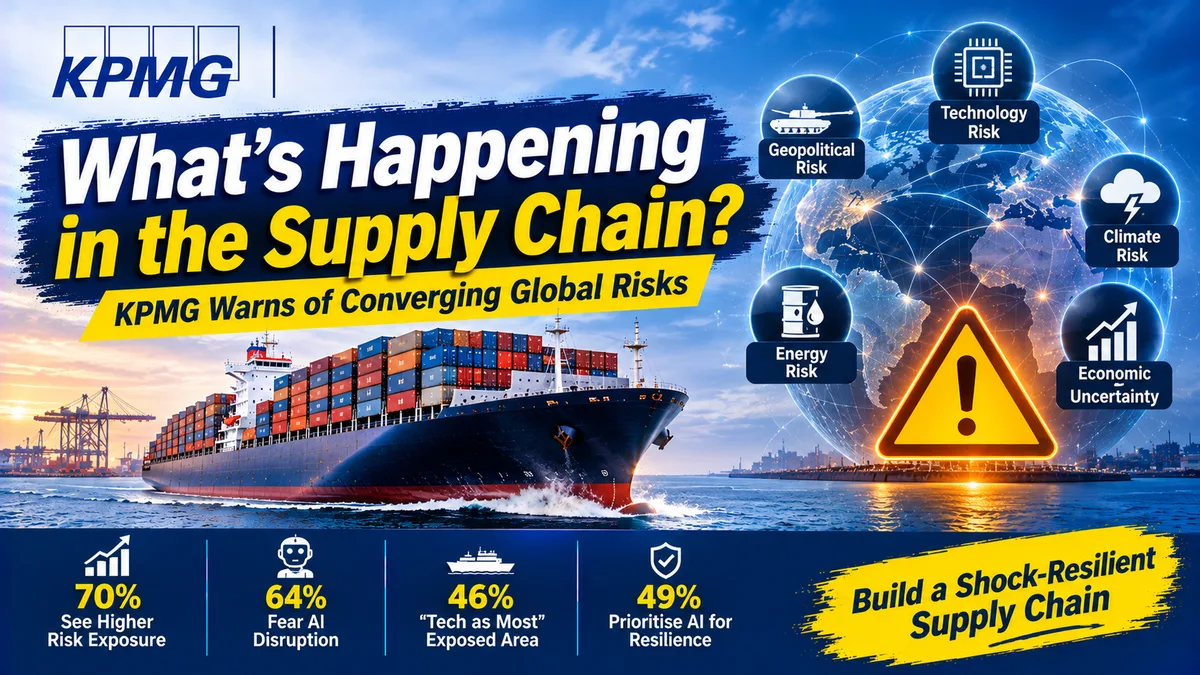
The era of isolated supply chain shocks is over. What companies now face is a convergence of risks — geopolitical, technological, energy-related and climatic — arriving simultaneously and amplifying one another. That is the central warning in a major new report released today by KPMG International, titled "Building a Shock-Resilient Supply Chain", presented at KPMG in India's 17th ENRich Conclave on energy and natural resources.
The report draws on a pulse survey of 109 senior executives and business leaders conducted by Ipsos for KPMG International's Energy, Natural Resources and Chemicals practice in September 2026. Respondents came from India, the US, China, Germany, Japan and Saudi Arabia, spanning sectors including automotive, consumer and retail, industrial manufacturing, infrastructure and transportation, and energy.
The Core Finding: Risk Has Left the Building
Nearly 70% of respondents said their organisation's risk exposure has increased over the past two years. More strikingly, 56% expect external disruptions — from geopolitics, energy, cyber threats, trade or climate — to cause severe operational disruption or significantly hit costs and performance over the next three to five years.
The report's central argument is that the traditional risk model has been inverted. The most consequential threats now emerge outside corporate boundaries — in shipping corridors, energy markets, government policies, and cyber infrastructure — where a company cannot control the outcome, only its own exposure, preparedness, and speed of response.
Regina Mayor, Global Head of Clients & Markets at KPMG International, put it plainly: "What makes today's business environment particularly challenging is not the scale of any single disruption, but the way multiple risks are converging and reinforcing one another."
What Executives Fear Most
When asked which risks would have the greatest impact over the next two years, executives ranked them as follows:
- Technology and AI disruption — 64% (ranked first)
- Geopolitical conflict — 58% (ranked second)
- Macroeconomic uncertainty — 48% (ranked third)
When asked which parts of the supply chain are most exposed to disruption, respondents identified:
- Technology and digital dependencies — 46%
- Delivered costs and price volatility — 39%
- Shipping and logistics — 33%
The prominence of technology risk at the top of both lists reflects a structural shift in how global supply chains operate. As AI infrastructure investment accelerates globally — across data centres, semiconductor manufacturing and energy systems — the supply chains supporting that build-out have become uniquely time-sensitive and uniquely vulnerable.
Hormuz as the Stress Test
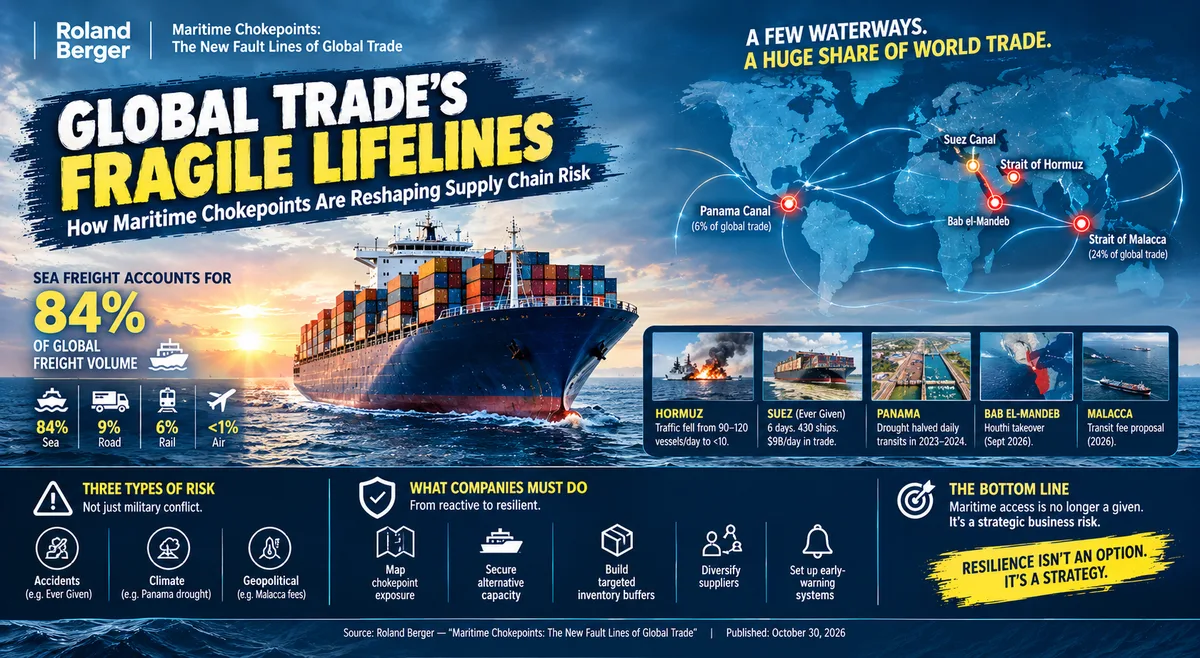
The report uses the 2026 disruption to traffic through the Strait of Hormuz as its central stress test — and the lessons are pointed. Diversified supplier bases can still share the same maritime chokepoint. Contracts do not create vessels or insurance capacity. Freight, currency and financing costs can amplify a physical disruption far beyond its immediate scope.
More than a quarter — 28% of respondents — said energy security and resilience has become a significant strategic priority for senior leadership, a direct consequence of the ongoing conflict-driven closure of one of the world's most critical waterways. The report notes that for companies with exposure to Gulf supply chains, the Hormuz disruption has demonstrated that diversifying suppliers is not the same as diversifying risk — not when those suppliers all depend on the same corridor.
AI: The Threat That Is Also the Solution
In a striking finding, the same technology that tops the risk list also leads the response. To strengthen supply chain resilience, executives are prioritising:
- AI and predictive analytics — 49%
- Scenario planning and stress testing — 44%
- Alternative sourcing strategies — 39%
- Efficiency and cost optimisation — 31%
The paradox is real but logical: AI-driven disruption creates new vulnerabilities in supply chains, while AI-powered tools are simultaneously the best available mechanism for anticipating and responding to those disruptions in real time.
Anish De, Global Head of Energy, Natural Resources and Chemicals at KPMG International, framed the broader imperative: "Resilience is no longer just a supply chain function; it has become a board-level imperative shaped by energy-linked disruption and a broader set of interconnected risks spanning technology, financial stability, operations and global value chains."
Confidence Remains — But Is It Warranted?
Despite the scale of risk identified, executive confidence remains high: 70% said they were confident or very confident of maintaining critical operations during a major external disruption. The report does not dispute this confidence — but it does challenge it. The recommendation is a tiered resilience approach, ranging from regular assessment and internal controls to, where the risk exposure warrants it, capital reallocation and structural network redesign.
For logistics professionals, freight forwarders and supply chain managers operating in 2026 — with Hormuz transits at a fraction of pre-crisis levels, container rates up 130% since February, Asian ports congested by typhoon cascades, and the Panama Canal still constrained — the KPMG report's core message is a timely one: resilience is not a supply chain function. It is a board-level strategy. And the companies that treat it as one will be the ones still moving cargo when the next shock arrives.
🔑 Key Takeaways — November 4, 2026
- 70% of executives say risk exposure has increased over the past two years — KPMG survey of 109 senior leaders across 6 countries, September 2026.
- 56% expect external disruptions to cause severe operational damage within 3–5 years — covering geopolitics, energy, cyber, trade and climate simultaneously.
- AI disruption is now the #1 feared risk (64%) — ahead of geopolitical conflict (58%) and macroeconomic uncertainty (48%).
- Technology and digital dependencies are the most exposed supply chain stage (46%) — ahead of shipping and logistics (33%).
- Hormuz is the report's core stress test — proving that diversified suppliers still share the same chokepoints, and that contracts do not create vessels or insurance.
- AI is both the top threat and the top resilience tool — 49% of executives are prioritising AI and predictive analytics to build shock resilience.
- Resilience is now a board-level imperative — not a supply chain function — per KPMG Global Head Anish De.
Source date: November 4, 2026 | Published: November 4, 2026
Comments
No comments yet. Be the first to share your thoughts!