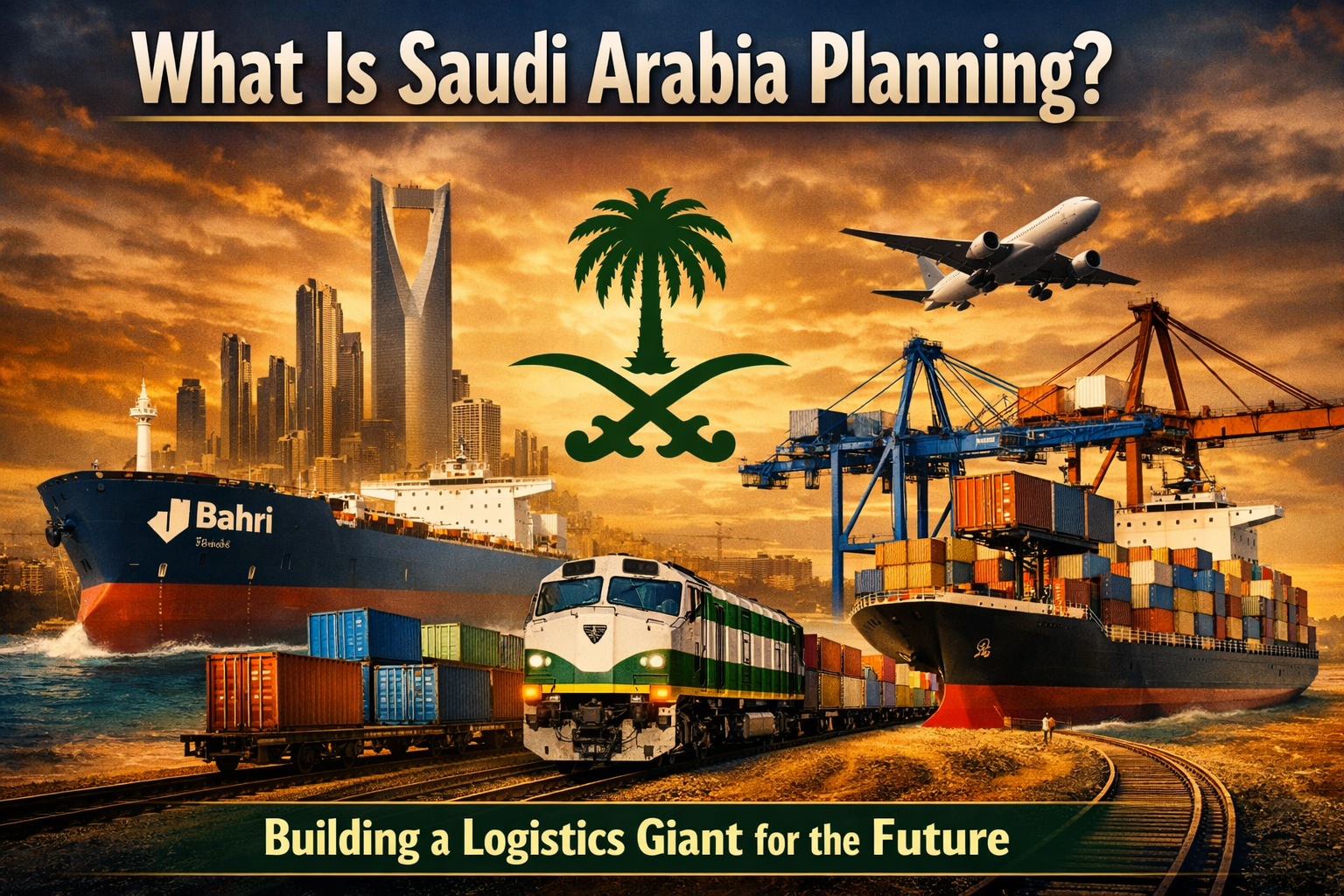
What Is Saudi Arabia Planning?
Saudi Arabia's sovereign wealth fund is considering consolidating transport and supply-chain assets to create a logistics giant that can attract foreign investment and better serve the kingdom's trade hubs amid the upheaval caused by the Iran war.
The Public Investment Fund (PIF) has held early-stage talks on combining parts of its sprawling portfolio of ports, rail, and shipping assets into a single entity. The enlarged firm could potentially evolve into a vehicle for multibillion-dollar investments across the logistics industry.
Crucially, the PIF could also look to eventually bring international investors into the business, including through an initial public offering. In plain terms: Saudi Arabia wants to build a national logistics champion — and then potentially list it on the stock market.
Which Assets Could Be Combined?
The assets under discussion could include Bahri, the National Shipping Company of Saudi Arabia and one of the Kingdom's core maritime carriers, along with Saudi Global Ports and Saudi Railway Co.
Here's what each of these brings to the table:
- Bahri (National Shipping Company of Saudi Arabia) — valued at $8.3 billion, with operations spanning crude oil tankers, chemicals, dry bulk, and integrated logistics. It is already one of the largest shipping companies in the Middle East.
- Saudi Global Ports — operates key port terminals including King Abdulaziz Port in Dammam and King Abdullah Port, handling millions of TEUs of container throughput annually.
- Saudi Railway Co. (SAR) — runs the Kingdom's national rail network, connecting industrial cities, ports, and population centers across Saudi Arabia's vast geography.
Combining these three would create an end-to-end logistics company: ships bringing cargo into Saudi ports, rail moving it inland, and integrated logistics managing the entire supply chain.
Why Now? The Iran War Factor
The timing is not a coincidence. Saudi Arabia's sovereign wealth fund is considering this move amid the turmoil triggered by the Iran war. The closure of the Strait of Hormuz — which previously handled roughly 20% of the world's oil — has fundamentally disrupted the Middle East's role in global energy and trade flows.
For Saudi Arabia, this disruption is both a threat and an opportunity. Its Red Sea and Gulf ports are critical alternative routing points for cargo that can no longer safely transit the Hormuz strait or the wider Gulf. By building a fully integrated logistics platform, the Kingdom can position itself as the region's indispensable trade hub — not just an oil exporter.
Saudi Arabia's reported plan reflects a larger shift in global supply chains: logistics networks are becoming instruments of resilience, industrial policy, and geopolitical optionality.
The UAE Competition Factor
There is another dimension to this story: Saudi Arabia wants to compete with the UAE. Dubai's DP World is already one of the world's largest port operators, with terminals across six continents. Abu Dhabi Ports has also been aggressively expanding globally. The UAE has effectively turned logistics into a cornerstone of its national economy.
Saudi Arabia's ambition is different in scale. It has a larger domestic economy, deeper industrial ambitions, Gulf and Red Sea access, and a sovereign wealth fund capable of forcing consolidation across major portfolio assets.
A unified Saudi logistics platform with Bahri's fleet, Saudi Global Ports' terminals, and SAR's rail network would be a formidable regional competitor — and a genuine rival to DP World on the global stage.
Part of Vision 2030
This move fits squarely into Saudi Crown Prince Mohammed bin Salman's Vision 2030 economic diversification programme. The Kingdom has long stated its goal of becoming one of the world's top 10 logistics hubs. Building a national logistics champion — backed by $1 trillion in sovereign wealth — is one of the most direct ways to get there.
Vision 2030 has already seen major investments in ports, special economic zones, and transport infrastructure. A consolidated logistics entity would pull all these investments together under one roof and give them a clear commercial mandate: attract foreign cargo, capture regional trade flows, and grow internationally.
What Does This Mean for the Logistics Industry?
- A new global competitor is emerging. A combined Bahri + Saudi Global Ports + Saudi Railway would be one of the largest integrated logistics companies in the Middle East — with ambitions to grow far beyond it.
- The Middle East logistics landscape is being reshaped. With the Iran war disrupting Hormuz, Saudi Arabia is positioning itself as the region's new trade anchor.
- International investors will be watching. The prospect of a future IPO means this could become a major investment opportunity in the logistics sector.
- Freight forwarders and shippers should track Saudi port capacity. As the new entity develops, Saudi ports may offer new routing options and competitive rates for cargo moving to and from Asia, Europe, and Africa.
Key Takeaways
- Saudi Arabia's $1 trillion PIF is in early talks to merge ports, shipping, and rail assets into one logistics giant.
- Key assets: Bahri ($8.3B shipping co.), Saudi Global Ports, Saudi Railway Co.
- Driven by Iran war disruption and Vision 2030 ambitions.
- Could eventually go public via an IPO to attract international investors.
- Would directly compete with UAE's DP World for Middle East logistics dominance.
- Discussions are still at an early stage — no final decision made yet.
The global logistics map is being redrawn in real time. Saudi Arabia's move to build a national logistics champion is one of the most significant strategic plays in the industry this year — and it's only just getting started.


Comments
No comments yet. Be the first to share your thoughts!
Join the conversation
You need an account to comment on articles.