What Is Happening?
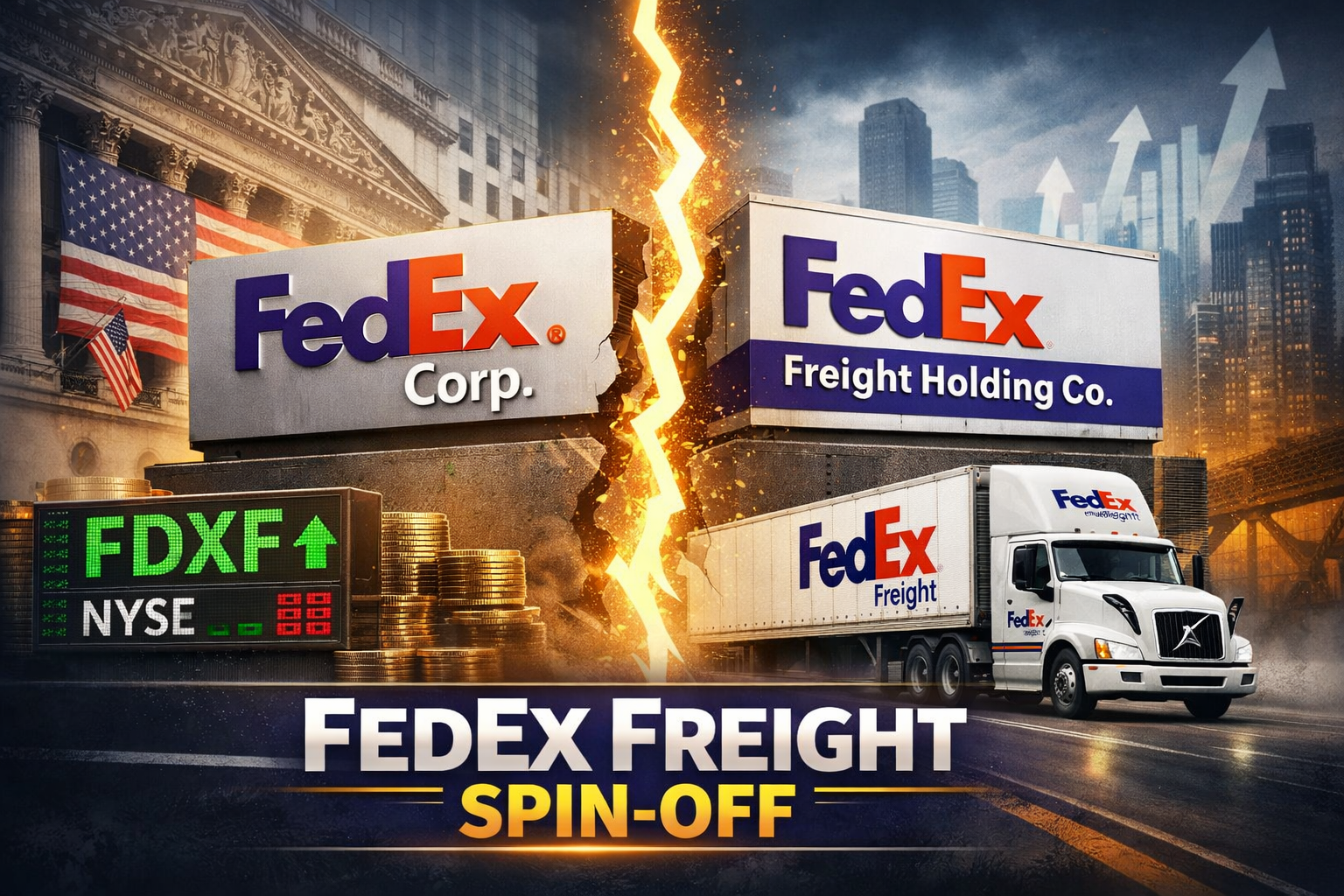
On May 13, 2026, FedEx's Board of Directors officially approved the spin-off of its freight business. FedEx Freight — currently the largest less-than-truckload (LTL) carrier in North America — will become a fully independent, publicly traded company effective June 1, 2026.
The new company, called FedEx Freight Holding Company, Inc., will list on the New York Stock Exchange under the ticker symbol FDXF. The parent company, FedEx Corp., will continue trading under its existing symbol FDX and will retain a 19.9% stake in the new entity.
FedEx stockholders on record as of May 15, 2026 will automatically receive one share of FedEx Freight for every two FedEx shares they hold — making this a tax-free dividend spin-off, not a sale.
Why Is FedEx Doing This?
The logic is simple: FedEx Freight is a massive, profitable LTL business — but it operates very differently from FedEx's express parcel and international networks. By separating the two, each company can focus entirely on its own customers, pricing strategy, capital investments, and growth plans without having to share resources or priorities.
FedEx Freight hosted its inaugural Investor Day at the New York Stock Exchange in April 2026, laying out its standalone strategy. The message was clear: as an independent company, FedEx Freight intends to compete aggressively for LTL market share, invest in its network, and pursue growth opportunities it couldn't prioritize as a division of a larger parent.
How Big Is FedEx Freight?
FedEx Freight is not a small operation. It is the largest LTL carrier in North America, known for industry-leading transit times and service reliability. LTL shipping — where multiple shippers share space on the same truck — is the backbone of B2B freight movement across the United States and beyond.
For context, LTL shipping is used by manufacturers, wholesalers, retailers, and importers who don't have enough cargo to fill an entire truck but still need reliable, scheduled delivery. FedEx Freight's network covers virtually every business address in the US, making it a critical part of domestic supply chains.
What Does This Mean for Shippers and Freight Forwarders?
In the short term, operations continue normally — nothing changes for existing customers on June 1. Freight will still move, contracts will still be honoured, and the same service levels apply.
But over the medium term, the separation could lead to:
- More competitive LTL pricing — as an independent company focused solely on freight, FedEx Freight may have more flexibility to negotiate rates and invest in service.
- Distinct customer relationships — shippers who use both FedEx parcel and LTL services may need to manage two separate commercial relationships going forward.
- Increased competition — a standalone, publicly accountable FedEx Freight will be under more pressure to grow market share, which could intensify competition with XPO, Old Dominion, Saia, and other LTL carriers.
- Fresh investment in the network — without having to compete internally for FedEx Corp. capital, the freight division can now set its own investment agenda.
The Bigger Picture
This spin-off is part of a broader trend in the logistics industry: large conglomerates breaking apart so each business unit can move faster and compete more effectively. UPS has been going through its own transformation, aggressively cutting Amazon volume to focus on higher-margin shipments. DHL continues to expand in healthcare logistics. And now FedEx is betting that two focused companies will outperform one large, complex one.
For the global logistics community, the birth of FDXF on June 1 is worth watching closely. A newly independent FedEx Freight, hungry to prove itself on the public markets, is likely to be a more aggressive competitor — and that's good news for shippers looking for value and reliability in LTL freight.
Key Takeaways
- FedEx Freight officially separates from FedEx Corp. on June 1, 2026.
- It will trade on NYSE under ticker symbol FDXF.
- FedEx shareholders get one FDXF share for every two FDX shares held (record date: May 15).
- FedEx Freight is the largest LTL carrier in North America.
- No immediate service disruption — operations continue normally for customers.
- Long term, expect more competitive pricing and aggressive network investment.



Comments
No comments yet. Be the first to share your thoughts!
Join the conversation
You need an account to comment on articles.