
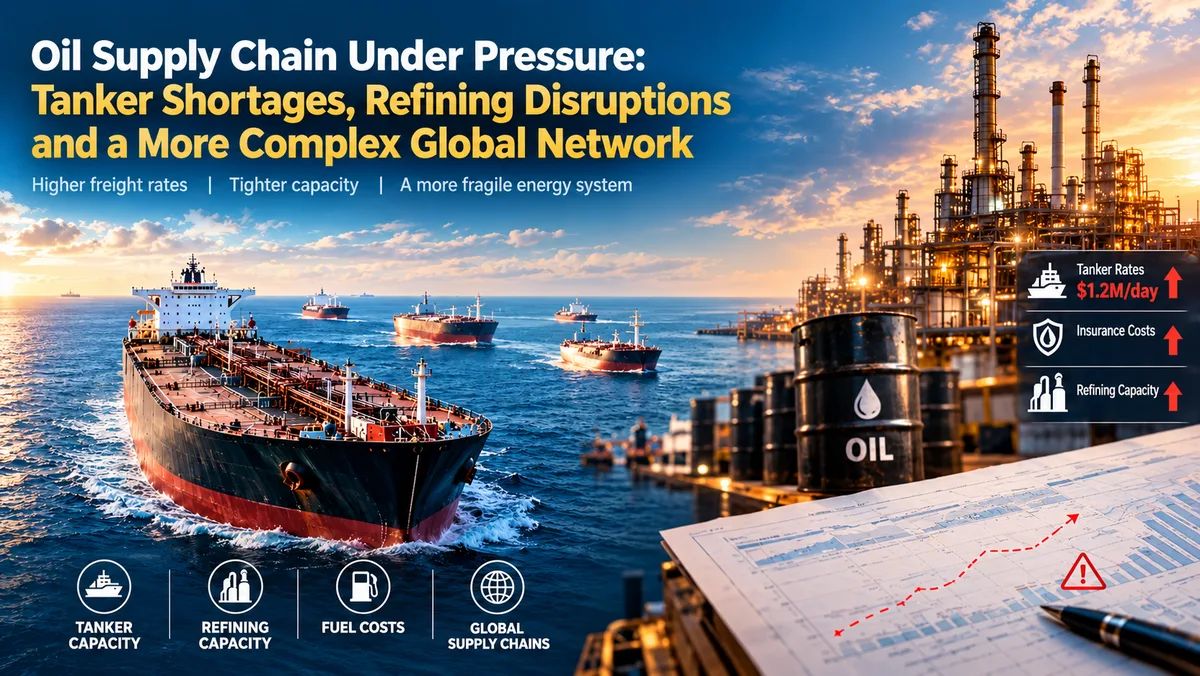
For decades, the global oil industry functioned as a finely tuned system designed to move enormous volumes of crude and fuel over long distances at the lowest possible cost. The conflicts in the Middle East and Eastern Europe have fractured that model, as a combination of record-high tanker rates, soaring insurance costs, and a severe shortage of refining capacity has created bottlenecks across the entire energy supply chain, bottlenecks that are proving far harder to resolve than a simple production shortfall would be.
Hormuz has become a transportation-capacity problem
Even where oil continues to flow, the physical process of moving it has grown far more complicated. Much of this is due to the shuttle system now operating around the Persian Gulf, where multiple tankers are frequently required to transport crude through the Strait of Hormuz to the Gulf of Oman, with cargoes then transferred to smaller vessels before heading to buyers in Asia. At one point this year, roughly 4% of global oil supplies moved via this more complex routing, tying up significant numbers of very large crude carriers and reducing vessel availability everywhere else in the market, a ripple effect that extends well beyond the Gulf itself.
This shuttle system matters because, in petroleum logistics, a tanker effectively functions as inventory in motion. Even if the total number of tankers in the global fleet hasn't changed, effective transportation capacity declines whenever a vessel's cycle time increases, meaning the same fleet can move meaningfully less oil over any given period. This single dynamic, more complex routing stretching out how long each vessel takes to complete a voyage, has pushed VLCC rates from the Middle East to Asia above $1.2 million per day, up from roughly $30,000 a day in January, a roughly 40-fold increase in under a year.
Buyers are rerouting, and that's tightening the market further
At the same time, buyers are increasingly sourcing crude from the Atlantic Basin and shipping it to Asia over far longer routes, a workaround that further tightens the overall tanker market even as it solves individual buyers' supply concerns. Every vessel redirected to a longer Atlantic Basin-to-Asia route is a vessel unavailable for shorter-haul business elsewhere, compounding the capacity squeeze across the entire global tanker fleet rather than simply moving the problem around.
A scarcity of supertankers has sent ocean freight costs soaring to the point that some long-haul crude trades are no longer economically worthwhile, nudging refiners toward nearer sources of crude instead, even when that crude may be more expensive on a pure commodity basis. "It has never been this expensive to move oil around," said Saad Rahim, chief economist at Trafigura Group, speaking at the Bloomberg Commodity Investor Forum. With freight now taking a far bigger slice of a cargo's total value, shipping a load from Houston to Asia piles on roughly $26 a barrel, around $52 million for a single cargo, an amount equal to about one-quarter of the West Texas Intermediate futures price. Before the current conflict, shipping represented only a sliver of delivered crude cost, meaning freight has shifted from a minor line item to a genuine strategic variable in trading decisions.
Russia adds a second shock to refined products
Beyond crude tanker capacity, refining disruption in Russia has created a separate, compounding shock to refined product supply. A refinery outage in Russia doesn't stay contained to Russia; it becomes a tanker-capacity problem in the Atlantic Basin, an inventory problem in Europe or Latin America, and potentially a pricing problem for trucking fleets thousands of miles away, illustrating how quickly disruption in one part of the system ripples across an entirely different geography and transport mode.
Diesel has proven especially sensitive to this kind of disruption. Product tankers travel different routes than crude carriers, and when supply is disrupted at the refining stage, inventories fall quickly in exporting countries while importing countries compete directly for replacement supply, an important distinction for supply chain planning, since a crude shortage and a refined product shortage don't necessarily respond to the same fixes. A country can have ample crude access and still face a diesel shortage if its own, or its trading partners', refining capacity is impaired.
A network-design problem, not just an energy story
Analysts increasingly argue the refining and tanker story belongs as much on a logistics page as an energy-markets one. The underlying challenge can be described through four familiar supply chain variables: node capacity, lane capacity, inventory, and substitution time. Pipelines, tankers, and terminals provide lane capacity, while alternative crude grades, refineries, shipping routes, and suppliers provide the substitution options that determine how quickly the system can adapt when one part of it breaks down. Framed this way, the oil market today looks remarkably similar to the kind of multi-node disruption logistics professionals have grown used to managing in container shipping and air freight over the past several years.
This has led some to argue that refineries themselves now belong on the global supply chain chokepoint map, alongside more traditional bottlenecks like the Suez and Panama canals. Tankers are actively being rerouted in real time as traders and shipping companies work around both physical disruption and the elevated insurance and freight costs that come with operating in or near conflict zones, a constant, moving recalibration rather than a one-time adjustment.
Why it matters for the industry
The result of all this is that oil prices are no longer primarily a function of how much crude exists in the ground, but of the industry's ability to transport and process it, making it significantly more difficult for prices to come down even as underlying supply recovers. For logistics providers, freight forwarders, and anyone managing fuel-dependent supply chains, that distinction matters enormously: a supply problem can often be solved with more production, but a logistics problem requires fixing tanker availability, refining capacity, and safe shipping routes all at once, a far slower and more complex undertaking.
For the broader freight and shipping industry, this dynamic also matters indirectly, since elevated bunker fuel and diesel costs tied to these bottlenecks feed directly into ocean freight surcharges, trucking rates, and air cargo fuel costs across nearly every mode of transport, regardless of whether a given shipment has anything to do with oil itself.
Key takeaways
- Middle East crude exports have risen to their highest levels since the Iran war began, yet oil prices remain elevated.
- VLCC rates from the Middle East to Asia have surged to over $1.2 million per day, up from roughly $30,000 in January.
- Shipping a single Houston-to-Asia cargo now adds roughly $26 a barrel, about $52 million per cargo, in freight costs alone.
- Refinery disruptions in Russia are creating a parallel shock to refined products like diesel, separate from the crude tanker shortage.
- Analysts argue refineries and tanker networks now function as supply chain chokepoints in their own right, not just energy market variables.
For freight forwarders, fuel buyers, and logistics providers across every mode of transport, this shift is worth tracking closely, since elevated fuel costs tied to tanker and refining bottlenecks are likely to keep rippling into broader freight and shipping costs well beyond the energy sector itself.


Comments
No comments yet. Be the first to share your thoughts!