
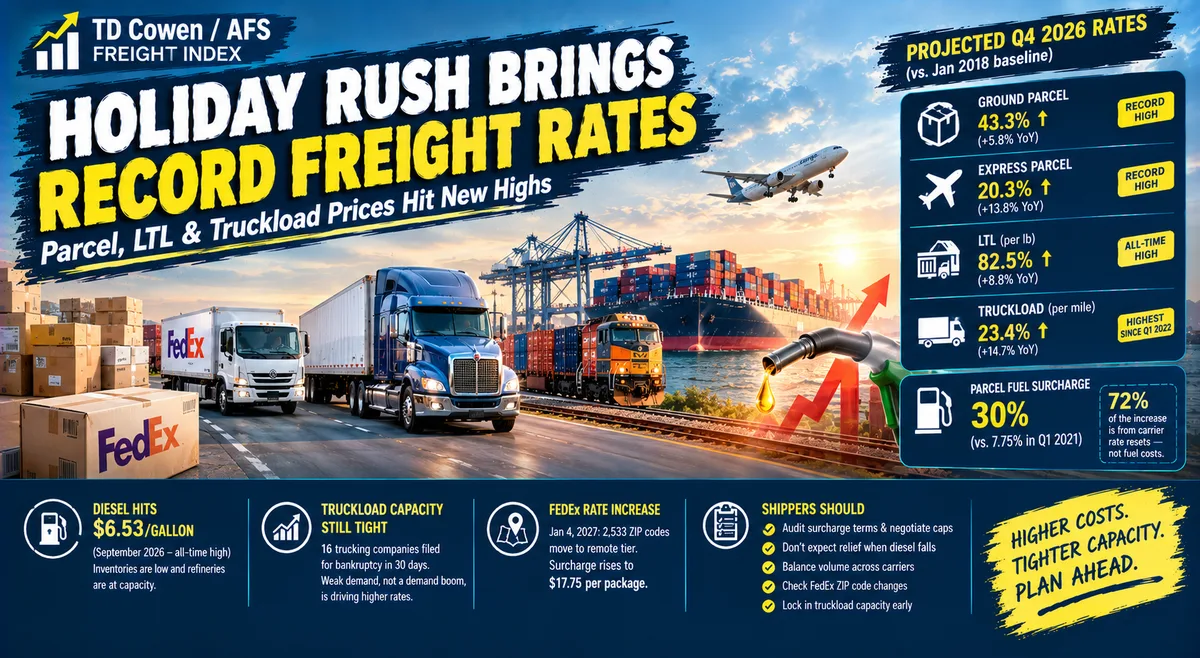
Shippers heading into the holiday rush are about to pay more for parcel, LTL and truckload freight than at almost any point in recent memory. The Q4 TD Cowen/AFS Freight Index, released October 13 by AFS Logistics and TD Cowen, projects record pricing in parcel and LTL and the strongest truckload rates in more than four years, even though underlying freight demand remains soft.
The Numbers Across Every Mode
The index tracks actual net charges, including accessorial fees such as fuel surcharges, against a January 2018 baseline. For Q4 2026 it projects:
- Ground parcel: 43.3% above baseline, a record high, up 5.8% year-on-year.
- Express parcel: 20.3% above baseline, the fifth consecutive record quarter, up 13.8% year-on-year.
- LTL (rate per pound): 82.5% above baseline, the third straight all-time high and the first quarter ever to break 80%, up 8.8% year-on-year.
- Truckload (rate per mile): 23.4% above baseline, up 14.7% year-on-year and the highest since Q1 2022. A year earlier, in Q4 2025, the index stood at just 7.6%.
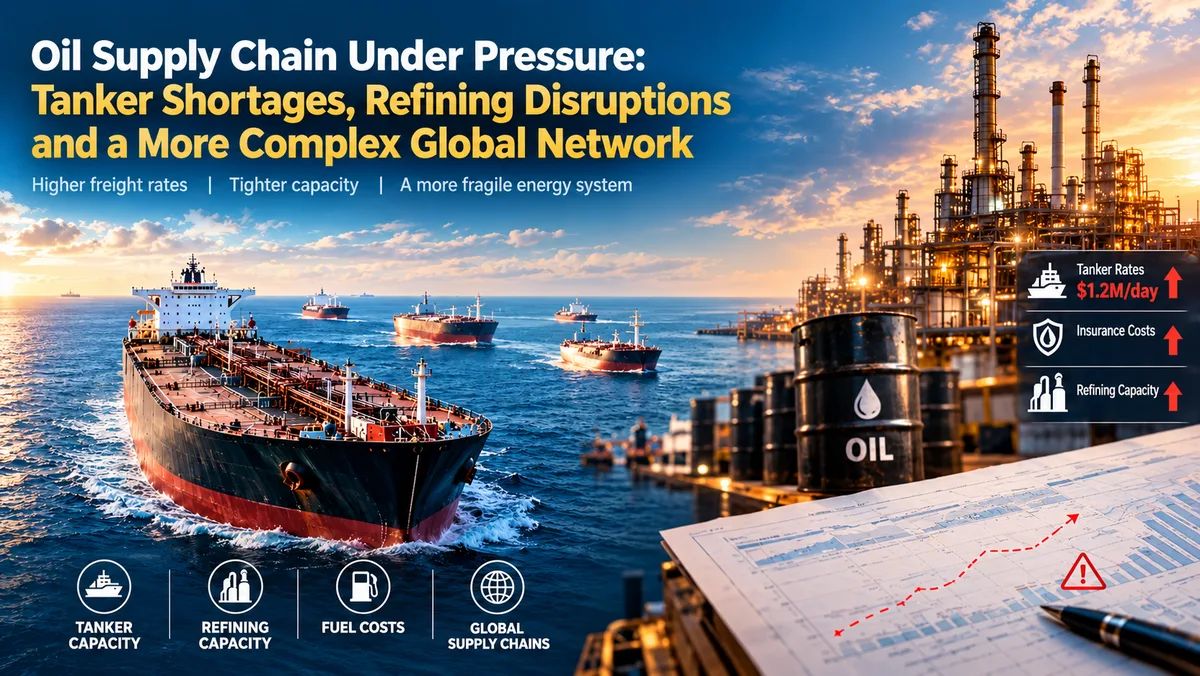
Fuel is the common thread. Diesel peaked at an all-time high of $6.53 a gallon in September. AFS CEO Andy Dyer expects fuel to keep transportation costs elevated for the foreseeable future, because inventories are low and refineries are running at capacity. Supplies have to rebuild before pump prices can ease, even if crude oil falls.
The Fuel Surcharge Finding Shippers Should Not Miss
The most important point is not that fuel is expensive. It is that, for parcel, much of the surcharge no longer tracks fuel at all. The parcel fuel surcharge has climbed from 7.75% in Q1 2021, when diesel averaged $2.91 a gallon, to 30% in September 2026. AFS found that 72% of that 22.25-point increase comes from carriers repeatedly resetting their surcharge tables, not from the price at the pump. If diesel returned to $2.91 tomorrow, the surcharge would still be 23.75%, roughly three times its 2021 level.
Mingshu Bates, AFS's Chief Analytics Officer, described the consequence plainly: even if crude normalizes, "the effective fuel surcharge will not show a material decrease." In other words, the surcharge has become a revenue lever for carriers as well as a cost pass-through.
LTL behaves differently. Its fuel surcharge follows diesel closely: it spiked in the early months of the Iran war, eased in early summer, then jumped to 79% above its September 2025 level as diesel hit its record. That means LTL surcharges should fall when fuel does, while parcel surcharges likely will not.
A Second Hidden Increase From FedEx
Fuel is not the only surcharge shippers should watch. FedEx's recently announced general rate increase, effective January 4, 2027, reclassifies 2,533 ZIP codes from the extended delivery area tier to the remote tier, the most expensive. In those ZIP codes the surcharge rises to $17.75 per package, roughly doubling the fee for residential deliveries and more than tripling it for commercial ones. This kind of change rarely shows up in headline rate comparisons. It shows up on invoices.
Truckload and LTL: Tight Supply, Weak Demand
Truckload rates are rising without a demand boom behind them. GDP grew 2.2% in Q2, but that growth is concentrated in services and investment rather than goods that need to be moved. The squeeze is on the supply side. Regulatory enforcement is taking drivers off the road and closing training locations, so capacity is unlikely to rebound at its historical replacement rate. High diesel costs have also pushed weaker carriers out of business: 16 trucking companies filed for bankruptcy in a single 30-day period. Steady demand chasing a shrinking pool of trucks is what is pushing rates up.
LTL shows the same disconnect. National carriers are reporting mid-single-digit tonnage declines, yet pricing remains exceptionally strong, because carriers are prioritizing only the loads that fit their networks profitably, according to AFS's Mich Fabriga.
What Shippers Should Do Now
- Audit surcharge terms, not just base rates. Ask carriers how often their fuel tables are reset and negotiate caps or tables pegged to actual diesel prices, especially in parcel.
- Do not budget for surcharge relief when diesel falls. Assume parcel surcharges stay sticky into 2027, while LTL surcharges should track diesel down.
- Balance volume across carriers. Demand surcharges penalize volume above the baselines set earlier in the year, and AFS notes that alternative carriers are gaining share from the large incumbents as shippers diversify to protect capacity.
- Check your delivery ZIP codes against FedEx's reclassification list before January 4, particularly for residential and commercial deliveries in rural or remote areas.
- Lock in truckload capacity early. With rates at four-year highs and capacity still tightening, relying heavily on spot rates carries more risk than it did a year ago.
Key Takeaways — October 14, 2026
- The Q4 TD Cowen/AFS Freight Index, released October 13, projects 2026 as the most expensive parcel shipping year on record, with ground parcel at 43.3% and express at 20.3% above the 2018 baseline.
- LTL rates per pound are projected at 82.5% above baseline, the first quarter ever to exceed 80% and the third straight all-time high.
- Truckload rates are projected at 23.4% above baseline, up 14.7% year-on-year and the highest since Q1 2022, driven by shrinking capacity rather than rising demand.
- Diesel hit an all-time high of $6.53 a gallon in September, and AFS expects fuel to keep costs elevated because inventories are low and refineries are at capacity.
- 72% of the rise in the parcel fuel surcharge since 2021 comes from carriers resetting surcharge tables, not from the cost of fuel. Even at $2.91 diesel, the surcharge would still be 23.75%.
- FedEx's January 4, 2027 rate increase moves 2,533 ZIP codes to its most expensive remote delivery tier, with the surcharge rising to $17.75 per package.


Comments
No comments yet. Be the first to share your thoughts!