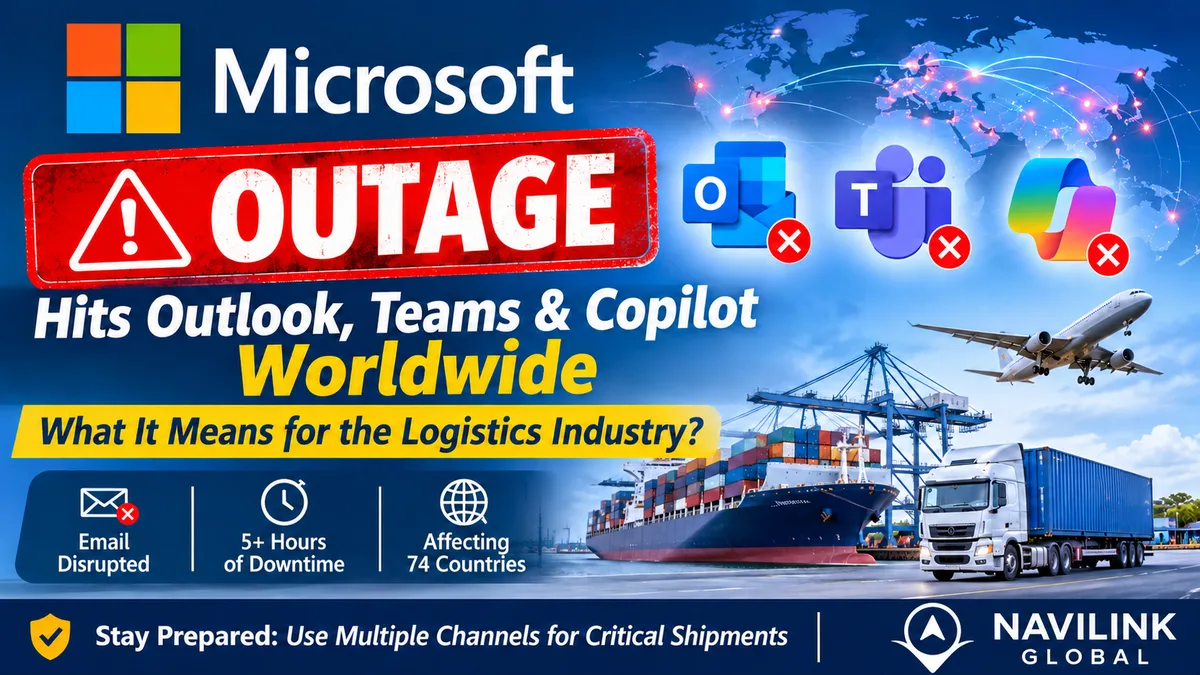

A major Microsoft outage disrupted Outlook, Teams, Copilot and other Microsoft 365 services around the world, creating a headache for the logistics industry, where email remains the main channel for quotes, booking confirmations, customs queries and shipment updates.
What happened
The disruption began on Thursday, November 12, shortly after 1:00 p.m. Eastern Time, with outage tracker Downdetector recording nearly 130,000 reports of Outlook problems. Within about an hour it had spread to Microsoft products in 74 countries and territories. Services including Outlook, Exchange Online, OneDrive and Microsoft 365 were affected, and the outage lasted more than five hours. Some users were still reporting problems on Friday. Reports at the time said no malicious activity had been seen.
The business impact was immediate. Electric truck maker Workhorse delayed its third-quarter results announcement from November 12 to November 16, citing disruption from the outage.
How logistics firms responded
Across the freight industry, companies moved quickly to keep customers informed. Carriers and customs brokers in the UK and Ireland posted notices telling clients that email replies might be delayed. Some directed customers to a dedicated phone line for customs enquiries, while others pointed them to chat functions inside their customer portals, where messages about shipments, customs entries and invoices are kept against the relevant job.
These simple steps kept cargo moving, and they showed how exposed day-to-day freight communication is when one platform goes down.
Why it matters for shippers and forwarders
Logistics runs on time-sensitive information. A missed email about a customs hold, a booking cut-off or a changed delivery slot can mean storage fees, demurrage or a missed vessel. When a core tool like email fails, the risk is not only slower replies but also missed instructions and confusion over which version of a document is current.
Outages also create openings for fraud. When teams are working through unusual channels, fake messages asking to change bank details or approve urgent payments become harder to spot. Verifying any unexpected request through a second, trusted channel is good practice at all times, and especially during disruption.
How to prepare for the next outage
- Keep a shared list of phone numbers and alternative contacts for your key forwarders, carriers and customs brokers.
- Use more than one channel for critical shipments, such as portal messaging, phone or a secondary email address.
- Store key shipping documents, including bills of lading, invoices and customs entries, where your team can reach them without email.
- Confirm any change in payment details by phone before acting on it.
- Build relationships with more than one freight forwarder so a single point of failure does not stall your shipments.
Key takeaways
- A global Microsoft outage disrupted Outlook, Teams and Copilot in 74 countries on November 12.
- Freight and customs firms used phone lines and portal chat to keep serving customers.
- Email dependence is a real operational risk for time-sensitive shipments and customs work.
- Outages raise fraud risk, so verify unusual payment or instruction requests through a second channel.
For shippers, the practical lesson is to avoid relying on a single provider or channel. Having more than one trusted freight forwarding partner gives you backup options when systems fail. NavilinkGlobal helps shippers connect with freight forwarding professionals and receive real quotes, so you can build that wider network before you need it.



Comments
No comments yet. Be the first to share your thoughts!