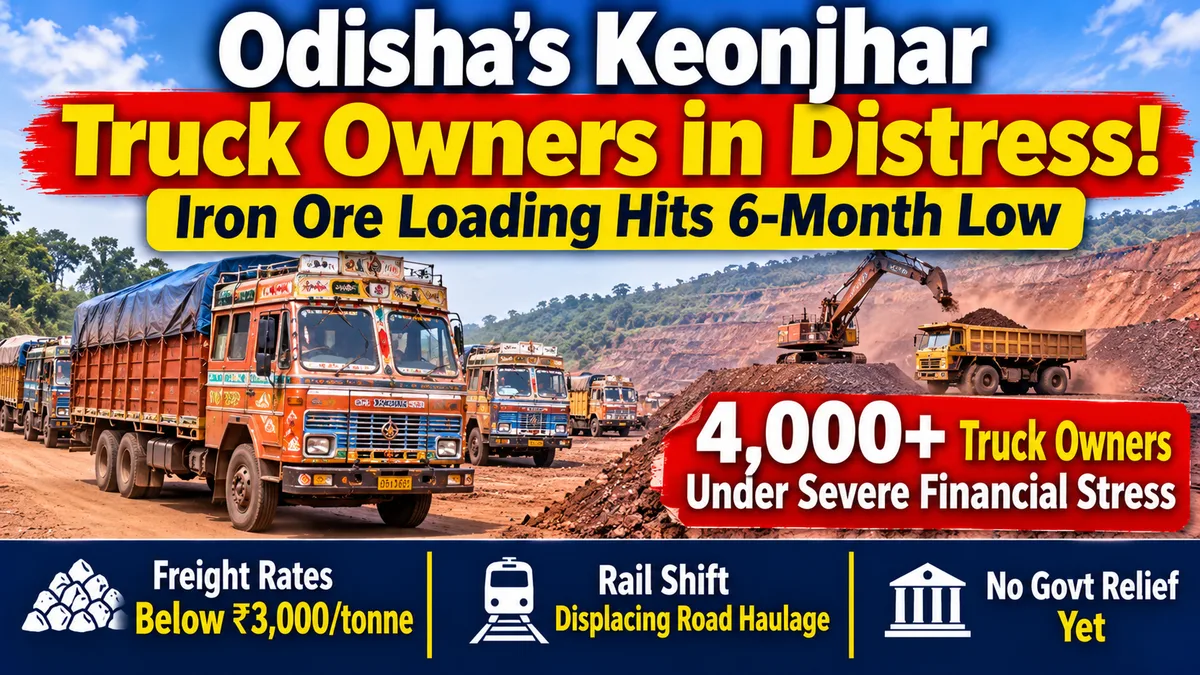

More than 4,000 truck owners in Odisha's Anandapur subdivision are under severe financial pressure after iron ore loading from mines in Keonjhar district — one of India's most significant iron ore producing regions — fell sharply for more than six months. The crisis has left thousands of vehicle owners unable to cover operating costs, with many trucks sitting idle or displaced to other districts in search of work.
What Is Happening on the Ground
Truck owners told regional newspaper Sambad that loading has remained largely suspended across several sectors in Keonjhar, with limited local work forcing many vehicles to relocate to the Koida sector in neighbouring Sundargarh district. Even there, the rates available are substantially below what operators need to cover costs.
The earlier benchmark rate for hauling iron ore from Joda to Paradip — a key route connecting the mining belt to Odisha's main port — was approximately ₹3,000 per tonne. Current rates have fallen well below that level, leaving truck owners unable to recover the cost of diesel, tyres, and spare parts — all of which have become more expensive over the same period.
Bishwaranjan Maharana, a truck owner from Ghasipura, told Sambad that alleged political interference in iron ore transport was preventing operators from receiving fair freight rates — a charge that adds a governance dimension to what is already a serious economic crisis for the region's transport community.
The Rail Shift — Structural Change Behind the Crisis
Devadatta Nayak, Vice President of the Keonjhar Truck Owners' Association, identified the core structural driver: mining companies are increasingly prioritising rail transport over road-based trucking for iron ore evacuation. This shift — driven by cost efficiency, regulatory pressure to reduce road damage, and India's national push to increase freight movement by rail — is directly displacing thousands of truckers who have historically depended on road-based iron ore haulage for their livelihoods.
Nayak also pointed to a decline in iron ore exports as a compounding factor — reducing the overall volume of ore being moved regardless of transport mode.
Why Keonjhar Matters for India's Steel Supply Chain
Keonjhar district in Odisha is one of India's most critical iron ore producing zones, feeding steel plants across Odisha, Jharkhand, and beyond. The Joda-Barbil mining belt within Keonjhar supplies ore to major integrated steel producers as well as smaller sponge iron units. The Joda-to-Paradip corridor is a primary artery connecting this production zone to export markets.
The shift from road to rail — while economically rational for mining companies — has significant social and economic consequences for the tens of thousands of people whose livelihoods depend on the road transport ecosystem: truck owners, drivers, mechanics, fuel suppliers, and roadside support businesses.
India's government has been actively promoting rail freight through dedicated freight corridor development and incentives for mining companies to shift ore movement off congested state highways. The Keonjhar situation reflects the human cost of that transition playing out in real time — without adequate support mechanisms for displaced road transporters.
No Government Response Yet
Truck owners have formally appealed to the Odisha state government to intervene. As of the time of publication, no government decision, relief measure, or timetable for restoring road-based loading activity has been announced. The Keonjhar Truck Owners' Association continues to press for state-level action on freight rate regulation and transition support.
🔑 Key Takeaways — November 23, 2026
- 4,000+ truck owners in distress — iron ore loading in Keonjhar has been largely suspended across multiple mining sectors for six months.
- Freight rates below operating costs — current rates have fallen well below ₹3,000/tonne benchmark, leaving owners unable to cover diesel, tyres and parts.
- Rail is replacing road — mining companies prioritising rail transport is the primary structural driver of the crisis.
- Iron ore exports also falling — reducing total volume regardless of transport mode, adding pressure on top of the modal shift.
- Political interference alleged — truck owners claim unfair freight rate allocation linked to political factors.
- No government relief announced — formal appeals to Odisha state government remain unanswered.
- Broader lesson — India's road-to-rail freight shift, while strategically sound, is creating real economic pain for road transport communities without adequate transition support.



Comments
No comments yet. Be the first to share your thoughts!