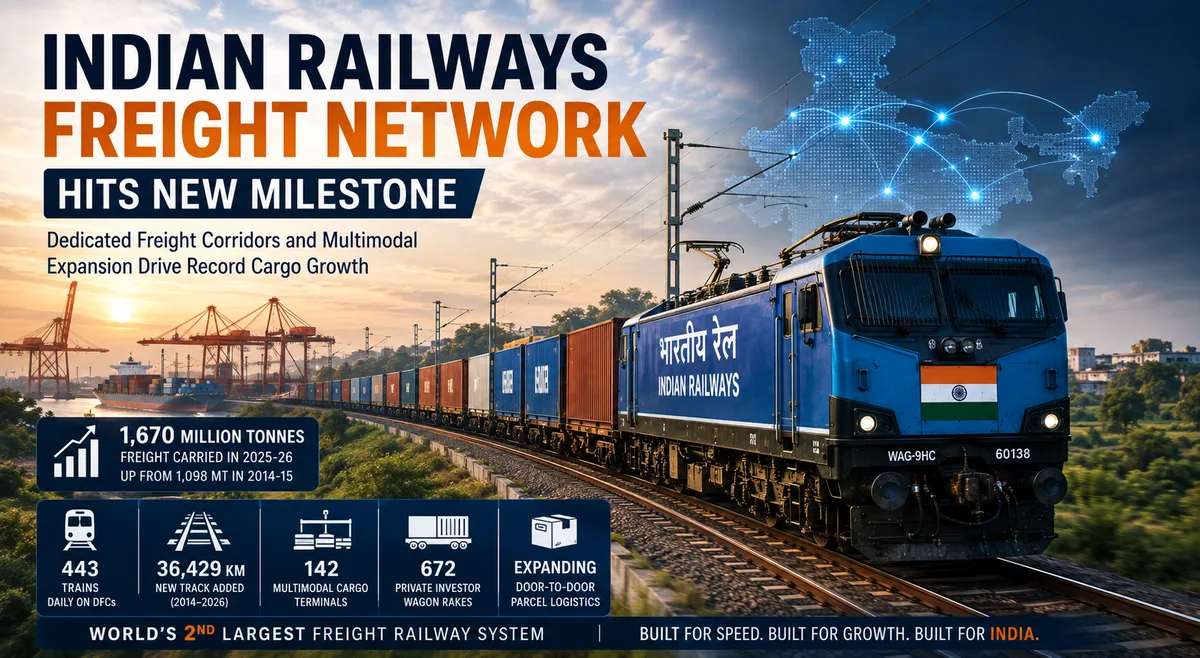
India's freight railway network has reached a milestone that would have seemed unlikely a decade ago. Indian Railways carried 1,670 million tonnes of freight in 2025-26 — up from 1,617 million tonnes the previous year and 1,098 million tonnes in 2014-15 — making it the world's second-largest freight-carrying railway system, behind only the United States. The figure was confirmed by Union Minister for Railways Ashwini Vaishnaw in a statement to the Rajya Sabha on August 8, 2026, citing the full commissioning of both Dedicated Freight Corridors as the primary structural driver of the achievement.
For global logistics operators, importers, exporters, and freight forwarders routing cargo through India, the network behind those numbers is fundamentally different from what existed five years ago — and it is still being built out. Understanding what changed, and what is still coming, is now a practical supply chain necessity, not just background knowledge.
The Dedicated Freight Corridors — What They Actually Are
The headline number — 1,670 million tonnes — cannot be understood without understanding the two infrastructure projects that made it possible. The Eastern Dedicated Freight Corridor spans 1,337 kilometres from Ludhiana in Punjab to Sonnagar in Jharkhand, connecting northern India's industrial heartland — Punjab, Haryana, Uttar Pradesh, Bihar — with the eastern coal belt. The Western Dedicated Freight Corridor spans 1,506 kilometres from Dadri in Uttar Pradesh to Jawaharlal Nehru Port Terminal in Navi Mumbai, connecting India's largest container port with the manufacturing and agricultural hinterland of Rajasthan, Gujarat, and northern India.
Both corridors are now fully commissioned, with approximately 443 trains operating daily across the two networks. That figure understates the operational significance: these are not shared tracks where freight trains negotiate paths with passenger services. They are purpose-built freight-only lines, engineered for heavier axle loads, higher speeds, and continuous operation without the delays and conflicts that have historically made Indian rail freight unreliable for time-sensitive cargo.
The practical results are measurable. Average freight train speeds on the DFCs are significantly higher than on the conventional network. Turnaround times for wagons have improved. And critically, the diversion of freight traffic onto dedicated lines has freed up capacity on the conventional rail network — allowing Indian Railways to run more passenger services and more goods trains simultaneously, without the bottlenecks that previously forced one to wait for the other.
The Infrastructure Numbers Behind the Milestone
The DFCs are the headline, but the broader infrastructure expansion that underpins the freight milestone is equally significant:
- New track commissioning: Indian Railways commissioned an average of 8.32 kilometres of new track per day between 2014 and 2026 — nearly double the 4.2 km per day averaged between 2009 and 2014. In total, 36,429 km of new track was added in the twelve-year period, compared with 7,599 km in the previous five-year period. As of April 1, 2026, Indian Railways has 514 sanctioned infrastructure projects spanning 40,000 km currently in progress, at a total estimated cost of approximately ₹8.31 lakh crore, of which ₹3.05 lakh crore has already been spent.
- Gati Shakti Multi-Modal Cargo Terminals: Under the Gati Shakti policy, 142 multimodal cargo terminals have been commissioned across India, with an aggregate freight handling capacity of 224 million tonnes per year. Private investment mobilised under this policy amounts to approximately ₹10,000 crore. In 2025-26, these terminals handled 146 million tonnes of freight — making them a meaningful and growing component of India's overall rail freight throughput.
- Specialised wagon fleet expansion: Approximately 275 rakes of special-purpose wagons and 397 rakes of general-purpose wagons are currently operational under private investment schemes, covering commodities including cement, oil, steel, and fly ash. A separate scheme for automobile transportation has around 54 industry-owned rakes in operation — directly relevant to India's rapidly growing vehicle export market.
- Door-to-door parcel logistics: Indian Railways is expanding into last-mile freight through its Joint Parcel Product-Rapid Cargo Service scheme, with CONCOR providing services on the Delhi-Kolkata and Mumbai-Kolkata corridors and a pilot project running at Sonik goods shed.
What This Means for Global Trade Flows Through India
India's shift from the world's fourth-largest to the world's second-largest freight railway is not just a domestic logistics story. It has direct implications for international trade flows using Indian ports and hinterland connections:
The Western DFC's direct connection to Jawaharlal Nehru Port Terminal — India's largest container port — means that cargo arriving at JNPT from Asia, Europe, and the Middle East can now move inland on a dedicated freight corridor rather than competing with passenger trains on the conventional network. That single connectivity improvement changes the economics of routing containerised cargo through India versus through Singapore or Dubai for distribution to the Indian subcontinent.
For exporters using Indian manufacturing hubs in Rajasthan, Gujarat, Haryana, and Punjab, the Western DFC provides a direct, high-speed rail connection to the port that did not exist at competitive service levels before. Textile exporters, pharmaceutical manufacturers, automotive parts producers, and agricultural commodity exporters can now access port connectivity that is structurally more reliable than what existed three years ago.
The Eastern DFC similarly changes the connectivity picture for coal, steel, and bulk commodity flows between India's industrial belt and its eastern ports, with downstream effects on shipping volumes and cargo mix at ports including Kolkata, Haldia, and Paradip.
The Next Phase — Three More Corridors in Planning
The most significant forward-looking element of the August 8 announcement is the confirmation that expansion is continuing. The Union Budget 2026 announced a new Dedicated Freight Corridor connecting Dankuni in West Bengal to Surat in Gujarat — approximately 2,100 kilometres running through West Bengal, Jharkhand, Odisha, Maharashtra, and Gujarat. The Railway Board has directed expedited implementation with fast-track action on pre-construction activities. Preparation of the Detailed Project Report is now underway.
Beyond Dankuni-Surat, India is preparing Detailed Project Reports for three additional freight corridors: a North-South Corridor linking northern industrial regions with southern port cities, an East-Coast Corridor connecting the eastern seaboard for port-led freight movement, and an East-West Corridor enabling cross-country bulk cargo flows. The combined estimated investment for these three corridors is in the range of ₹2 lakh crore — a commitment that signals India's freight infrastructure expansion is a multi-decade programme, not a completed project.
India as the First Country to Operate Electric Double-Stack Container Trains at Scale
One specific technical achievement from the Western DFC deserves separate attention for its global significance. India has become the first country in the world to commercially operate electric double-stack container trains at scale under overhead electrification. Double-stack containers — two layers of containers on a single flatcar — are standard in the United States on diesel-powered routes, but they require significantly more vertical clearance than conventional rail infrastructure provides. The Western DFC was engineered from the outset with the clearance profile and electrification infrastructure needed to run double-stack trains, making it a genuinely world-first operational achievement rather than just a domestic milestone.
The practical freight benefit is straightforward: a double-stack train carries twice the container volume of a single-stack train for roughly the same locomotive and crew cost. That cuts the per-container logistics cost significantly and makes rail competitive with road freight on lanes where it previously was not.
What Logistics Operators Should Know Right Now
- The Western DFC is now a viable, competitive option for JNPT hinterland movements. If you are routing containerised cargo through JNPT to or from northern India — including Delhi NCR, Punjab, Rajasthan, and Haryana — the Western DFC provides significantly better transit times and reliability than the conventional rail network. Engage your Indian freight partners on current DFC service options before defaulting to road.
- The Gati Shakti terminal network changes the last-mile calculation. 142 multimodal cargo terminals handling 146 million tonnes per year represent a substantially expanded inland origin/destination network. Locations that previously lacked competitive rail freight access may now have viable terminal options. Review your Indian origin and destination points against the current GCT network.
- The automobile transportation scheme is directly relevant to vehicle logistics. India's vehicle export market has been growing rapidly, and the 54 industry-owned rakes specifically designed for automobile transportation represent dedicated capacity for a sector that has historically struggled with rail connectivity to port.
- The Dankuni-Surat DFC will reshape east-west freight economics when complete. A 2,100-km dedicated freight corridor connecting eastern and western India will fundamentally change the logistics cost structure for cargo moving between Bengal, Jharkhand, Odisha, and the Gujarat-Maharashtra manufacturing corridor. Start factoring this into long-range network planning now, even though the corridor is years from completion.
Key Takeaways — August 8, 2026
- Indian Railways carried 1,670 million tonnes of freight in 2025-26 — up 3.25% year-on-year and up 52% from 1,098 million tonnes in 2014-15 — making it the world's second-largest freight-carrying railway, behind only the United States.
- Both Dedicated Freight Corridors are now fully commissioned: the Eastern DFC (1,337 km, Ludhiana to Sonnagar) and the Western DFC (1,506 km, Dadri to JNPT), with 443 trains operating daily across the two corridors.
- 142 Gati Shakti Multimodal Cargo Terminals have been commissioned with 224 million tonnes per year of aggregate capacity, handling 146 million tonnes of freight in 2025-26.
- India is the first country in the world to commercially operate electric double-stack container trains at scale under overhead electrification — a global first achieved on the Western DFC.
- A new 2,100-km Dankuni-Surat DFC was announced in the Union Budget 2026, with Detailed Project Report preparation now underway. Three additional corridors (North-South, East-Coast, East-West) are in planning, with a combined estimated investment of ₹2 lakh crore.
- For global logistics operators: the Western DFC's direct connectivity to JNPT makes rail a genuinely competitive option for containerised hinterland freight that it was not three years ago.


Comments
No comments yet. Be the first to share your thoughts!