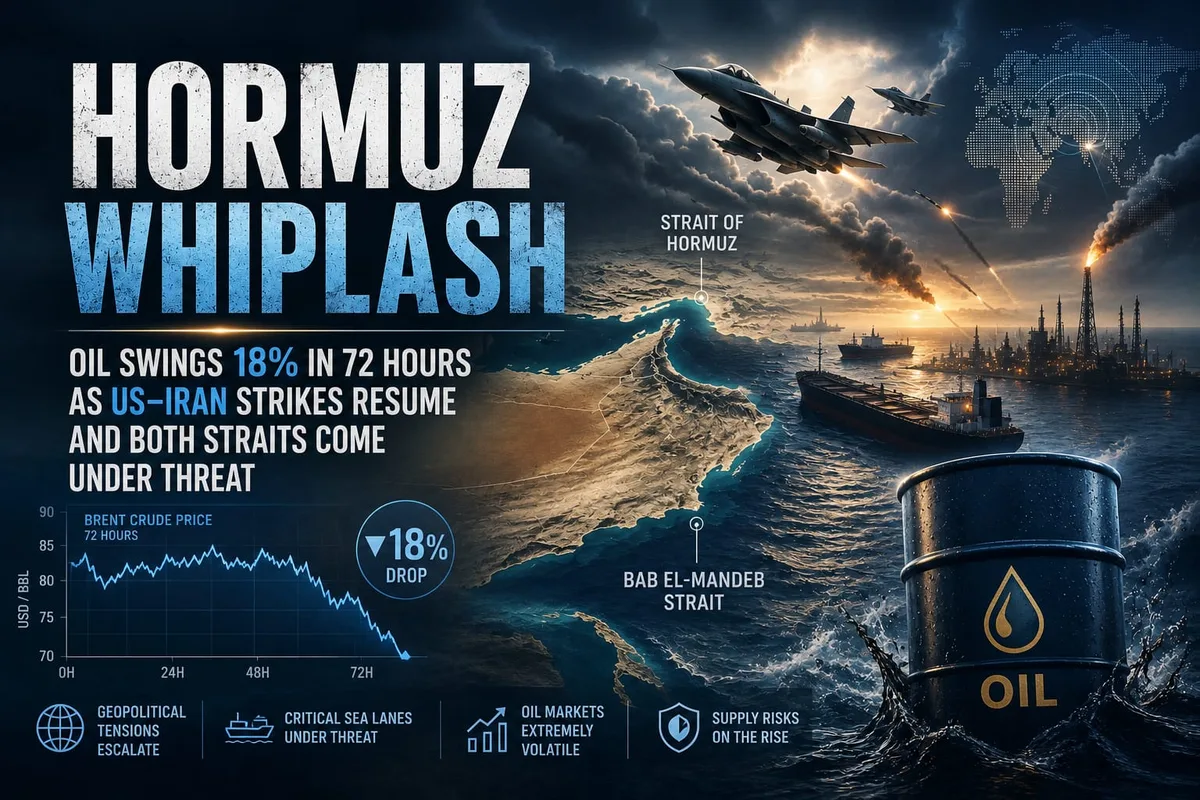
Since NavilinkGlobal last reported on the Hormuz situation on July 23, the conflict has moved through three distinct phases in less than a week — each one demonstrating how rapidly the market conditions affecting global shipping can reverse. For supply chain professionals trying to plan around this crisis, the 72 hours between July 27 and July 30 are a case study in exactly why static planning assumptions fail in this environment.
Phase One: The Pause — Oil Falls 11%
On July 27, the United States paused its airstrikes on Iran for the first time in nearly two weeks. Trump confirmed the pause was made at Iran's request, warning the US would resume attacks if a new ceasefire deal was not reached. Iran's Foreign Ministry spokesperson Esmail Baghaei said talks with Oman on managing safe passage through Hormuz had "made progress and continued" — the first diplomatic signal in days that a negotiated reopening remained possible.
Markets reacted immediately. Brent crude fell 11.3% to $85.87 per barrel — its biggest single-day decline since April 8, the day of the first ceasefire agreement. US crude dropped approximately 7% to $82.61. The speed and scale of the oil price reaction confirmed what the market has been signalling throughout this conflict: the premium priced into energy costs is almost entirely geopolitical. When the shooting stops, even temporarily, traders move fast.
For shipping, the picture was more sobering. Despite the pause in hostilities, fewer than 10 commodity ships passed through the Strait of Hormuz as of Monday morning — against a pre-war normal of approximately 100 commercial vessels per day. The operational reality on the water was not matching the diplomatic signal. Shipowners and insurers were not resuming normal transit decisions based on a ceasefire request; they were waiting for a signed, enforced agreement with demonstrated compliance — a standard the previous MOU failed to meet.
Phase Two: Escalation Resumes — Oil Rebounds 7%
The pause lasted less than 48 hours. On July 29, the US launched fresh strikes on Iran following an intercepted Iranian missile attack on US forces. Explosions were reported in Bandar Abbas — the southern port city that sits directly at the entrance to the Strait of Hormuz — and on the Persian Gulf island of Kish. Iranian state media IRIB confirmed blasts in both locations. Iran's state broadcaster said there was no damage to residential areas.
Oil prices jumped in reaction, with Brent crude up over 7% to $90.66 per barrel as of mid-afternoon ET on July 29. The reversal — from $85.87 to $90.66 in less than 48 hours — represents an 18-percentage-point swing in the global oil benchmark driven entirely by the on/off rhythm of US-Iran military exchanges. For any supply chain with significant fuel exposure, that kind of price volatility is now a planning variable in its own right, not a background condition.
Trump's stated position hardened further. He told Fox News that the US was "going to keep the Strait, and we'll probably run it. We'll become the guardian of the Strait. Maybe we'll call it the 'Guardian Angel of the Strait'." He added that the US "should be reimbursed" for securing the waterway. That language represents a significant shift from the ceasefire framework language of June — from "reopening the strait under a negotiated MOU" to "the US controlling and being paid for managing the strait." The implications for how any future diplomatic resolution is structured are significant.
Phase Three: The Second Chokepoint — Bab al-Mandeb Falls 22%
The most operationally significant development of the past 72 hours for the shipping industry is not the Hormuz strike-pause-strike cycle — it is what is happening simultaneously at the Bab al-Mandeb Strait, 1,500 kilometres to the southwest.
Transits of the Bab al-Mandeb Strait have fallen by 22% since the Houthis declared a maritime embargo on Saudi Arabia on July 21 — a story NavilinkGlobal reported on July 22. That 22% decline in Bab al-Mandeb traffic represents the materialisation of a risk this page flagged when it first reported on the Houthi embargo: that even a US-Iran ceasefire would not resolve the separate threat to Saudi Arabia's Red Sea export route through Yanbu.
The continued closure of the Strait of Hormuz combined with the Houthis targeting Saudi-flagged oil tankers in the Bab al-Mandeb had caused further panic in the industry. Deutsche Bank analysts noted in a research note that the dual threat raises "the prospect of simultaneous disruption to both Gulf and Red Sea export routes" — precisely the scenario this page flagged as the worst-case outcome when the Houthi blockade was first announced.
The one partial relief: the Houthis have not targeted any ships since the initial two Saudi tankers, possibly bringing some calm back to investors. But that calm is contingent on Houthi restraint — not on any structural change to the threat environment, and not on any diplomatic agreement covering the Red Sea dimension of this crisis.
Separately, Saudi Arabia intercepted several drones launched from Iraq that targeted petroleum facilities in the kingdom's Eastern Province and the Riyadh region. The expansion of attacks to Saudi oil infrastructure from Iraq-based Iran-backed groups adds a third geographic dimension to the energy supply chain disruption — one that extends beyond the two straits to the production infrastructure feeding them.
Where Diplomacy Stands Right Now
Oman launched a regional diplomatic push on July 27 aimed at finding a political solution. Iran confirmed it continued to speak with Oman about managing safe passage through Hormuz, with its Foreign Ministry describing talks as having "made progress." The US naval blockade of Iran continued throughout the pause period — with a dozen commercial ships redirected, two disabled, and two boarded as of July 27, according to CENTCOM.
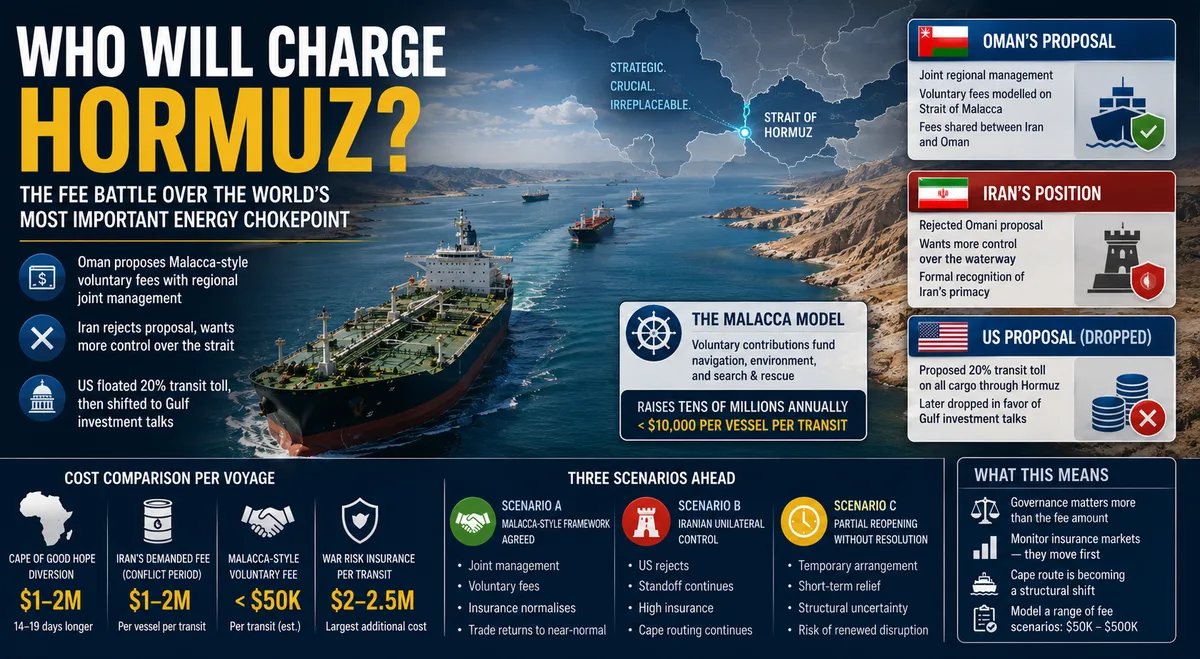
The diplomatic picture is fractured. Iran insists the June MOU gives it the right to manage shipping in the strait and collect transit fees. The US insists on freedom of navigation without Iranian oversight or fees. Trump has now framed the US position as permanent control and reimbursement — language that suggests the gap between the two positions has widened, not narrowed, since the June MOU was signed. As Britannica's updated conflict summary noted as of July 29: the conflict has entered "a new phase as Saudi Arabia helps hit proxies and diplomacy stalls again."
What This Means for Shippers and Logistics Operators Right Now
- The 18% oil swing in 72 hours is the new normal, not an aberration. Any supply chain contract, fuel surcharge model, or carrier rate structure built around a stable oil price assumption needs to be rebuilt around a volatility assumption. Brent between $85 and $102 — the range of the past two weeks — is not a pricing environment; it is a planning emergency.
- Both straits are now simultaneously disrupted. Fewer than 10 ships per day through Hormuz. Bab al-Mandeb transits down 22%. Deutsche Bank has flagged this as the "simultaneous disruption" scenario. Saudi Arabia's Yanbu workaround is under Houthi pressure. There is no currently reliable, fully functioning major energy export route from the Gulf region. This is the most severe simultaneous chokepoint disruption in modern maritime history.
- Trump's "Guardian of the Strait" language changes the diplomatic landscape. If the US position has shifted from "reopen the strait under a negotiated framework" to "the US controls and is reimbursed for managing the strait," the pathway to a negotiated settlement that Iran can accept has narrowed considerably. A resolution that gives Iran no role and no revenue in a waterway it has asserted sovereignty over is not a resolution Iran's current government can agree to domestically. Watch whether this language softens in subsequent days — if it does, a deal is possible. If it hardens, the conflict has entered a new phase.
- The Iraq drone attack on Saudi oil infrastructure is a new escalation vector. Previous episodes involved maritime attacks on shipping and military assets. Drones from Iraq targeting Saudi petroleum production facilities in the Eastern Province introduce the possibility of direct production disruption — not just shipping disruption — which would affect oil availability, not just oil transit.
Key Takeaways — July 30, 2026
- US-Iran strikes paused July 27 — Brent crude fell 11.3% to $85.87, its biggest single-day drop since April 8, but fewer than 10 ships per day were still transiting Hormuz despite the pause.
- Strikes resumed July 29 after Iran attempted a missile attack on US forces — US hit Bandar Abbas and the island of Kish. Brent rebounded 7% to $90.66, an 18-percentage-point swing in 72 hours.
- Bab al-Mandeb transits have fallen 22% since the Houthi maritime embargo on Saudi Arabia was declared July 21 — both major Gulf export chokepoints are now simultaneously disrupted.
- Iran-backed drones from Iraq targeted Saudi petroleum facilities in the Eastern Province and Riyadh — introducing production disruption risk alongside transit disruption risk for the first time.
- Trump framed the US position as permanent control of the strait with reimbursement — significantly harder language than the June MOU framework and a potential obstacle to any negotiated resolution Iran can accept.
- Oman diplomacy continues but no agreement exists. The US naval blockade of Iran remains in force. The conflict, per Britannica's July 29 update, has entered "a new phase as diplomacy stalls again."

Comments
No comments yet. Be the first to share your thoughts!