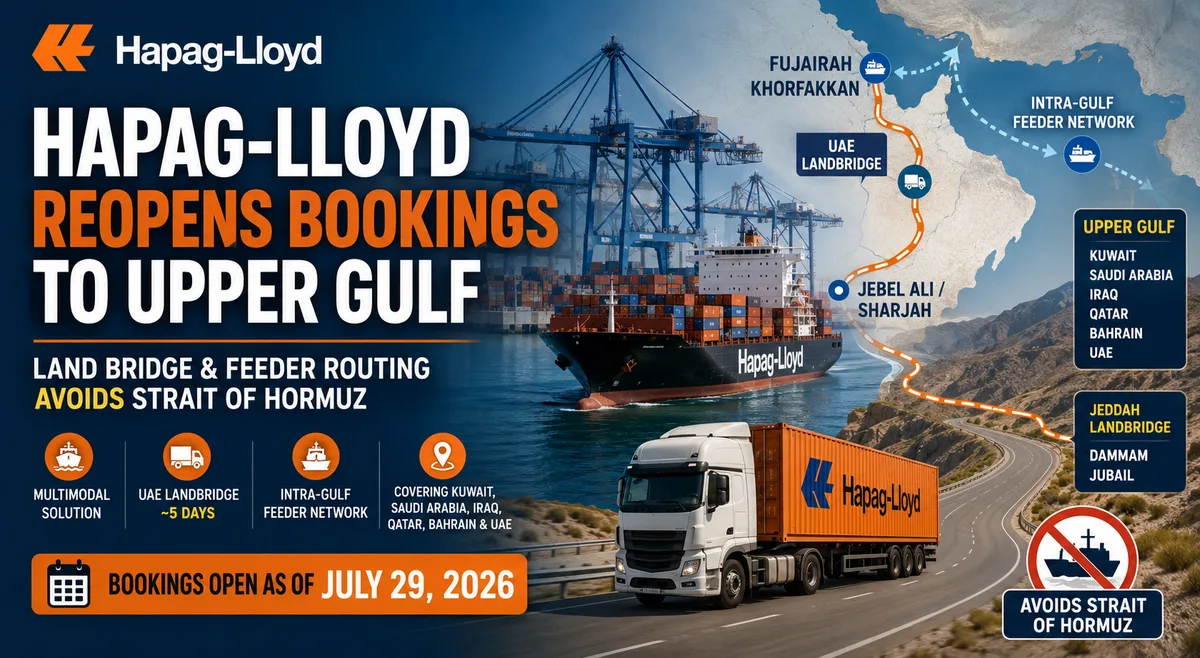
For shippers and freight forwarders who have been unable to move cargo into the Upper Gulf since the Strait of Hormuz effectively closed in February, today's announcement from Hapag-Lloyd is the most actionable news in five months. The world's fifth-largest container carrier confirmed on July 29 that it has reopened bookings to and from destinations across the Upper Gulf — Kuwait, Saudi Arabia, Iraq, Qatar, Bahrain, and the United Arab Emirates — using a multimodal routing that avoids the Strait of Hormuz entirely.
The announcement does not mean the strait has reopened. It means Hapag-Lloyd has engineered a workaround complex enough, and reliable enough, to resume commercial bookings on lanes that have been effectively suspended since the conflict began. For supply chain planners who have been waiting for any pathway back into the Gulf, this is the clearest signal yet that an overland alternative is operationally viable — and for the first time, one of the world's largest carriers is prepared to stake its reputation on it.
How the New Routing Actually Works
The revised routing Hapag-Lloyd has built is a multimodal chain that connects incoming ocean freight to Upper Gulf destinations without passing through the strait at any point. Understanding it in detail matters because the specific routing determines the transit time, cost, and operational risk your cargo will carry.
For cargo bound for the UAE — including Jebel Ali, Dubai, Sharjah, and Abu Dhabi — the new process works as follows: vessels offload at Fujairah or Khorfakkan, the UAE's east coast ports located on the Gulf of Oman side of the Arabian Peninsula, outside the Strait of Hormuz. Cargo then moves inland by bonded road transport — a landbridge — crossing the UAE from east coast to west coast. Hapag-Lloyd has estimated this landbridge segment takes approximately five days. From the west coast, cargo connects onward to its final UAE destination.
For cargo bound for Kuwait, Iraq, Qatar, and Bahrain — all of which sit deeper inside the Persian Gulf — the routing adds a further step. After arriving at Fujairah or Khorfakkan by vessel and crossing the UAE landbridge to Jebel Ali or Sharjah, cargo then connects to the intra-Gulf feeder network — smaller vessels operating within the Gulf itself, which are not subject to the same threat environment as ocean-going vessels transiting the strait from outside. These feeders carry cargo from Jebel Ali or Sharjah onward to its final Gulf destination.
For cargo destined for Dammam and Jubail — Saudi Arabia's primary Gulf Coast ports — the routing uses a different solution already in place: the Jeddah landbridge. Cargo arrives at Jeddah on the Red Sea coast, then moves overland across Saudi Arabia's Al-Bahah corridor to the Eastern Province. This route has been operational since the early months of the crisis and has been used by multiple carriers; Hapag-Lloyd is formalising its use as a standard booking option rather than an ad-hoc exception.
The Constraints You Need to Know
Hapag-Lloyd's announcement comes with three explicit constraints that directly affect how useful this routing is in practice — and shippers need to understand all three before committing cargo.
First, there is no fixed weekly schedule for feeder services within the Gulf. Hapag-Lloyd specifically stated that intra-Gulf feeders will not operate on a regular timetable and will remain contingent upon regional safety conditions. This is a significant operational caveat: it means shippers cannot plan around predictable vessel departures from Jebel Ali or Sharjah to final Gulf destinations. Service frequency will vary based on security assessments, not commercial scheduling. The five-day landbridge estimate covers the UAE crossing only — the total end-to-end transit time from origin to a destination like Kuwait City or Doha will be substantially longer, and less predictable, than the landbridge segment alone.
Second, Hapag-Lloyd's Carrier's Haulage service via Jeddah remains suspended for cross-border movements to the Upper Gulf until further notice. This applies to cargo moving from Jeddah to consignees outside of Saudi Arabia — meaning shippers relying on Hapag-Lloyd's own trucking network for the Jeddah-to-Eastern-Province cross-border movement cannot currently use it. The Jeddah landbridge solution is available, but the inland last-mile connectivity through Hapag-Lloyd's own network is not — meaning shippers will need to arrange their own overland transport or work with local partners for the Saudi cross-border leg.
Third, Merchant's Haulage from Jeddah for consignees outside Saudi Arabia is also restricted. Shippers who handle their own inland transport arrangements from Jeddah still face the same cross-border limitation — the restriction is on the movement itself, not just on who operates the trucks.
What This Means in the Context of the Broader Hormuz Crisis
Hapag-Lloyd's booking reopening is the most operationally detailed workaround any major carrier has announced since the Strait of Hormuz crisis began in February. But it needs to be understood against the broader landscape this page has been tracking.
As this page reported on July 22, DP World signed a 50-year concession to build two new deepwater terminals at Fujairah — the same ports that now serve as Hapag-Lloyd's transshipment points. That 50-year commitment is now validated by Hapag-Lloyd's operational routing decision: the carrier has effectively confirmed that the UAE east coast is the viable bypass route, and has structured its commercial bookings around it. The infrastructure investment and the routing decision are two sides of the same strategic bet.
As this page also reported on July 23, a 10-day ceasefire proposal from regional mediators — Qatar, Egypt, Pakistan, and Oman — remains on the table but unaccepted by either the US or Iran. The Hapag-Lloyd announcement's caveat that feeder services remain "subject to regional safety conditions" directly reflects this reality: the carrier is reopening bookings while explicitly reserving the right to suspend them again if conditions deteriorate. This is not a restoration of normal service — it is a cautious, contingency-hedged reopening that can be reversed at short notice.
The Lloyd's List Intelligence data this page reported on July 23 showed non-Iranian ship transits through the strait had fallen to just 25 for the week of July 13-19, down from 108 the prior week. Hapag-Lloyd's landbridge routing is designed precisely for that environment — moving cargo without any vessel transiting the strait at all.
What Shippers and Freight Forwarders Should Do Right Now
- Contact your Hapag-Lloyd representative immediately if you have suspended Upper Gulf cargo. The booking reopening is live as of today, July 29. Cargo that has been sitting in origin ports or in transit limbo since February now has a carrier-backed routing option. Confirm the specific routing for your destination port, the current feeder frequency, and the estimated total transit time before committing shipments.
- Build significant buffer time into delivery commitments. The five-day landbridge is one segment of a multimodal chain. Total transit times from Asian or European origins to Upper Gulf destinations will be substantially longer than pre-crisis norms and less predictable than the landbridge estimate alone suggests. Communicate this clearly to consignees before shipments depart.
- Understand the Carrier's Haulage limitation before booking. If your standard Hapag-Lloyd booking includes Carrier's Haulage for the inland segment from Jeddah to Eastern Province Saudi destinations, that service remains suspended. You will need to arrange your own inland transport for that leg or work with a local logistics partner.
- Watch for other carriers following Hapag-Lloyd's lead. When one of the world's largest carriers formalises a workaround routing and reopens commercial bookings, it typically signals that other major lines have assessed the same routing and are close to similar decisions. Expect announcements from MSC, CMA CGM, Maersk, and COSCO in the coming days to weeks if Hapag-Lloyd's service operates without incident.
- The route is safety-contingent — plan for disruption. Hapag-Lloyd's explicit caveat that feeder schedules remain subject to regional safety conditions is not standard contract language. It signals that the carrier views the situation as genuinely volatile and reserves the right to adjust or suspend service without standard notice periods. Shippers with time-critical cargo or just-in-time delivery requirements should consider whether the predictability constraints of this routing are compatible with their operational needs.
Key Takeaways — July 29, 2026
- Hapag-Lloyd announced today, July 29, that it has reopened bookings to and from Upper Gulf destinations — Kuwait, Saudi Arabia, Iraq, Qatar, Bahrain, and the UAE — using a landbridge and feeder routing that completely avoids the Strait of Hormuz.
- UAE cargo transships via Fujairah or Khorfakkan, then crosses the UAE by landbridge (estimated five days) to Jebel Ali or Sharjah for final delivery.
- Kuwait, Iraq, Qatar, and Bahrain cargo follows the same UAE landbridge, then connects to the intra-Gulf feeder network from Jebel Ali or Sharjah.
- Dammam and Jubail cargo continues to use the established Jeddah landbridge solution through Saudi Arabia's Eastern Province.
- Feeder services have no fixed weekly schedule and remain subject to regional safety conditions — the routing can be suspended at short notice if security deteriorates.
- Hapag-Lloyd's Carrier's Haulage via Jeddah for cross-border Upper Gulf movements remains suspended — shippers need their own inland transport arrangements for that leg.


Comments
No comments yet. Be the first to share your thoughts!