If your company has spent 2026 building AI into routing, warehouse robotics, or customer service — the way SAP and CMA CGM have, both covered on this page in recent weeks — last week's news out of Silicon Valley deserves your attention, even though it has nothing directly to do with ships, ports, or trucks.
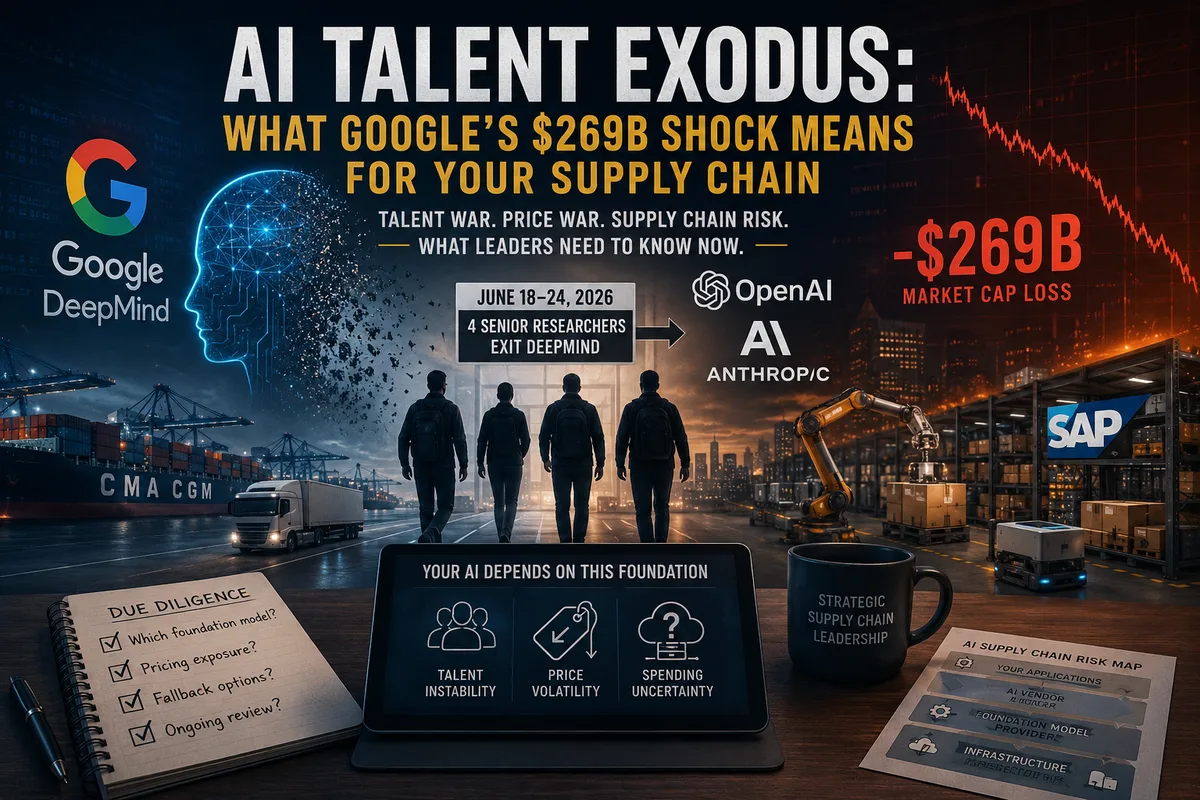
Between June 18 and June 24, 2026, four senior AI researchers left Google's DeepMind division for rival labs Anthropic and OpenAI. The exits triggered a sell-off that wiped approximately $269 billion off Alphabet's market capitalization — one of the steepest declines the company has posted in over a year, according to reporting from Bloomberg, CNBC, and Semafor.
What Happened — Four Departures in Six Days
The exits came in two waves. Noam Shazeer, a VP of engineering and co-lead of Google's Gemini model, announced his move to OpenAI on June 18. Two days later, John Jumper — the DeepMind researcher who won a Nobel Prize for his AlphaFold protein-folding work — left for Anthropic after nine years at the company. Then, reported by Bloomberg on June 24, two more senior Gemini contributors, Jonas Adler and Alexander Pritzel, were confirmed to be following Jumper to Anthropic. Adler had worked on Google's AI coding efforts; Pritzel was a core specialist in model training.
Alphabet shares fell as much as 7% in the worst of the sessions. Investors weren't reacting to an earnings miss or a regulatory problem — they were reacting to people leaving. Analysts now describe AI research talent as a priced-in component of company valuation, not a background HR detail.
Google Pushes Back — But the Pattern Is the Real Story
Google DeepMind CEO Demis Hassabis addressed the departures directly at the Cannes Lions Festival, telling interviewers that Google still has the deepest research bench of any AI lab and wins its fair share of top talent in what he called the most competitive hiring market the tech industry has ever seen. A Google spokesperson echoed those remarks in response to the Adler-Pritzel reports.
Wall Street's reaction suggests the market isn't fully buying the reassurance — at least not yet. 28 of 33 analysts covering Alphabet still maintain "Buy" ratings, and the company's underlying business — a $460 billion-plus cloud backlog, double-digit revenue growth, and an AI consumer product reaching roughly 2 billion people monthly — remains genuinely strong. But the stock move itself is the data point that matters here: investors are increasingly pricing AI talent retention as a leading indicator of whether AI infrastructure investment will pay off.
Why This Matters If You're Not in the AI Business
Most logistics and supply chain companies aren't building their own AI models — they're licensing or embedding someone else's. SAP's autonomous supply chain agents, covered on this page last week, run on Claude, built by Anthropic — one of the two labs at the center of this very talent story. Not every carrier has taken that route: CMA CGM deliberately built its MAIA platform on Mistral AI, a French company, specifically to avoid dependency on US-based AI providers and keep operational data under European data sovereignty rules.
That contrast is the point. The foundation-model layer underneath today's logistics AI tools is genuinely volatile right now, and which provider sits beneath the product you're using is no longer a minor technical detail. The U.S. National Security Agency's March 2026 guidance on AI supply chain risk made this explicit: any AI-enabled routing engine, demand forecast, or warehouse automation platform inherits risk from the model provider and infrastructure behind it — not just from the vendor whose logo appears on the contract.
Three things are happening simultaneously at that foundation layer right now, and all three matter to anyone running AI tools downstream:
- Talent instability at the top labs. The researchers who define how capable and reliable these models are keep moving between companies, sometimes mid product-cycle. Google's own Gemini 3.5 Pro release has already slipped past two announced timelines and is now confirmed delayed to July.
- A brewing price war. Reporting from the Wall Street Journal indicates OpenAI is weighing steep token-price cuts to compete with Anthropic for enterprise customers, partly under pressure from far cheaper Chinese open-weight models that have rapidly gained share on some API marketplaces. Pricing volatility at this layer flows straight through to whatever your AI vendor eventually charges you.
- An open question about spending sustainability. The largest AI infrastructure spenders are projected to spend north of $450 billion combined on AI capacity in 2026. Whether that spending converts into stable, steadily improving products — or into consolidation, sudden price hikes, or discontinued features — is an active debate among analysts, not a settled outcome.
What Supply Chain Leaders Should Actually Do
None of this is a reason to pull back from AI adoption. The operational gains reported by early movers — SAP's 20-30% procurement efficiency gains, CMA CGM's enterprise-wide rollout to 80,000 employees — are real and measurable. But it is a reason to widen what "vendor due diligence" means when the vendor's product is built on someone else's foundation model.
- Ask which foundation model sits underneath your AI tools. A routing platform, a customer-service bot, and a forecasting engine may all ultimately depend on the same handful of providers. Concentration risk is easy to miss when it's hidden a layer down.
- Ask your vendor about pricing exposure. If your AI vendor's costs are set by a foundation-model provider currently fighting a price war, you want to know now whether that risk is absorbed by the vendor or passed through to you.
- Build in fallback options. Industry guidance increasingly recommends multi-model contingency planning rather than single-provider lock-in, precisely because the upstream AI layer has shown it can shift quickly — through pricing changes, model delays, or talent movement.
- Treat AI vendors with the same scrutiny as strategic logistics partners. That means defined service requirements, periodic review, and visibility into how the vendor itself depends on providers further upstream.
Key Takeaways — June 28, 2026
- Four senior Google DeepMind researchers left for Anthropic and OpenAI between June 18-24, 2026.
- Alphabet lost approximately $269 billion in market value — its steepest decline in over a year.
- Google DeepMind's CEO pushed back publicly, citing the company's research depth and hiring track record.
- SAP's logistics AI agents run on Anthropic's Claude; CMA CGM deliberately chose Mistral AI (France) instead, for data sovereignty reasons — a real split in industry strategy.
- A separate brewing price war between OpenAI and Anthropic, plus rising competition from cheap Chinese open-weight models, adds further uncertainty to AI pricing in the second half of 2026.
- Supply chain leaders evaluating AI tools should now ask not just what a vendor's product does, but which foundation model powers it and how exposed that provider is to talent and pricing instability.
The Autonomous Enterprise and AI-powered supply chain tools covered on this page aren't going away — adoption is accelerating, not slowing. But the foundation underneath those tools is proving far less stable than the polished product demos suggest. For procurement and supply chain leaders, that instability is becoming a routine line item in vendor due diligence — not an afterthought.

Comments
No comments yet. Be the first to share your thoughts!