
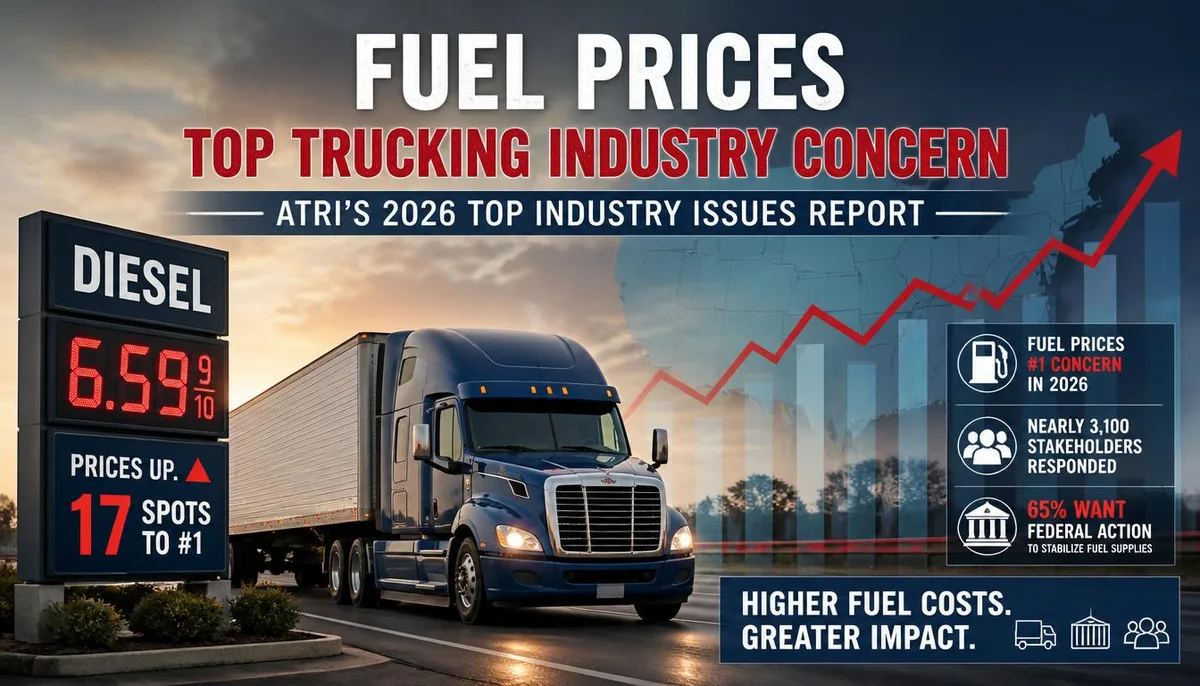

Fuel prices have become the trucking industry's biggest worry. The American Transportation Research Institute (ATRI), the industry's not-for-profit research arm, released its 22nd annual Top Industry Issues report on October 18 at the American Trucking Associations' Management Conference & Exhibition in Charlotte. Fuel prices climbed 17 spots from last year to take first place, ending a three-year run at the top for the economy.
What the survey found
Nearly 3,100 industry stakeholders took part, including motor carrier executives (about 48%), professional truck drivers (about 26%), and other groups such as suppliers, driver trainers, and law enforcement. Respondents were asked to rank the issues they see as most impactful and to choose the strategies they believe would best address them. Around 30% placed fuel prices in their top three concerns. It is only the fourth time fuel has topped the list, after 2005, 2008, and 2022, years that were all marked by sharp energy price spikes.
The timing explains the jump. Diesel has climbed above $6.50 per gallon, and inflation has reached 3.4%. For comparison, diesel averaged roughly $3.67 per gallon across 2025 and was closer to $5 by the middle of this year, so the cost of running a truck has risen sharply in a short time. Industry leaders pointed out that the spike arrived just as the freight economy was starting to show positive signs. ATRI also noted that higher fuel costs do not stay inside the trucking industry, since they are passed on to consumers through higher prices for goods and higher borrowing costs.
Different groups, different priorities
Concerns varied depending on who was asked. Motor carriers ranked lawsuit abuse reform first, followed by fuel prices and the driver shortage. Truck drivers, including owner-operators and company drivers, put fuel prices first, followed by truck parking and driver compensation. Owner-operators and independent contractors also listed broker issues among their top three. Among law enforcement respondents, the top-ranked issue was electronic logging device (ELD) fraud.
The wider top ten also includes CSA safety scoring and insurance cost and availability. Artificial intelligence in trucking and diesel emissions regulations, which both debuted on the list last year, remain in the top ten. As economic conditions showed some improvement, the economy slipped to sixth place, while workforce issues, including the driver shortage and driver retention, moved back into the top ten.
What the industry wants done
Among respondents who named fuel prices as a top concern, about 65% said the best response would be federal action to stabilize fuel supplies and limit price increases. That reflects how little control individual carriers feel they have over diesel costs when oil markets are being shaped by conflict in the Gulf and disruption to energy shipping. Carriers can adjust routes, speeds, and fuel purchasing, but they cannot change the underlying price of diesel.
Costs were already high
The fuel spike lands on an industry already under cost pressure. ATRI's separate research found that non-fuel operating costs hit a record $1.854 per mile in 2025, up 4.2% from the year before, while the average total cost of operating a truck reached a record $2.336 per mile. Fuel itself was relatively stable in 2025 at about $0.48 per mile, so the current jump is a new burden on top of existing increases in insurance, repair and maintenance, and driver pay. Early 2026 data showed insurance up 6.4%, fuel up 5.9%, driver benefits up 4.5%, and repair and maintenance up 2.4% in the first quarter compared with 2025 averages. Operating margins in the truckload and refrigerated segments have been reported at below 1%, leaving little room to absorb higher diesel prices.
Capacity is not coming back quickly
Higher costs also make it harder for new trucks to enter the market. Industry data shows that new trucking capacity is not entering the freight market, even after a full year of elevated tender rejections, meaning carriers are turning down more loads than usual. Large carriers are feeling the cost squeeze too. J.B. Hunt recently reported third-quarter revenue growth of 21% to $3.68 billion, yet said it is focused on repairing margins as costs rise. Trade press coverage this month has also described carriers navigating major fuel cost pressure heading into the holiday shipping season, though the severity varies from fleet to fleet.
Why it matters for shippers and forwarders
When carriers face rising fuel and operating costs, those costs usually show up in freight rates, fuel surcharges, and tighter capacity. For shippers and freight forwarders moving cargo by truck, this is a good reason to review fuel surcharge terms in contracts, plan peak season trucking capacity early, and consider intermodal options where they make sense. Smaller carriers and owner-operators, who feel fuel price swings most directly, may also be less able to take on loads at lower rates, which can limit options in the spot market.
Key takeaways
- Fuel prices jumped 17 spots to rank as the number one concern in ATRI's 2026 Top Industry Issues report.
- Diesel has topped $6.50 per gallon, and inflation has reached 3.4%.
- Nearly 3,100 industry stakeholders responded, and about 30% placed fuel in their top three concerns.
- Carriers rank lawsuit abuse reform first, while drivers rank fuel prices first.
- About 65% of those worried about fuel want federal action to stabilize fuel supplies.
- Record operating costs and thin margins leave little room for carriers to absorb higher diesel prices.
For freight forwarders and shippers, higher diesel costs are likely to feed through to trucking rates and surcharges heading into peak season, making early planning and clear contract terms more important than ever.


Comments
No comments yet. Be the first to share your thoughts!