What Happened on July 30?
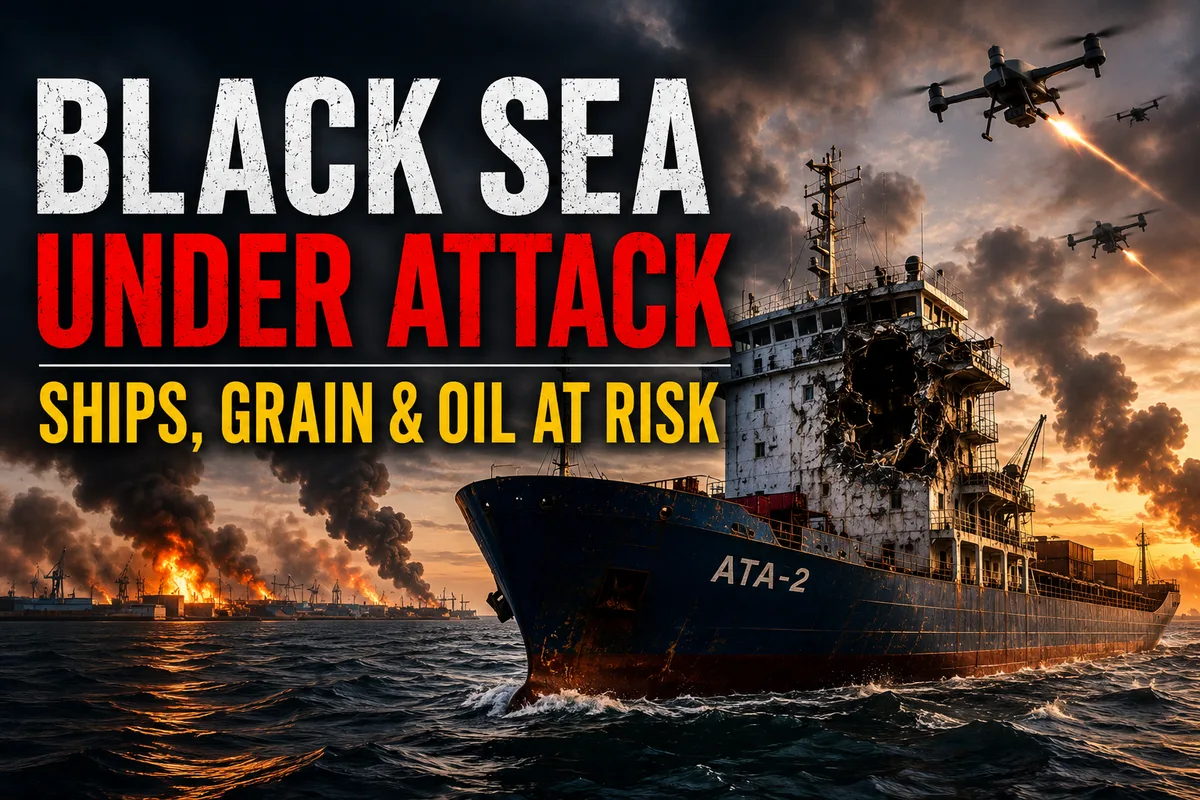
On July 30, 2026, the Turkish-owned, Panama-flagged cargo ship ATA-2 was struck by Russian drones in the Black Sea.
The 6,555 dwt ATA-2 was carrying corn after departing Chornomorsk when it was reportedly struck by three Russian drones. Video showed a large hole in the 2006-built ship's upper deck, with damage to the accommodation block and bridge.
Remarkably, all 13 crewmembers were reported safe. The Panama-flagged vessel retained limited manoeuvrability using a backup manual control system and headed towards Romania, with repairs expected in Turkey.
The ATA-2 attack was not an isolated incident. The attack was one of at least three reported against ships serving Ukrainian ports over the past 24 hours. The Black Sea is now seeing multiple ship attacks every single day.
What Is Operation MoLoChKa — And Why Did This Start?
To understand what is happening in the Black Sea right now, you need to understand what began on July 6, 2026.
Operation MoLoChKa is an ongoing Ukrainian military campaign, launched on July 6, 2026, using naval and aerial attack drones against tankers and other vessels of the Russian shadow fleet in the Sea of Azov, later extending into the Black Sea.
Ukraine's goal is to destroy Russia's ability to export oil, fuel, and cargo through the Black Sea — cutting off a critical revenue source that funds Russia's war. The campaign has been devastatingly effective. Since July 6, Ukraine's drone forces have hit 196 enemy watercraft across the Black Sea and Sea of Azov. That is nearly 200 vessels struck in just 25 days.
Russia responded by doing the same to Ukraine. In response to the disruption of its own fuel and cargo logistics, Russia escalated a persistent campaign of missile and drone strikes against Ukraine's shipping facilities in the Black Sea, targeting the ports of Odesa, Chornomorsk and Pivdennyi.
The result is a full-scale maritime war in the Black Sea — with both sides striking ships, ports, oil terminals, and grain facilities every day.
Third-Country Ships Are Being Hit Too
Here is the most alarming development for commercial shipping: it is not just Russian and Ukrainian vessels being hit. Ships from Turkey, India, Kazakhstan, Panama, and other neutral countries are also being struck.
Here is a timeline of third-country vessel incidents in July 2026 alone:
- July 19: Three Russian cruise missiles hit the Turkish-operated, Guinea-Bissau-flagged ship Golden Leo off the coast of Odesa. The vessel was carrying corn at the time of the strike. The attack killed nine crew members and a Ukrainian harbor pilot.
- July 21: The Panama-flagged vessel Lady Zehma sustained damage following a drone strike and a rocket attack while transiting the Black Sea after departing Odessa. The vessel carried 22 seafarers including nineteen Azerbaijani, one Turkish, one Ukrainian and one Egyptian nationals.
- July 30: ATA-2 — Turkish-owned, carrying corn — struck by three Russian drones. All 13 crew safe.
- July 31 (today): Two more vessels attacked — Nissos Sifnos struck near its cargo manifold while loading, and Marathi was attacked while approaching a terminal.
Ships carrying grain, corn, and oil — neutral commercial vessels simply doing business — are being hit with missiles and drones in the Black Sea right now.
Kazakhstan's Oil Exports Are Also Under Threat
One of the most serious knock-on effects of the Black Sea war is what is happening to Kazakhstan's oil exports.
Kazakhstan is a major oil producer. Most of its seaborne oil exports flow through the Caspian Pipeline Consortium (CPC) — a pipeline that ends at a marine terminal on Russia's Black Sea coast.
At least five tankers diverted or held position after attacks on the CPC terminal, underlining the speed with which attacks translate into lost export capacity. CPC carries the overwhelming majority of Kazakhstan's seaborne oil exports and has repeatedly halted operations following drone strikes.
Kazakhstan's foreign ministry condemned the attacks. But the disruption continues. Every time the CPC terminal is hit or tankers refuse to enter the area, Kazakhstan's oil export revenue falls — and global oil supply tightens further, adding pressure to already elevated energy prices.
What Has Sunk — The Golden Leo
The human and commercial cost of this Black Sea war became even more visible this week when the MV Golden Leo finally sank.
The MV Golden Leo, a coastal transport loaded with corn at the time she was hit, went down within sight of shore near the port city of Odesa. Nine crew members and a Ukrainian harbor pilot died in the strike after at least one Russian weapon struck the ship's bridge. The Golden Leo caught fire and burnt out, and had been adrift in nearly calm seas for a week before she rolled over and went down bow first.
This is not an abstract shipping disruption. Real ships are sinking. Real people are dying. And the cargo those ships were carrying — grain, corn, fuel — is not reaching its destination.
What Does This Mean for Global Food and Energy Supply?
The Black Sea is one of the world's most important routes for food exports. Ukraine and Russia together supply a huge share of global wheat, corn, and sunflower oil. When Black Sea shipping is disrupted, food prices around the world go up — particularly in the Middle East, Africa, and Asia, which depend heavily on Black Sea grain.
Ukraine's Black Sea grain exports were facing a severe crisis, with attacks on Odesa resulting in a one-third reduction in grain storage capacity, leading traders to pause shipments due to heightened security risks. Traders have reported widespread logistical problems, including difficulties with procurement, sales and cargo accumulation.
A one-third reduction in grain storage capacity at Odesa is enormous. It means Ukraine cannot accumulate cargo fast enough to load ships even when ships are willing to come. And fewer ships are willing to come — because of the attack risk.
The global market impact:
- Wheat and corn prices rising — Black Sea supply disruption pushes global grain prices higher
- Sunflower oil tightening — Ukraine is the world's largest sunflower oil exporter; disruption affects cooking oil supply globally
- Kazakhstan oil exports disrupted — CPC terminal attacks reduce global oil supply
- War-risk insurance premiums surging — every ship entering the Black Sea now pays dramatically higher insurance costs
What Should Shippers and Logistics Professionals Do?
- Avoid the Black Sea if at all possible. No commercial cargo is worth the risk of a drone or missile strike. If your supply chain involves Black Sea routing, explore alternative routes now — even if they cost more.
- Check your war-risk insurance coverage. Standard marine cargo insurance does NOT cover war risks. If your cargo moves anywhere near the Black Sea, confirm you have a separate war-risk policy in place and check the exclusion zones your insurer applies.
- Plan for grain and food commodity price increases. If your business depends on wheat, corn, or sunflower oil — or any product that uses these as inputs — build higher commodity costs into your planning for Q3 and Q4 2026.
- Monitor CPC oil terminal status. If your supply chain depends on Kazakh oil or products refined from it, track whether the CPC terminal is operational. Disruptions there flow through to fuel prices and freight costs across a wide region.
- Inform your customers. If you have cargo moving through or near the Black Sea, proactively communicate potential delays and cost increases to your customers. Early communication protects business relationships.
Key Takeaways — July 31, 2026
- Turkish cargo ship ATA-2 struck by 3 Russian drones in the Black Sea on July 30 — all 13 crew safe.
- 196 vessels hit since Ukraine launched Operation MoLoChKa on July 6, 2026.
- Both sides — Ukraine and Russia — are attacking commercial ships in the Black Sea daily.
- Third-country vessels from Turkey, Panama, India, and Azerbaijan have all been hit.
- MV Golden Leo sank this week — 10 people killed in Russian missile strike on July 19.
- Kazakhstan's CPC oil terminal repeatedly attacked — oil exports disrupted.
- Ukraine grain storage capacity at Odesa reduced by one-third — global food supply affected.
- War-risk insurance premiums surging for all Black Sea voyages.
- Avoid the Black Sea — check insurance — plan for rising grain and fuel costs.
The Black Sea has become a war zone for commercial shipping. Nearly 200 vessels have been struck in 25 days. Ships carrying corn and grain are sinking. Oil terminals are being bombed. And the ripple effects — higher food prices, disrupted energy exports, surging insurance costs — are being felt in supply chains far beyond the Black Sea region. Every logistics professional needs to understand what is happening here — because the consequences are already reaching global markets.

Comments
No comments yet. Be the first to share your thoughts!