
What Just Happened — June 10, 2026
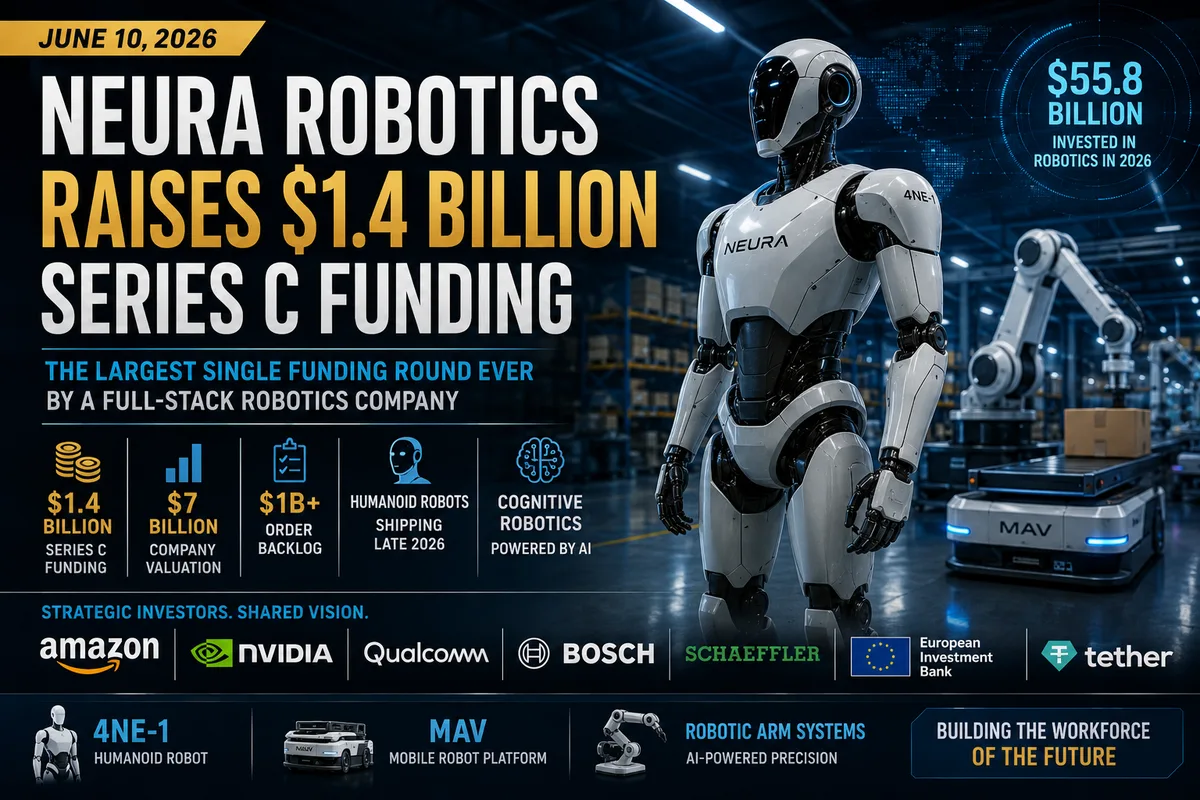
Germany-based Neura Robotics announced on June 10, 2026 that it has raised up to $1.4 billion in a Series C funding round — the largest single funding round ever raised by a full-stack robotics company anywhere in the world.
The company is now valued at $7 billion.
The investors who backed this round tell you everything about where the industry is heading:
- Amazon — the world's largest logistics and fulfillment operation, with 750,000+ robots already deployed
- NVIDIA — the world's most important AI chip company, whose processors power almost every AI system on earth
- Qualcomm — the semiconductor company pushing AI into edge devices and industrial systems
- Bosch — one of the world's largest industrial technology companies
- Schaeffler — a major German industrial components manufacturer
- European Investment Bank — the EU's official investment institution, backing this as a strategic European asset
- Tether — the stablecoin issuer, expanding into AI and robotics
When Amazon, NVIDIA, and Bosch all invest in the same robotics company at the same time — it is not speculation. It is a strategic bet by companies that understand exactly where logistics and manufacturing are heading.
Who Is Neura Robotics — And What Do They Build?
Neura Robotics was founded in 2019 in Metzingen, Germany. It describes itself as the pioneer in "cognitive robotics" — robots that do not just follow pre-programmed instructions but can actually learn, adapt, and respond to their environment using AI.
The company builds three main products:
- 4NE-1 (pronounced "for anyone") — a humanoid robot. It has two arms, two legs, stands upright, and is designed to work alongside humans in manufacturing and warehouse environments. It can handle objects, navigate complex spaces, and learn new tasks. First volume shipments are scheduled for late 2026.
- MAV — a mobile robot platform designed specifically for factory and warehouse transport. It moves goods around facilities autonomously — similar to the robots you see in Amazon fulfillment centers but significantly more advanced.
- Robotic arm systems — AI-powered arms for precision manufacturing and assembly tasks.
The company already has a backlog of orders exceeding $1 billion — meaning customers have already committed to buying its robots before they even ship in volume. That is an extraordinary level of pre-order demand.
What Are "NEURA Gyms" — And Why Are They Revolutionary?
One of the most interesting announcements alongside the funding was the planned rollout of NEURA Gyms — the world's first real-world training environments for cognitive robots and Physical AI.
Here is why this matters. AI software learns by being trained on data. Language AI like ChatGPT learned by reading billions of pages of text. Image AI learned by seeing millions of photographs. But physical robots that need to pick up objects, navigate warehouses, open doors, and handle fragile items need to learn from physical, real-world experience — not just digital simulations.
A NEURA Gym is a real-world facility where humanoid robots practice real physical tasks — picking, packing, carrying, navigating — in a controlled environment that mirrors actual warehouse and manufacturing conditions. The robots try tasks, fail, learn, and improve — continuously. The AI they develop in these gyms is then shared across all robots in the network.
Think of it like this: instead of training one robot in isolation, NEURA Gyms train thousands of robots simultaneously — and every lesson learned by one robot is shared with all the others. This is how humanoid robots will get good enough to work reliably in real warehouses, very quickly.
The Scale of the Humanoid Robot Race — $55.8 Billion Invested in 2026
Neura Robotics' $1.4 billion round is not happening in isolation. It is part of a global investment explosion in humanoid robotics that has no precedent in history.
According to Dealroom data, robotics companies have raised $55.8 billion in 2026 — setting a new annual record with months still remaining. The total is nearly double the previous record set in 2025.
Here is who the major players are in the humanoid race right now:
- Figure AI (US) — backed by Microsoft, OpenAI, NVIDIA, and Amazon. Already running humanoid robots in BMW factories.
- Physical Intelligence / PI (US) — a pure AI company teaching robots to handle physical objects using large AI models
- 1X Technologies (Norway) — building humanoid robots for security and logistics
- Agility Robotics (US) — makers of "Digit," which GXO Logistics is already piloting in live warehouse environments
- Boston Dynamics (US/Korea) — its Atlas humanoid is already performing warehouse tasks in testing
- Unitree Robotics (China) — building highly capable, low-cost humanoids with Chinese government backing
- Neura Robotics (Germany) — now Europe's most funded humanoid company, backed by Amazon and NVIDIA
The race is genuinely global — US, China, Europe, and beyond. And $55.8 billion invested in a single year tells you that the world's most sophisticated investors believe humanoid robots in warehouses and factories are not a distant future — they are an imminent commercial reality.
Why Amazon Invested — The Warehouse Connection
Amazon's participation in this round is the most significant signal for the logistics industry.
Amazon is already the world's largest deployer of warehouse robots — with over 750,000 robotic systems across its global fulfillment network. It has been using flat mobile robots (Kiva/Amazon Robotics), robotic arms for picking and packing, and AI-powered conveyor systems for years.
But all of those systems have one limitation: they can only do specific, fixed tasks in carefully controlled environments. A flat mobile robot carries shelves — it cannot climb stairs, open a box with irregular dimensions, or handle a fragile item that has fallen on its side. That is where humanoid robots change everything.
A humanoid robot that can see, reason, and use its hands to manipulate objects the way a human does — can do any task in any warehouse environment, without needing the entire facility to be redesigned around the robot's limitations. Amazon is investing in Neura because it wants that capability — and it wants it before its competitors have it.
What Does This Mean for the Logistics Industry?
For every warehouse operator, freight forwarder, and logistics company — the Neura Robotics funding round is a signal about what warehouses will look like in 3-5 years:
- Labour shortages become less critical. The global logistics industry faces severe labour shortages — particularly for repetitive warehouse tasks like picking, packing, and sorting. Humanoid robots that can perform these tasks remove the dependency on finding and retaining human workers for the most difficult-to-fill roles.
- 24/7 operations become standard. Humanoid robots do not get tired, do not need breaks, and do not call in sick. Warehouses running humanoid robots can operate continuously — dramatically increasing throughput without increasing headcount.
- Unit costs fall over time. Once the capital cost of a humanoid robot is paid off — typically within 2-4 years at current productivity levels — the ongoing cost is electricity and maintenance. That is significantly cheaper than a human worker with salary, benefits, training, and turnover costs.
- Flexibility increases. A humanoid robot retrained on new tasks via software update can switch from picking to packing to returns processing within hours. Human retraining takes weeks or months.
- The gap between large and small logistics operators will widen. Large companies like Amazon, DHL, and GXO that can afford to deploy humanoid robots at scale will gain enormous efficiency advantages over smaller operators who cannot. This is the most important competitive implication for the industry.
When Will This Actually Happen?
Here is an honest timeline based on current company announcements:
- Late 2026: Neura Robotics ships its first volume 4NE-1 humanoid robots — initial deployments in automotive and logistics facilities
- 2027: First commercial-scale humanoid robot deployments in major warehouse networks. Figure AI and Agility Robotics already have agreements with automotive manufacturers for 2027 deployment.
- 2028-2029: Humanoid robots become a standard technology option for large warehouse operators — similar to how flat mobile robots became




Comments
No comments yet. Be the first to share your thoughts!