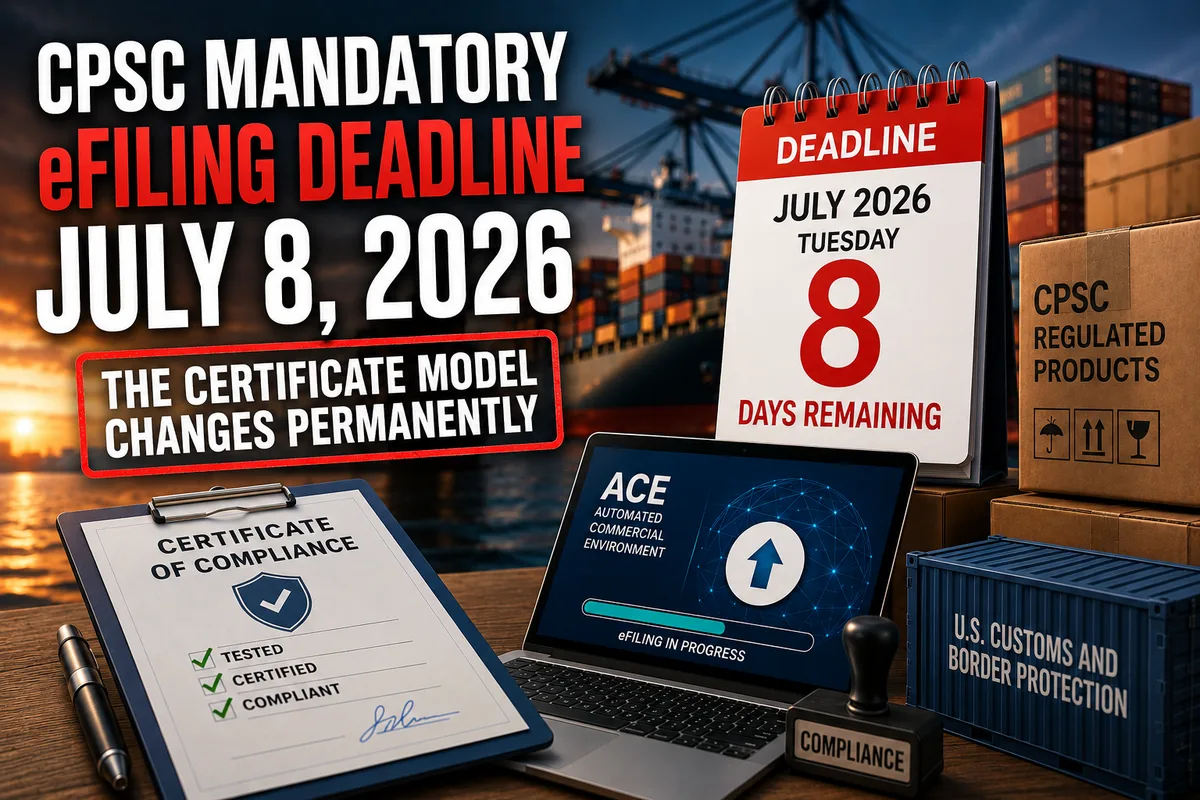
For years, US importers of regulated consumer products operated under a simple compliance model: obtain a Certificate of Compliance, keep it on file, and produce it if the Consumer Product Safety Commission asked. Starting July 8, 2026 — eight days from today — that model ends permanently.
Under a final rule approved by the CPSC in December 2024 and published in the Federal Register on January 8, 2025, importers must now electronically file their certificate data through US Customs and Border Protection's Automated Commercial Environment (ACE) at the time of entry. Not after the fact. Not on request. Upfront, with every regulated shipment, before cargo arrives at the US border.
The voluntary testing window that has been running since January 2025 closes on July 7. From July 8, it is mandatory — and non-compliance triggers automatic risk score downgrades, cargo holds, additional CPSC examinations, and potential denial of entry. For logistics operators moving regulated goods through US ports, this is not a background regulatory update. It is a hard operational deadline that changes the customs workflow for a wide range of product categories starting next week.
Who This Actually Affects
The rule covers any finished consumer product subject to CPSC mandatory safety standards, rules, or bans. The affected product list is broader than most importers realize at first glance. It includes children's products requiring a Children's Product Certificate — toys, clothing, furniture, car seats, and related items — as well as general-use products requiring a General Certificate of Conformity. Beyond those obvious categories, the list also covers mattresses and bedding, bicycles and helmets, household appliances, consumer electronics, textiles and apparel, and sporting goods.
Critically, the rule eliminates waivers that previously benefited certain importers. Even Section 321 de minimis low-value shipments, promotional samples, trial batches, and single-unit consumer goods fall under eFiling rules if the product is CPSC-regulated. There is no small-importer exemption. If you import regulated products into the United States, the rule applies to you regardless of shipment value or volume.
One important note on scope: the July 8 deadline applies to standard US port-of-entry imports. Goods entering through Foreign Trade Zones have a separate deadline of January 8, 2027 — giving FTZ operators additional runway, though CPSC and CBP have made clear this is not a route to avoid the requirement.
What Actually Changes at the Border
The operational change is significant. Under the old system, a customs broker filed an entry and the importer's certificate sat in a folder somewhere, available on request. Under the new system, certificate data must be transmitted electronically as part of the ACE entry filing — before the shipment arrives.
Importers have two ways to do this. The first is the Full PGA Message Set, where the importer provides all seven mandatory data fields to their customs broker for direct transmission: product identifier, applicable CPSC safety rules, certifying party, date and place of manufacture, most recent test date, testing laboratory name and address, and contact information for test records. This method requires no pre-registration but does require the full data set every time.
The second method is the Reference PGA Message Set, which requires pre-registration in the CPSC Product Registry. Importers load their product certificate data into the registry in advance and receive three short reference identifiers: a Certifier ID, a Product ID, and a Certificate Version ID. At the time of entry, only these three numbers need to be transmitted to the customs broker — significantly streamlining repeat shipments of the same product. CPSC and major carriers including FedEx strongly recommend this method for importers who ship regulated products regularly, but the registration process takes time. With eight days remaining, importers who haven't started that process yet should contact their broker immediately.
What Happens If You Miss It
The consequences of non-compliance are graduated but serious. From July 8 onward, missing or defective eFiling submissions trigger automatic risk score downgrades in CBP's system. Higher risk scores mean more intensive examinations, cargo holds at the port, and requests for supporting documentation — all of which add time and cost to every affected shipment.
In more serious cases, the CPSC can submit requests to CBP to initiate seizure of non-compliant products. Beyond the immediate shipment-level risk, failure to comply with CPSC certification requirements is treated as a violation of the Consumer Product Safety Act, carrying potential civil penalties, criminal penalties, asset forfeiture, and product recalls. CPSC has stated it does not intend to request outright denial of entry solely for missing eFiling data initially — but it will adjust risk scores, which means more holds, more examinations, and more friction for every regulated shipment going forward.
What Needs to Happen in the Next Eight Days
For logistics operators, freight forwarders, and importers who haven't yet aligned their workflows with this requirement, the priority list is clear:
- Confirm which products you import are CPSC-regulated. Use the CPSC's own Regulatory Robot tool at cpsc.gov to check which safety rules apply to each product by HTS tariff line. The rule covers more than 600 HTS tariff lines — if you haven't mapped your product catalog against this list, do it today.
- Contact your customs broker immediately. Your broker transmits the eFiling data to CBP on your behalf. They need your certificate data in the correct format before your next regulated shipment arrives. Do not assume your broker has already set this up — confirm it directly.
- Decide on your filing method and register if needed. If you ship the same regulated products repeatedly, registering in the CPSC Product Registry now will significantly reduce the friction of every future shipment. The registration process takes time — begin it immediately if you plan to use the Reference PGA method.
- Verify your certificates are complete and current. The eFiling system requires structured data elements — product identifier, manufacturer details, test date, test lab — that may not all be captured in existing certificates. Review your current certificates against the full data requirements before July 8.
- Build eFiling into your standard pre-shipment checklist. This is not a one-time fix. From July 8 onward, every regulated shipment needs certificate data submitted before arrival. The process needs to become part of your standard export documentation workflow with suppliers, not an afterthought on arrival.
Key Takeaways — June 30, 2026
- CPSC mandatory eFiling takes effect July 8, 2026 — eight days from today — ending the paper-based certificate model permanently for US consumer product imports.
- All importers of finished consumer products subject to CPSC safety rules are affected, regardless of shipment size or value. No small-importer exemption exists.
- Certificate data must be electronically filed through CBP's ACE system at the time of entry — not after, not on request, but upfront with every regulated shipment.
- Two filing methods exist: Full PGA Message Set (all seven data fields every time) and Reference PGA Message Set (three short IDs after pre-registering in CPSC Product Registry).
- Non-compliance from July 8 triggers automatic CBP risk score downgrades, cargo holds, additional examinations, and potential seizure — not a warning period.
- Foreign Trade Zone imports have a later deadline of January 8, 2027, but standard imports have no extension.
- Importers who have not yet coordinated with their customs broker should do so today — June 30 is the last business day before the final week before the deadline.



Comments
No comments yet. Be the first to share your thoughts!